
- 1. 1. Why PVC needs its own line
- 2. 2. Three PVC families: rigid, flexible, cellular
- 3. 3. Formulation: the six ingredients that decide performance
- 4. 4. Lead versus calcium-zinc: the regulatory shift
- 5. 5. Die and calibration — why the sleeve matters more
- 6. 6. The processing window, and what happens outside it
- 7. 7. Problems specific to PVC profiles
- 8. 8. Applications and what each one demands
- 9. 9. What to specify in an RFQ
- 10. 10. Frequently asked questions
- 11. Send the section drawing and the application
On this page
- Why PVC needs its own line
- Three PVC families: rigid, flexible, cellular
- Formulation: the six ingredients that decide performance
- Lead versus calcium-zinc: the regulatory shift
- Die and calibration — why the sleeve matters more
- The processing window, and what happens outside it
- Problems specific to PVC profiles
- Applications and what each one demands
- What to specify in an RFQ
- Frequently asked questions
1. Why PVC needs its own line
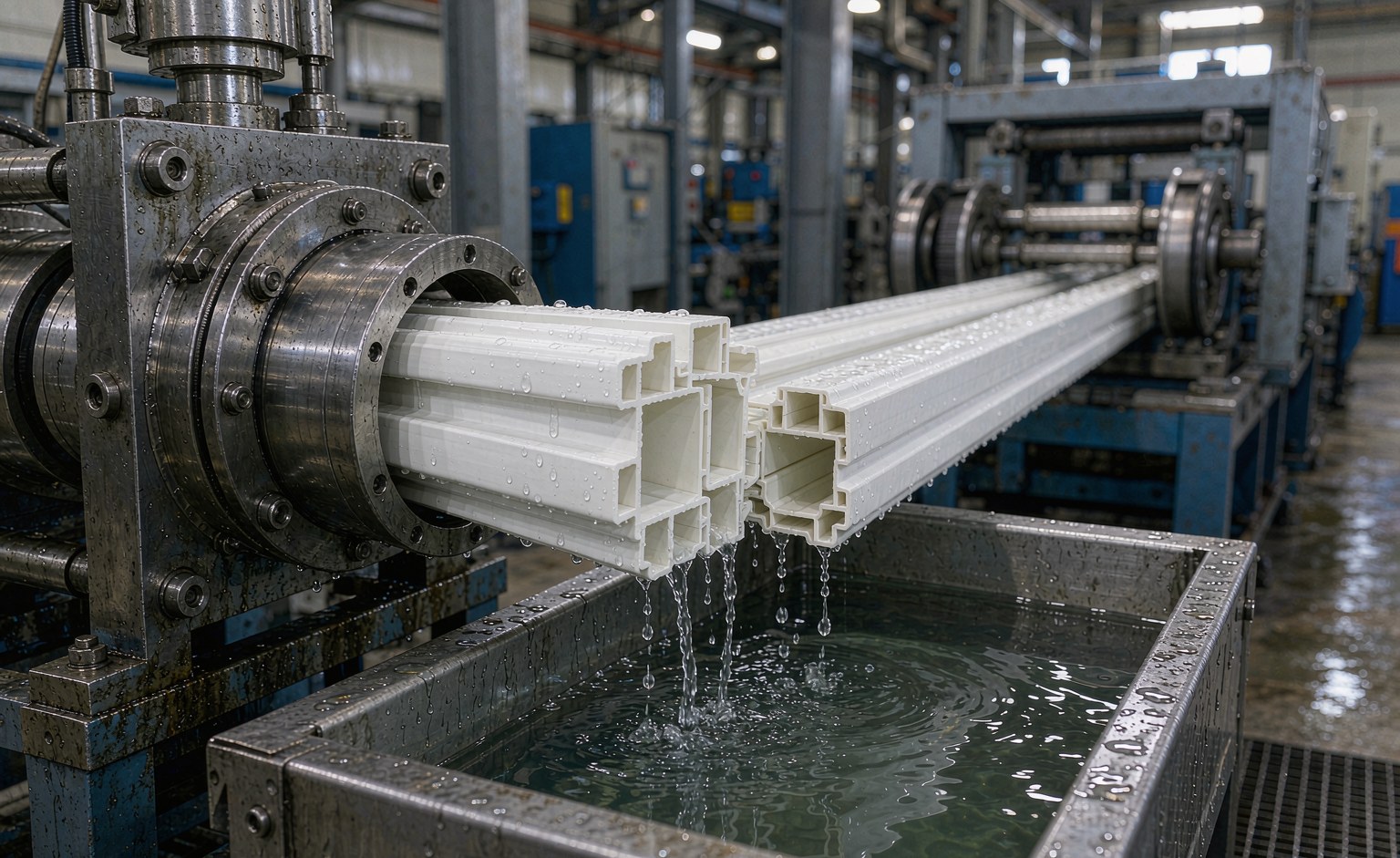
PVC is the largest volume material in profile extrusion, and it is also the least forgiving. Two properties make it a specialist material rather than just another thermoplastic.
It degrades instead of melting cleanly. Above roughly 200 °C, PVC starts eliminating hydrogen chloride. The polymer chain develops conjugated double bonds, which is why degraded PVC turns yellow, then brown, then black. The released HCl is corrosive, and once degradation starts it accelerates — the HCl catalyses further breakdown. A PVC line that stops with material in the barrel for twenty minutes can produce a barrel full of black char.
It needs a formulation, not a grade. You rarely buy "PVC" as a ready compound and run it. A PVC profile compound is resin plus stabiliser plus internal lubricant plus external lubricant plus filler plus impact modifier plus pigment, and the balance of those six decides whether the profile processes well, welds well, survives ten years of sunlight, and passes impact at −10 °C. Change one and the others usually need adjusting.
The practical consequence for buyers: a supplier who runs PVC on a general-purpose line, or who will not tell you the stabiliser system, is a risk. The equipment needs corrosion-resistant screw and barrel, the temperature control needs to be tight, and the operator needs to know what a PVC surge looks like before it becomes scrap.
2. Three PVC families: rigid, flexible, cellular
| Family | What it is | Typical hardness | Densité | Where it goes |
|---|---|---|---|---|
| uPVC (rigid) | Unplasticised PVC — no plasticiser, stabilised and lubricated | Rigide | 1.40–1.45 g/cm³ | Window and door profiles, pipe, conduit, trunking, fencing, wall panels |
| fPVC (flexible) | PVC with 20–60 phr plasticiser | 55–95 Shore A | 1.20–1.35 g/cm³ | Seals, gaskets, edge trims, hose, cable jacketing, co-extruded soft lips |
| Cellular PVC | PVC foamed during extrusion, usually with an exothermic blowing agent | Rigide | 0.45–0.75 g/cm³ | Interior and exterior trim, mouldings, decking, fascia, signage |
The distinction that matters commercially is that uPVC and fPVC are the same polymer family — which is why they co-extrude together so well, and why a rigid profile with a flexible seal is the single most common co-extruded PVC product. Cellular PVC behaves differently again: the density reduction changes the cooling behaviour, the calibration requirement and the achievable surface finish.
3. Formulation: the six ingredients that decide performance
This is the part of PVC extrusion that buyers rarely see and that explains most of the price difference between two apparently identical quotes.
| Composant | Typical loading | What it does | What happens if it is cut |
|---|---|---|---|
| PVC resin | 100 phr (reference) | K value sets molecular weight: K67 for rigid profiles, K57–60 for flexible | Lower K value processes easier but drops impact and heat resistance |
| Thermal stabiliser | 3–6 phr | Scavenges HCl and blocks the degradation chain | Yellowing, burning, corrosion, short production runs |
| Internal lubricant | 0.5–1.5 phr | Reduces melt viscosity and internal friction | High torque, overheating, poor surface |
| External lubricant | 0.3–1.2 phr | Forms a film against hot metal — stops sticking to the die | Die build-up, drag lines, rough surface |
| Filler (CaCO₃) | 5–15 phr | Cost reduction, stiffness, thermal stability | Too much drops impact strength and gloss; too little raises cost |
| Impact modifier | 5–8 phr | CPE or acrylic (AIM) rubber phase absorbs impact energy | Brittle profiles that shatter in cold weather |
| TiO₂ | 4–6 phr | UV screening, whiteness, opacity | Yellowing and chalking within two or three summers outdoors |
Loadings are indicative for a white uPVC window profile. phr = parts per hundred resin. A compound for an indoor conduit is formulated very differently from one for an exterior window profile, which is why the two are not interchangeable.
The component buyers most often get wrong is the impact modifier. A profile without adequate CPE or acrylic modifier looks fine on the line and passes a dimensional inspection. It fails when a window frame is struck at −5 °C, or when a delivery driver drops a bundle. If the part will be installed and handled outdoors in winter, the impact requirement has to be specified and tested, not assumed.
4. Lead versus calcium-zinc: the regulatory shift
The stabiliser system is the single biggest formulation decision, and it is now a compliance question rather than a technical one.
- Lead-based stabilisers — tribasic lead sulphate, lead stearate. Historically the workhorse for rigid PVC: cheap, extremely effective, forgiving of process variation. Being phased out across Europe and increasingly restricted elsewhere because of lead toxicity. In the EU, the PVC industry committed to phasing out lead stabilisers, and most European window profiles are now calcium-zinc.
- Calcium-zinc (Ca/Zn) — the lead-free alternative for most profiles. Food-contact capable, increasingly the default for window profiles, trim and any product sold into Europe. The trade-off is a narrower processing window: Ca/Zn stabilisers are less forgiving of overheating and of long residence times, so the line has to be controlled more tightly.
- Organotin — mainly for pipe and fittings where clarity and potable-water compliance matter. Effective, but restricted in some applications and under pressure in others.
If the product is exported to Europe, or touches drinking water or food, confirm the stabiliser system before the die is cut. Changing from lead to Ca/Zn is not a drop-in substitution: the lubricant package usually needs rebalancing, and the process window shifts.
5. Die and calibration — why the sleeve matters more

In PVC profile extrusion the die produces a shape that is deliberately not the final shape. The extrudate leaves the die oversized and slightly distorted, then enters a vacuum calibration sleeve where it is drawn down to final size while water cools it. Two things follow from this:
- The sleeve sets the dimension. Die wear changes the wall thickness slightly, but the calibration sleeve sets the outside profile. This is why a worn sleeve causes out-of-tolerance parts even when the die is fine, and why sleeve replacement is a routine maintenance item on high-volume PVC lines.
- The drawdown is part of the design. The die is cut larger than the finished section by a drawdown allowance — typically 8 to 20 % depending on the section — and the allowance has to be right for the compound. Change the formulation and the drawdown changes.
PVC dies also need chrome plating or hardened steel in the land area, because HCl attack and the abrasive filler both wear the flow surfaces. A die that is fine for PP will corrode on PVC.
For hollow multi-chamber profiles — window frames being the obvious case — the calibration has an extra job: it must hold the internal chambers open while the outer wall is being sized. That requires internal air pressure balanced against the vacuum, and it is the part of the tool that most often needs rework on a new profile.
6. The processing window, and what happens outside it
A typical rigid PVC profile runs with a melt temperature around 175 to 195 °C, with the die head slightly hotter than the barrel. That is a narrow band. Below it the compound does not fuse properly and the profile has poor weld strength and a dull surface. Above it, degradation begins.
The signs, in order of appearance:
- Dull or slightly yellow surface — the first sign of thermal stress. Easy to miss under factory lighting.
- Yellow-brown streaks, usually along a flow line or at a die land where material is hanging.
- HCl smell — sharp and unmistakable. By the time you can smell it, degradation is established.
- Black specks and char — advanced. The barrel needs cleaning, and the compound may need reformulating.
Never leave a PVC line stopped with material hot in the barrel. A short stop is fine if the barrel is kept at temperature and the screw is left forward; a long stop requires purging. This one discipline prevents most of the black-speck scrap in a PVC plant.
Residence time matters as much as temperature. A small profile running in a large barrel means the compound sits hot for longer, and the same temperature that is safe at a high output will degrade the material at a low one. This is why a supplier will sometimes decline to run a very small section on a large line.
7. Problems specific to PVC profiles
General extrusion defects are covered in our separate troubleshooting guide. These are the ones that are particular to PVC, or that behave differently in PVC.
Die build-up (plate-out)
A white or yellowish deposit accumulating on the die lip and in the calibration sleeve, which then produces drag lines and rough surface. It comes from additives migrating to the surface — usually an imbalance between internal and external lubricants, or too much filler. The fix is a formulation adjustment, not more cleaning. Cleaning alone means the problem returns in a few hours.
Poor welded-corner strength
Window profiles are welded at the corners, and the weld strength depends on how well the compound fused during extrusion. Under-fused PVC — from a melt temperature that is too low or too much external lubricant — looks acceptable but welds badly. This is why window profile specifications include a weld strength test, and why it is tested on the finished welded frame rather than on the profile.
Cold-weather impact failure
A profile that survives a hammer test in summer can shatter at 0 °C. PVC's brittle-to-ductile transition sits close to normal outdoor winter temperatures, and the impact modifier is what moves it. Specify the impact test temperature, not just the impact value.
Colour shift and chalking outdoors
White PVC exposed to UV without adequate TiO₂ and a suitable stabiliser will yellow, then chalk. The chalking is surface degradation of the polymer, and it is not reversible by cleaning. For any exterior application, the TiO₂ loading and the stabiliser system have to be specified for the exposure, not inherited from an indoor compound.
Plasticiser migration in flexible PVC
Flexible PVC loses plasticiser over time, especially at elevated temperature or in contact with other plastics, and the part hardens and shrinks. In a co-extruded seal this shows up as a lip that becomes stiff and starts to pull away. If the soft component has a long service life at temperature, specify a polymeric plasticiser rather than a monomeric one.
Vacuum marks and sink in the calibration zone
Dark or dull patches where the profile was pulled against the sleeve too hard, or where the wall was too hot to resist the vacuum. Usually a cooling or vacuum-setting problem rather than a material one — but a wall that is too thin for the section will do it regardless of settings.
8. Applications and what each one demands
| Application | Material family | The requirement that drives the spec |
|---|---|---|
| Window and door profiles | uPVC, white or laminated | Weld strength, cold impact, UV stability over 10+ years, dimensional stability of the chamber geometry |
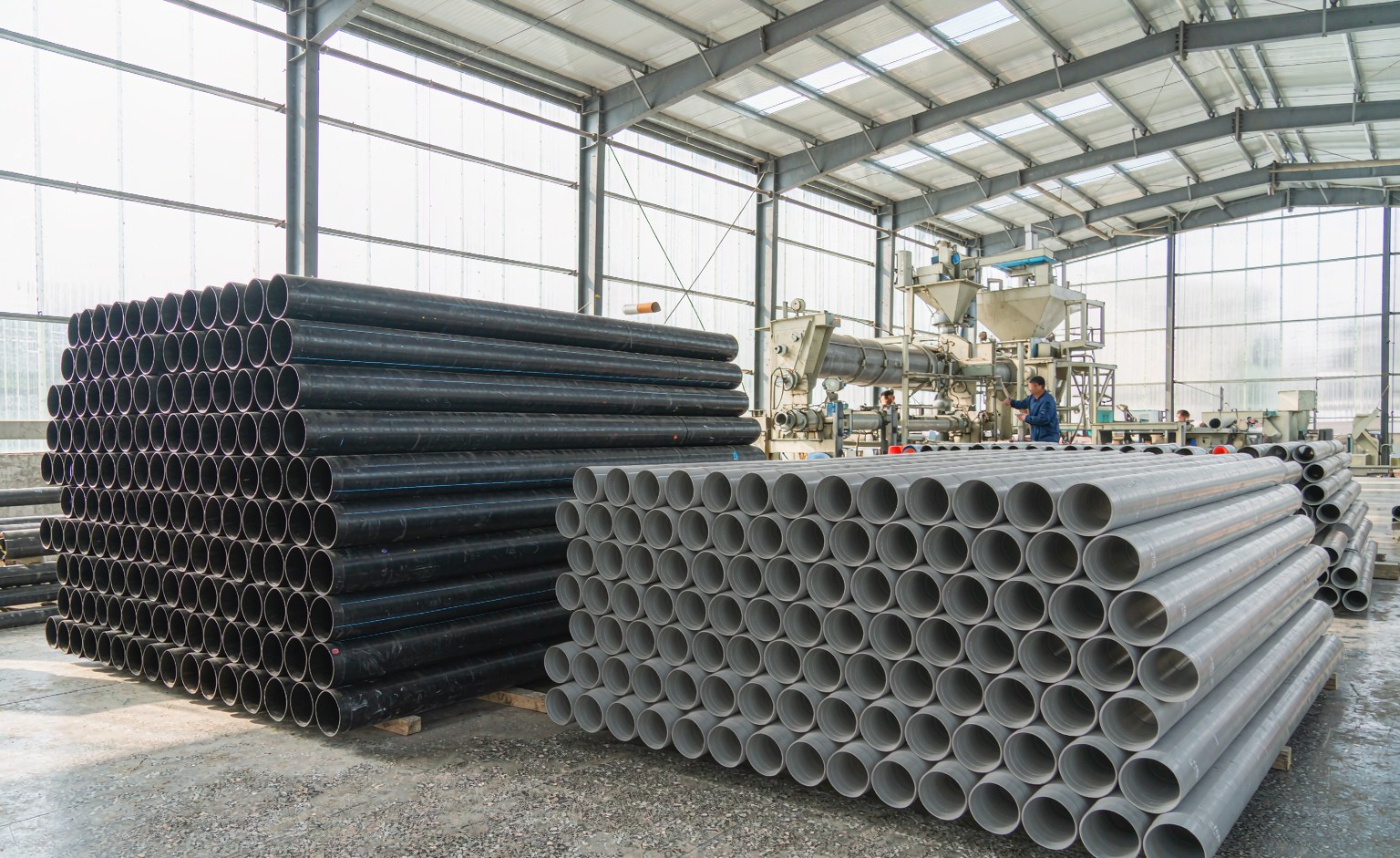
| Pipe and conduit | uPVC | Pressure rating or impact rating, potable-water compliance, wall thickness tolerance |
| Cable trunking and ducting | uPVC, often with a flexible lid | Flame resistance, impact, clean surface for labelling |
| Seals and gaskets | fPVC, often co-extruded | Shore hardness, compression set, plasticiser retention |
| Trim, mouldings, fascia | Cellular PVC | Density, screw retention, paintability, dimensional stability |
| Fencing and decking | uPVC or cellular | Impact at low temperature, UV, creep under load |
| Wall and ceiling panels | uPVC, thin wall | Flatness, gloss consistency, flame rating |
9. What to specify in an RFQ
- Cross-section drawing with wall thickness and all functional dimensions.
- Family and formulation intent — uPVC, fPVC or cellular; and whether the stabiliser must be lead-free.
- Colour to a reference — RAL, a physical sample, or a measured value. "White" is not a specification.
- Service environment — indoor or outdoor, temperature range, UV exposure, contact with chemicals or drinking water.
- Tests the part must pass — impact at a stated temperature, weld strength, Vicat softening, flame rating.
- Length, packing and handling — straight lengths or coils, maximum bundle size, whether the profile can be nested.
- Annual volume in metres, so tooling amortisation and line speed can be quoted realistically.
10. Frequently asked questions
What is the difference between PVC and uPVC?
uPVC is unplasticised PVC — rigid PVC with no plasticiser added. "PVC" on its own usually means the flexible grade in consumer contexts, and the rigid grade in construction contexts. When specifying, say "rigid PVC (uPVC)" or "flexible PVC" and give a hardness or a K value, rather than relying on the abbreviation.
Can PVC profiles be welded?
Yes, and for window profiles welding is the standard assembly method. The profile is cut at 45°, heated by a welding plate and pressed together. Weld strength depends on how well the compound fused during extrusion, which is why under-fused profiles fail at the corner rather than in the span.
Is lead-free PVC available for profiles?
Yes — calcium-zinc stabilised compounds are standard for window profiles sold into Europe and are widely available elsewhere. The processing window is narrower than lead, so the compound and the line settings have to be developed together rather than substituted.
What temperature does PVC profile extrusion run at?
Rigid PVC typically runs with a melt temperature of 175–195 °C, with the die head a few degrees hotter than the barrel. Above roughly 200 °C degradation begins and hydrogen chloride is released. The exact window depends on the compound and the section.
Can recycled PVC be used in a profile?
Yes, with limits. Post-industrial PVC regrind is routinely used in the core of a co-extruded profile or in non-visible applications. Post-consumer PVC is harder because of contamination and inconsistent stabiliser systems. For a visible, load-bearing or UV-exposed part, specify virgin compound for the outer layer at minimum.
Why do white PVC profiles turn yellow?
UV-driven degradation of the polymer, usually because the TiO₂ loading or the stabiliser system is inadequate for the exposure. Early yellowing can also come from thermal stress during extrusion rather than from service. Distinguishing the two matters: process-induced yellowing is uniform and appears immediately, UV yellowing develops over months and is usually worse on the sun-facing side.
Send the section drawing and the application
We will confirm the PVC family, the stabiliser system, the wall thickness that the section can actually hold, and a price per metre — plus the tests we recommend before the first production run, so a cold-weather impact failure does not surface after installation.




 FR
 EN
 ES
 DE
 PT
 AR
 RU
 JA
 KO
 IT
 NL
 TR
 PL
 ID
