
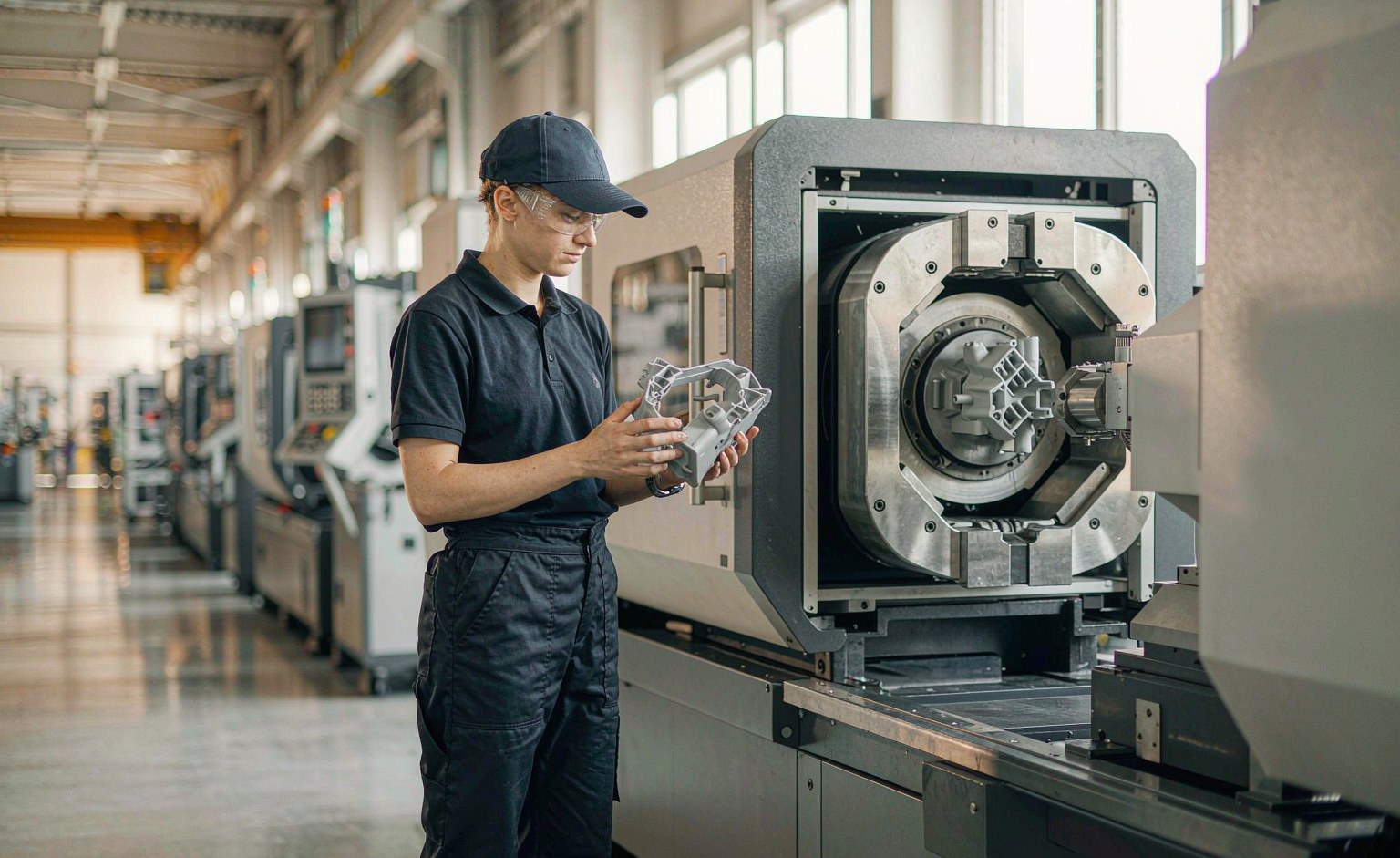
What opening stroke has to cover
Opening stroke is the distance the moving platen travels from closed to fully open. It sounds like a property of the mold, but it is really a property of everything that has to happen in the gap once the mold is open.
The part has to clear the core. The ejector system has to reach the end of its stroke. The finished part has to fall, or be gripped, without touching either half. And on an automated cell the robot arm needs room to reach in, close on the part and withdraw.
Each of those is a separate distance, and the stroke has to be at least their sum. When a molder says a tool is tight on a machine, this is almost always the number they mean.
It is also the specification most often left to the toolmaker to guess, which is why it is worth calculating on paper before the steel is cut.
The four numbers that add up
Start with part depth measured in the direction of opening. A 200 millimetre deep box needs at least 200 millimetres just to be free of the cavity.
Add the ejector stroke. For a deep part the ejector plate travels most of the core height, so 90 millimetres on the same box is typical, and it stacks on top of the part depth because the part is pushed out after the mold has already opened.
Add drop clearance, the gap that lets the part fall cleanly instead of being dragged back in as the mold closes. Sixty millimetres is a reasonable minimum on a large part.
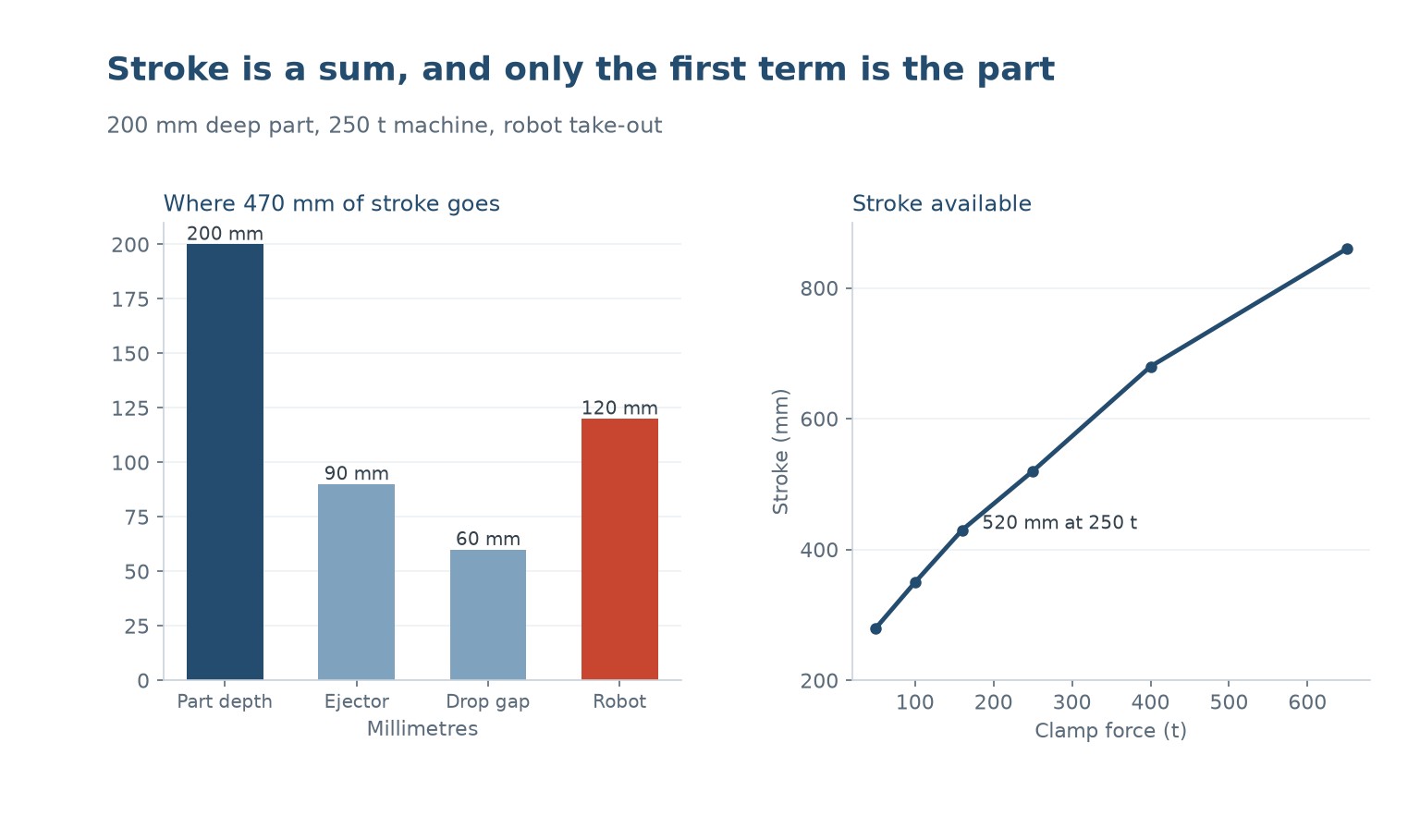
Then add the robot. A gripper that has to close on the part needs roughly the part depth plus its own body again, which is where the last 120 millimetres of the example goes. The chart on the left shows the four components adding up to 470 millimetres.
Stroke is a machine limit
The machine, not the mold, sets the ceiling. Stroke grows with clamp force, but not linearly, and the small machines fall short surprisingly quickly: a 100 tonne press may offer 350 millimetres while a 250 tonne offers 520.
The right hand panel plots typical maximum stroke against clamp force. If your calculation lands at 470 millimetres, a 160 tonne machine cannot do it even if the tonnage is adequate for the projected area.
That mismatch is common on thin, wide parts: the projected area needs a big platen but the part is shallow, so the molder picks tonnage and never checks stroke. The tool arrives, the mold opens, and the robot cannot get in.
The reverse also happens. A deep, narrow part needs little tonnage but a long stroke, and gets quoted on a machine that is too small in every dimension except force.
Daylight and tie-bar distance
Stroke is only half of access. Daylight is the maximum clear distance between the platens, which equals the mold height plus the stroke. A mold that is thick eats the daylight before the stroke even starts.
Tie-bar distance is the other constraint. A mold wider than the tie bars cannot go in at all, no matter how much stroke the machine has, and this is a hard stop rather than a performance penalty.
Platen size matters too, because a mold that overhangs the platen concentrates force at the edges and bends the platens. The rule of thumb is to keep the mold within about two thirds of the platen width.
So the machine check is four numbers, not one: clamp force, stroke, daylight and tie-bar distance. Any one of them failing rejects the machine.
| Composant | Typical value | Set by |
|---|---|---|
| Part depth | 200 mm | Part design |
| Ejector stroke | 90 mm | Core height |
| Part drop clearance | 60 mm | Automatisation |
| Robot gripper entry | 120 mm | Cell layout |
| Required stroke | 470 mm | Sum of the above |
Table 1 — Stroke budget for a 200 mm deep part.
When the stroke is too short
The first symptom is a part that stays on the core. The ejector pushes, the part lifts, and then it drops back before the mold closes because there was never enough gap for it to fall away. Operators call it sticking and it is really a stroke problem.
The second is a robot that faults on every cycle. The gripper enters, cannot reach the part, and the cell stops. The molder blames the robot program when the gap is simply too small.
The third is slower running. A manual take-out needs the operator to reach into a short gap, which is both slower and less safe, and cycle time climbs by several seconds every shot.
The fourth is damage. A part that is dragged out of a tight gap scuffs on the cavity edge, and a robot that grazes the mold marks the steel on the parting line.
| Symptom | What it looks like | Real cause |
|---|---|---|
| Parts sticking | Part lifts then falls back | No drop clearance |
| Robot faults every cycle | Gripper cannot reach | No gripper clearance |
| Slow cycle | Manual reach into a short gap | Stroke too small |
| Scuffed or marked parts | Drag marks on the side | Part rubs the cavity |
Table 2 — Symptoms of an inadequate opening stroke.
Checking it before the tool is cut
Do the sum at quotation, not at tryout. Take part depth, add the ejector stroke from the core design, add drop clearance, then add whatever the automation needs. Compare with the stroke of every candidate machine.
If the sum fails, there are cheap fixes. A shorter core or a part that ejects from the cavity rather than the core removes the ejector stack from the total. A robot that grips from above instead of from the side needs less entry depth.
A more expensive fix is a longer machine, which also changes the platen and the utility connections. That is why the calculation belongs in the quote, where it costs nothing, rather than in the schedule after the tool is hardened.
And write the required stroke on the mold drawing. It is a specification the toolmaker can design to, and the molder can check, which turns a commissioning surprise into a line on a drawing.
What is mold opening stroke?
The distance the moving platen travels from closed to fully open. It has to cover part depth, ejector stroke, part drop clearance and robot access.
How do I calculate the stroke a mold needs?
Add part depth, ejector stroke, drop clearance and gripper entry. For a 200 mm deep part with a robot that comes to about 470 mm.
Does clamp force determine opening stroke?
No. Stroke grows with machine size but not with tonnage directly, so a machine with enough force can still be too short. Check stroke separately.
What is the difference between stroke and daylight?
Stroke is the travel; daylight is mold height plus stroke, the maximum clear gap. A thick mold uses daylight before the stroke begins.
Why do my parts stick in the mold?
Often there is not enough drop clearance, so the part lifts on ejection and falls back before the mold closes. That is a stroke problem, not an ejection problem.
Can a robot work with a short opening stroke?
Only if it can enter from the side or grip with a slim end effector. Otherwise the stroke must include the gripper's entry depth, usually the part depth again.
Tool tight on the machine?
Send the part drawing and the press you plan to run it on. We will check stroke, daylight and tie-bar clearance before the tool is cut.





 FR
 EN
 ES
 DE
 PT
 AR
 RU
 JA
 KO
 IT
 NL
 TR
 PL
 ID
