The problem
Symptom. An ESD tray that read 2 x 10^7 ohm/sq at first article now measures 3 x 10^11 ohm/sq after 12 weeks, so a whole batch sits outside the dissipative band and no longer protects the boards.
What it costs. Out-of-band trays either let static through or conduct too fast, so electronics are at risk, the lot is rejected at goods-in and the buyer and moulder argue over whether the additive or the test humidity is to blame.
This guide separates migratory additives from permanent compounds, sets the surface-resistance band and 23 C / 50 % RH conditioning, and defines a lot acceptance test.
- 1. What an out-of-band ESD tray looks like
- 2. Separate a migratory additive from a test error
- 3. Resistance and conditioning for the drawing
- 4. Additive, coating and humidity that set resistance
- 5. Define a lot acceptance test for surface resistance
- 6. Recovery actions ranked by requalification cost
What an out-of-band ESD tray looks like
A dissipative tray should sit between 10^6 and 10^9 ohm/sq. A migratory antistat at 2 % loading reads 2 x 10^7 ohm/sq at 23 C / 50 % RH, yet climbs past 3 x 10^11 ohm/sq after 12 weeks in dry stores.
| Observed result | Most likely cause | First check on the order |
|---|---|---|
| Resistance rose to 3 x 10^11 ohm/sq | Migratory antistat dried out | Re-condition 48 h at 23 C / 50 % RH |
| Reading falls after humid conditioning | Humidity-dependent additive | Measure at 100 V per ANSI/ESD S11.11 |
| Tray passes once, fails after a wash | Topical coating wiped off | Repeat the reading after the defined wash |
| Only one corner reads high | Poor additive dispersion | Log resistance by point and by tray |
Table 1 - Reading an ESD tray dispute before rejecting the lot
Need a fixed price for this moulded part?
Send the 2D drawing, resin grade and annual volume. Our engineers return a DFM review, a material recommendation and a written quotation you can compare line by line.
Separate a migratory additive from a test error
Condition 5 trays for 48 h at 23 C / 50 % RH and measure with a concentric ring probe at 100 V. A reading that falls back to 10^7 ohm/sq after humid conditioning is a humidity-dependent additive, not a bad batch.
A five-step diagnostic sequence
- Pull the drawing and the goods-in readings.
Compare the 2 x 10^7 ohm/sq first article with the 3 x 10^11 ohm/sq reading after 12 weeks. - Condition 5 trays for 48 h at 23 C / 50 % RH.
Measure at 100 V with a concentric ring probe to ANSI/ESD S11.11. - Check whether the additive is migratory or permanent.
A 2 % migratory additive dries out; a 15 % carbon-filled PP holds near 3 x 10^6 ohm/sq. - Repeat the reading after the defined wash.
A 0.5 um topical coating that passes once but fails after a wash is not durable. - Re-mould and re-qualify if it stays out of band.
A tray still at 3 x 10^11 ohm/sq needs the permanent compound, not more conditioning.
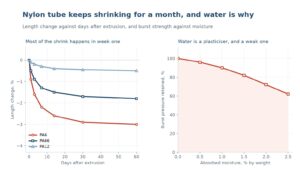
The chart below is a typical result from that measurement step. Use it to separate a design limit from a setting that can still be recovered.

Resistance and conditioning for the drawing
Put the band on the drawing: 10^6 to 10^9 ohm/sq to ANSI/ESD S11.11 at 100 V, measured after 48 h at 23 C / 50 % RH, with 5 trays per lot and a named permanent antistat compound.
| Parameter | Typical target | What goes wrong outside it |
|---|---|---|
| Surface resistance, ANSI/ESD S11.11 | 10^6 to 10^9 ohm/sq at 100 V | Above 10^11 the tray is insulative |
| Conditioning before measurement | 48 h at 23 C / 50 % RH | Dry trays read four decades higher |
| Antistat type | Permanent compound or 15 % carbon-filled PP | A 0.5 um coating wipes off in service |
| Lot sampling | 5 trays per lot, repeat after wash | A single pass hides a topical coating |
Table 2 - Surface-resistance parameters for the part drawing
Additive, coating and humidity that set resistance
A 0.5 um topical coating wipes off and a 2 % migratory additive needs humidity, rising more than four decades at 12 % RH. A 15 % carbon-filled PP holds near 3 x 10^6 ohm/sq across that range.
| Decision | Effect on resistance | Trade-off |
|---|---|---|
| Switch to 15 % carbon-filled PP | Holds about 3 x 10^6 ohm/sq | Higher resin cost, black colour only |
| Use a permanent antistat compound | Stable across 12 to 50 % RH | Requalify the material and colour |
| Keep the 2 % migratory additive | Cheap at 23 C / 50 % RH | Drifts over four decades in dry stores |
| Re-test only after conditioning | Clears a falsely rejected lot | Does not fix a dried-out additive |
Table 3 - Decisions ranked by requalification cost
Define a lot acceptance test for surface resistance
Agree lot acceptance before first article: 10^6 to 10^9 ohm/sq on 5 trays per lot, 48 h at 23 C / 50 % RH, a 100 V probe, and a repeat reading after the defined wash so a coating cannot pass once.
Not sure whether the fault is in the tool or the process?
Send us the drawing, the process window and a few sample parts. We will tell you which change fixes the fault before you commit to a tool modification.
What to send us
- Part drawing with the affected dimension
- Current process settings
- Sample parts from a good and a bad batch
- Annual volume
Recovery actions ranked by requalification cost
For an out-of-band lot, re-condition at 23 C / 50 % RH and re-measure. A tray that recovers to 10^7 ohm/sq is humidity-dependent; if it stays at 3 x 10^11, re-mould with the permanent compound and re-qualify.
Before you release this injection moulding job
- A surface-resistance band of 10^6 to 10^9 ohm/sq at 100 V is stated on the drawing
- Conditioning of 48 h at 23 C / 50 % RH is written into the test method
- The antistat type is named as a permanent compound or 15 % carbon-filled PP, not a topical coating
- A lot test of 5 trays per lot with a repeat reading after the defined wash is agreed
- First-article approval records resistance by tray and by point to ANSI/ESD S11.11
Attach this list to the RFQ. Most moulding faults are decided at the drawing stage.
Why did resistance rise after 12 weeks?
A 2 % migratory antistat needs moisture. In dry stores it climbed from 2 x 10^7 to 3 x 10^11 ohm/sq, over four decades, leaving the dissipative band.
Is the tray or the test to blame?
Condition 5 trays for 48 h at 23 C / 50 % RH and measure at 100 V. A reading that falls back to 10^7 ohm/sq was a dry tray, not a bad compound.
What band should we specify?
10^6 to 10^9 ohm/sq to ANSI/ESD S11.11 at 100 V, measured after 48 h at 23 C / 50 % RH, with 5 trays per lot.
Additive or coating?
A permanent antistat or 15 % carbon-filled PP holds near 3 x 10^6 ohm/sq across 12 to 50 % RH. A 0.5 um topical coating wipes off and fails after a wash.
Can we just re-condition an out-of-band lot?
Re-conditioning clears a falsely rejected lot, but a dried-out migratory additive drifts again. For a stable tray, specify the permanent compound.
Who owns a rejected ESD lot?
Put it in the order. Name the band, the 48 h at 23 C / 50 % RH conditioning, the 100 V test and the 5-tray lot sample so a reading is judged by one method.
Get a mouldable part and a fixed quotation
Send us the part file and the failure history. Our engineers will return a DFM review, a material recommendation and a fixed quotation with a defined first-article acceptance test.
To get an accurate quote, send:
- 3D file or 2D part drawing
- Resin grade and any regrind limit
- Annual volume and target unit price
- The failed sample or defect photos
Request a DFM review and quote
Why buyers work with Uplastech
ISO 9001, ISO 14001 and ISO 45001 certified. Founded in 2016, with injection moulding lines in Shanghai and an extrusion plant in Jiangsu. Moulding machines from 90T to 1100T and a maximum shot weight of 5100 g. Samples and a written quotation are available on request.



 EN
 ES
 FR
 DE
 PT
 AR
 RU
 JA
 KO
 IT
 NL
 TR
 PL
 ID