

A seal is a spring, not a plug
An O-ring does not seal by blocking a gap. It seals by being squeezed, and by pushing back against the surfaces that squeezed it. The force it pushes back with is what holds the two faces apart just enough to keep the gap closed, and it is that force, not the rubber itself, that keeps the fluid out.
That reframing matters because it tells you what to measure. A seal fails when the force it pushes back with falls below what the pressure is trying to open. The rubber can be perfectly intact and still fail, because it has taken a set and no longer pushes back.
Silicone is unusually good at staying elastic over a wide temperature range and unusually poor at holding force at high temperature for long periods. That combination makes the squeeze decision more important on silicone than on nitrile, because the material has less reserve.
Squeeze: the number that decides both
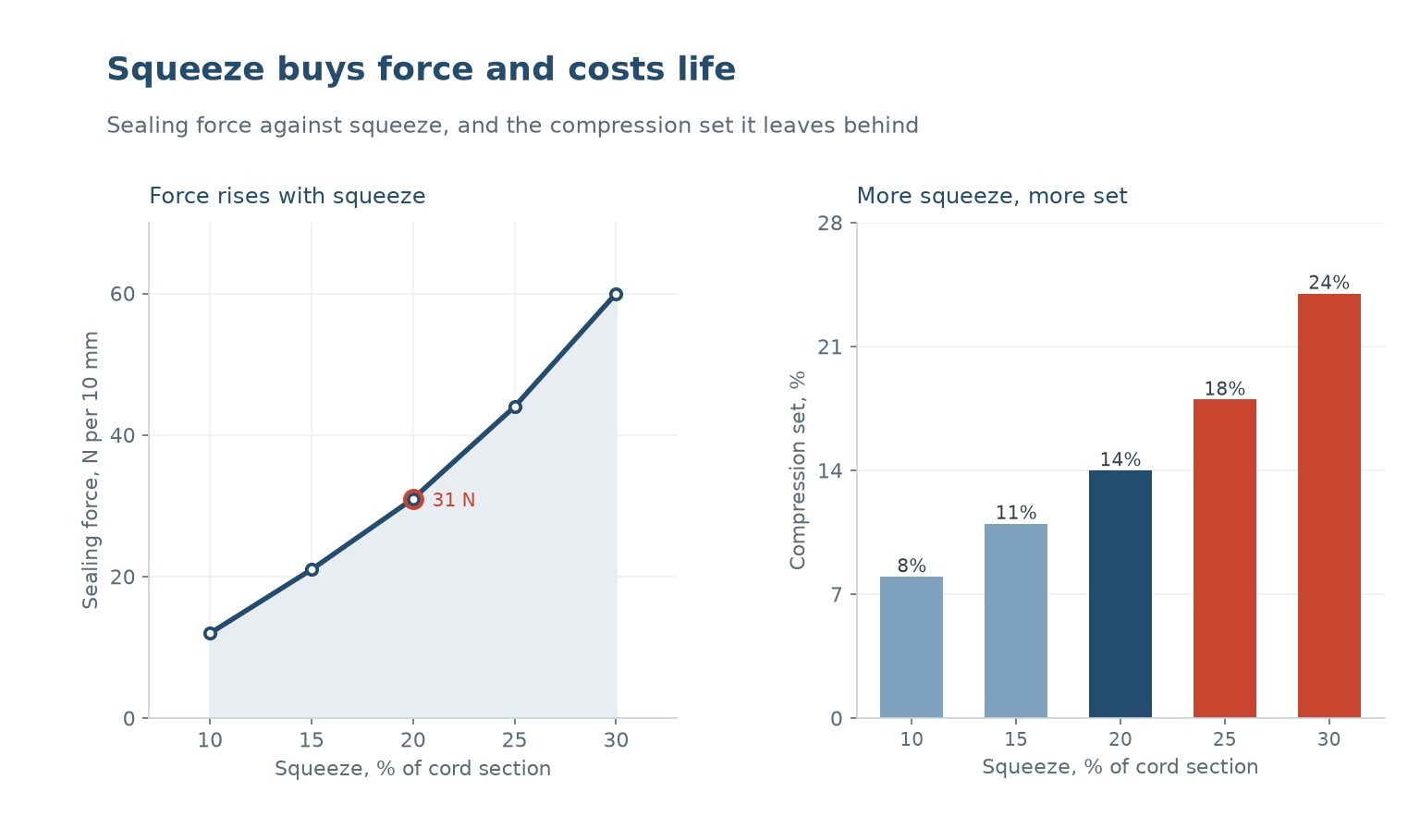
Sealing force against squeeze: 12 N per 10 mm of circumference at 10 percent, 21 at 15, 31 at 20, 44 at 25 and 60 at 30. The curve is not linear because the contact width grows with squeeze as well as the stress, so force rises faster than squeeze does.
Compression set over the same range: 8 percent at 10, 11 at 15, 14 at 20, 18 at 25 and 24 at 30. Set is the permanent deformation left after the load is removed, and it rises with squeeze because a more highly strained rubber relaxes more.
So squeeze is the only design variable that buys force and costs life in the same movement. Twenty percent is the usual compromise, and it is a compromise rather than an optimum: it gives about 31 N per 10 mm, which is enough for most static seals, at a set that leaves useful force after a thousand cycles.
Groove fill: the limit that catches people
Squeeze is only meaningful if there is somewhere for the displaced rubber to go. A groove has a cross-sectional area, the O-ring has a cross-sectional area, and the ratio is the fill. Above about 85 percent fill there is no room left, and the O-ring stops behaving like a spring and starts behaving like a hydraulic fluid.
The failure mode is spectacular. A groove that is over-filled with a low-hardness ring will not seat, the flange will not close to metal-to-metal, and the joint will leak at a torque that should have been plenty. The natural response is to tighten further, which extrudes the ring into the gap and produces a failure that looks like a material problem.
The fill limit also sets the tolerance on the groove depth. A groove machined 0.1 mm shallow on a 3 mm cord moves the fill by several percent, which is enough to take a comfortable design over the limit. That is why groove depth is a tighter tolerance than groove width on most drawings, even though it is the width that people dimension first.
Compression set is the clock
Compression set is measured by compressing a sample by a fixed percentage, holding it at temperature for a fixed time, releasing it and measuring how much it failed to recover. The number is a percentage of the original deflection, so 14 percent set means the ring came back to 86 percent of its original section.
For silicone the test conditions matter enormously. A ring that shows 12 percent set at 22 hours and 175 C can show 30 percent at 70 hours and 200 C. Quoting a set figure without the conditions is quoting nothing, and it is the most common gap in a silicone O-ring data sheet.
The practical consequence is that a silicone O-ring in a hot application should be sized for the set it will have at the end of life, not at the start. If the design needs 15 N to seal and the ring starts at 31 N with 14 percent set, there is room. If the application will take it to 30 percent set, the same ring ends near 22 N, and the margin is much thinner than the drawing suggested.
| Squeeze | Sealing force | Compression set | Where it is used |
|---|---|---|---|
| 10 percent | 12 N per 10 mm | 8 percent | Low pressure, easy assembly, vacuum |
| 15 percent | 21 N per 10 mm | 11 percent | Static seals, low temperature |
| 20 percent | 31 N per 10 mm | 14 percent | The general static seal compromise |
| 25 percent | 44 N per 10 mm | 18 percent | High pressure, or a worn groove |
| 30 percent | 60 N per 10 mm | 24 percent | Only where force matters more than life |
Table 1 — Squeeze against force and set, and where each level is appropriate
Why silicone fails at temperature
Silicone's useful property is a wide service range, typically minus 60 to 200 C. Its weakness is that above about 150 C it continues to crosslink slowly in service, and the crosslinking makes it harder and less resilient. A ring that was 50 Shore A when it was fitted can be 60 Shore A after a year at 180 C, and a harder ring pushes back less at the same squeeze because it has taken a set.
The second mechanism is reversion, which is the opposite: at very high temperature and in a sealed environment, some silicone compounds depolymerise and go soft and tacky. Reversion is a compound problem rather than a design problem, and it is why a 200 C application needs a grade that is specified for 200 C continuous rather than one rated for 200 C peak.
Both mechanisms are accelerated by the presence of oil, which swells silicone more than most elastomers. A silicone O-ring in a mineral oil at 150 C will fail by swelling and softening long before it fails by heat alone, and that is a material selection error that no amount of groove design fixes.
| Elastomer | Continuous max | Set at 175 C | Mineral oil |
|---|---|---|---|
| Silicone, VMQ | 200 C | about 14 percent | Poor, swells strongly |
| Fluorosilicone, FVMQ | 200 C | about 13 percent | İyi |
| FKM | 200 C | about 12 percent | Mükemmel |
| EPDM | 150 C | about 15 percent | Zayıf |
| NBR | 100 C | about 10 percent | İyi |
| HNBR | 150 C | about 12 percent | İyi |
Table 2 — Why silicone is chosen, and the three cases where it should not be
What to specify
An O-ring specification that can be enforced names the application, not just the size.
- Inside diameter, cord diameter and tolerance, on the actual standard used.
- Hardness in Shore A, and whether a low-set grade is needed.
- Compression set with the test conditions, since the bare percentage means nothing.
- Squeeze percentage and groove fill, both stated on the drawing.
- Service temperature, continuous and peak, and the fluid in contact.
- Whether the ring is post-cured, which reduces outgassing in a sealed assembly.
Groove fill is the item to check first on any existing design. It is arithmetic, it takes a minute, and it explains a surprising number of joints that will not seal at any torque.
What squeeze should a silicone O-ring have?
About 20 percent for a static seal. That gives roughly 31 N per 10 mm of circumference with a set of about 14 percent.
Why does more squeeze cause more compression set?
A more highly strained rubber relaxes more, so the permanent deformation left after release is larger. Squeeze buys force and costs life at the same time.
What is groove fill and why does it matter?
The ratio of the O-ring cross-section to the groove cross-section. Above about 85 percent there is no room for the displaced rubber and the joint will not close to metal-to-metal.
How do I compare compression set figures from two suppliers?
Only with the test conditions. 22 hours at 175 C and 70 hours at 200 C give very different numbers for the same compound.
Why do silicone O-rings harden in service?
Above about 150 C they continue to crosslink slowly, which raises hardness and reduces resilience, so the ring pushes back less at the same squeeze.
Can silicone O-rings be used in oil?
Only with care. Silicone swells strongly in mineral oil, and a swollen ring in a fixed groove over-fills it and leaks.
A joint that will not stop weeping?
Send the groove drawing, the pressure, the temperature and the fluid. We will check the fill and the squeeze, and tell you whether the ring or the groove is the problem.




 TR
 EN
 ES
 FR
 DE
 PT
 AR
 RU
 JA
 KO
 IT
 NL
 PL
 ID
