
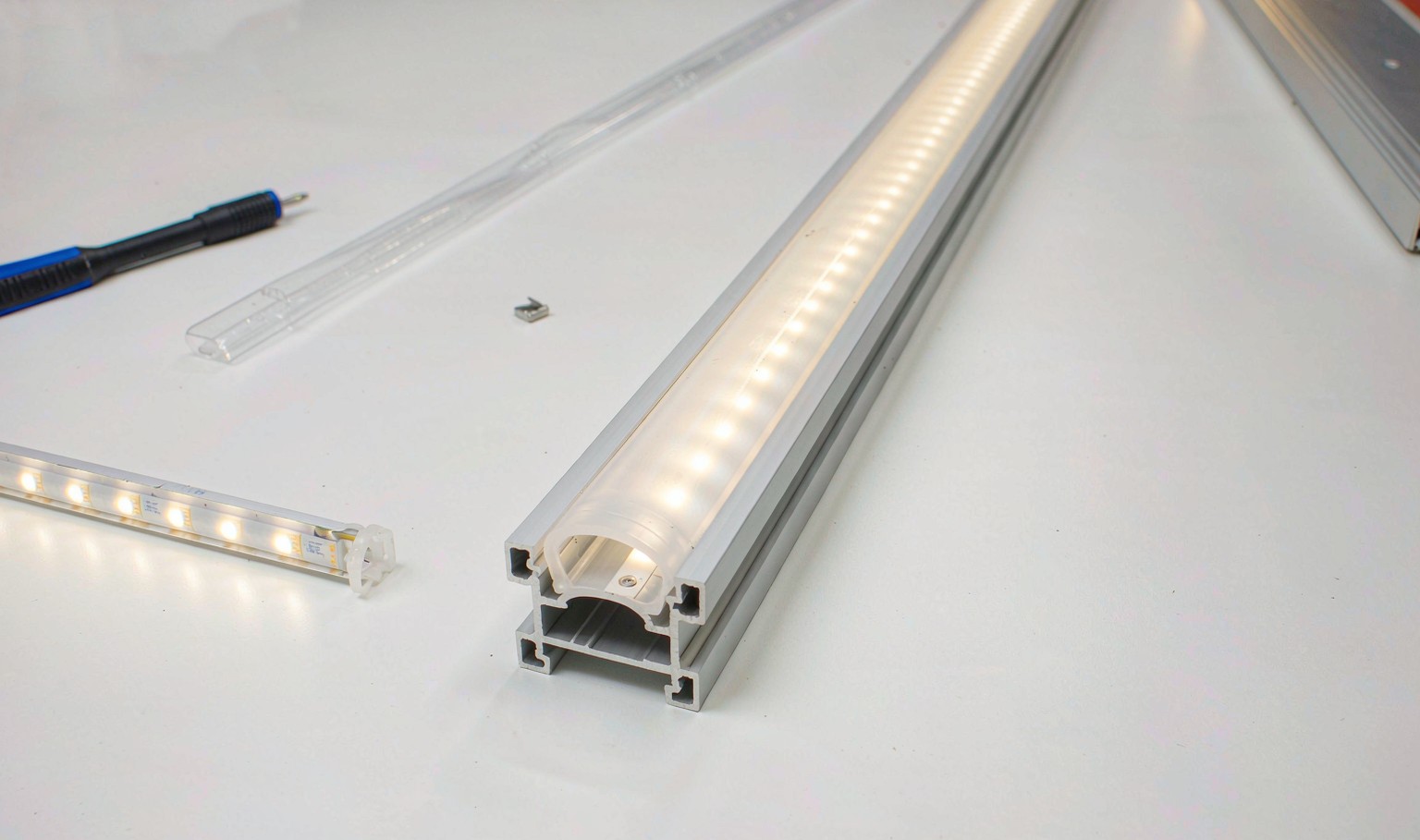
A diffuser is an optical component, not a cover
The job of a diffuser is to take a row of point sources and turn it into a uniform line. It does that by scattering: light enters the material, hits particles or boundaries inside it, and leaves in a different direction. Every scatter event is a chance for the light to leave through the side, be absorbed, or reflect back towards the LED.
So a diffuser is specified by two numbers that pull against each other. Transmission is how much of the light gets out the front. Hiding is how completely the individual sources disappear. A perfectly clear cover scores 92 percent transmission and hides nothing. A perfectly white cover hides everything and transmits 40 percent.
The commercial argument for a diffuser is usually made on hiding, because that is what the customer sees. The cost is paid in lumens and in heat, and both of them show up later: a fixture that was specified at 1,500 lumens and delivers 1,050 is a fixture that gets returned.
The design question is therefore not whether to diffuse but how much, and the answer is set by the pitch of the LEDs. A strip with 5 mm pitch needs less diffusion than one with 30 mm pitch, because the eye integrates the closer sources on its own.
Thickness decides transmission before anything else
In a scattering material, transmission falls roughly exponentially with thickness, because the path through the material is longer and the number of scatter events along it goes up. On a 1 mm wall a good silicone diffuser transmits about 91 percent. At 1.5 mm it is 86, at 2.0 it is 81, at 2.5 it is 76, and at 3.0 mm it is 71.
Twenty percentage points across 2 mm of wall is a large amount of light to give away for a thickness that a designer chose to make the part stiff enough to clip in. The usual compromise is 1.2 to 1.8 mm, which keeps transmission above 84 percent and still hides a 15 mm pitch strip.
Thickness is also the hardest thing to hold on an extruded or moulded diffuser, because the section is long and thin. A 1.5 mm nominal wall on a 1 m extrusion varies by plus or minus 0.08 mm, which is plus or minus 1.5 percentage points of transmission along the length. That variation is visible as a slightly brighter patch, and it is one of the reasons a long diffuser is often extruded rather than moulded: extrusion holds the section better than a long thin moulding does.

Filler buys hiding and heat path, and sells light
A clear silicone transmits 91 percent and hides nothing, because there is nothing inside it to scatter. The scattering comes from a dispersed second phase: a fine silica, a silicone resin powder, or a hollow microsphere. The loading of that phase sets both the hiding and the loss.
At 2 weight percent of diffuser filler, transmission is 84 percent and the strip is starting to blur. At 5 percent it is 74 and the dots are gone at a 15 mm pitch. At 8 percent it is 63, at 12 percent it is 48. The same loading raises thermal conductivity from 0.20 W/mK at zero to 0.66 at 12 percent, which matters because the diffuser is the closest thing to the LED and it is the part that has to carry heat away from it.
That is the trade in one line: the filler that hides the dots also conducts the heat, and both of them cost light. A fixture designer who wants 80 percent transmission and 0.6 W/mK cannot have both from the same compound, and the resolution is usually to put the thermally conductive material in the housing and keep the diffuser lightly filled.
Particle size matters as much as loading. A 2 micrometre filler scatters efficiently and hides well at a low loading, but it also back-scatters, so more light goes back into the housing. A 20 micrometre filler forward-scatters more and transmits better at the same hiding, and it is the reason two compounds at the same loading can differ by 8 percentage points.
| Filler loading | Transmission | Thermal conductivity | Hides 15 mm pitch |
|---|---|---|---|
| 0 wt% | 91% | 0.20 W/mK | Hayır |
| 2 wt% | 84% | 0.29 W/mK | Partly |
| 5 wt% | 74% | 0.41 W/mK | Evet |
| 8 wt% | 63% | 0.52 W/mK | Evet |
| 12 wt% | 48% | 0.66 W/mK | Completely |
Table 1 — What each filler loading buys and costs
Why silicone and not PMMA or polycarbonate
PMMA is the best optical material in the list. It transmits 92 percent, it is hard, it does not yellow indoors, and it is cheap. It is also brittle, and it softens at about 95 C. An LED strip in a sealed aluminium profile runs the diffuser at 70 to 85 C in still air, and a PMMA diffuser at that temperature is a diffuser that crazes and cracks at the clip points after a few thermal cycles.
Polycarbonate is tougher and it takes 120 C, but it yellows. The yellowing is photodegradation initiated by the short-wavelength blue light that an LED emits, and a PC diffuser over a high-blue white LED loses 10 to 15 percent of its transmission in two years. It also scratches, and a diffuser is a surface that gets touched.
Silicone takes 200 C continuously, it does not yellow under blue light because there is no aromatic backbone to break, and it stays flexible, which means it survives being clipped, flexed and dropped. It is also the most expensive of the three and the weakest mechanically, which is why a silicone diffuser is usually a thin cover over an aluminium body rather than a structural part.
The other silicone advantage is that it can be co-extruded or overmoulded onto the aluminium profile and bonded by its own cure. A PMMA cover needs a mechanical clip and a gasket; a silicone cover can be the gasket.
| Malzeme | Transmission | Continuous use | UV and blue light | Maliyet |
|---|---|---|---|---|
| PMMA | 92% | 80 C | Stable indoors | Düşük |
| Polikarbonat | 89% | 120 C | Yellows | Düşük |
| Silicone, unfilled | 91% | 200 C | Stable | Yüksek |
| Silicone, 5% filler | 74% | 200 C | Stable | Yüksek |
Table 2 — Optical materials for a diffuser cover
Making a long thin optical section
A linear diffuser is usually 1 to 3 m long and 1.5 mm thick, which is the worst aspect ratio in silicone processing. Extrusion handles it: the section is pulled through a die, cured in a tunnel and cut to length, and the wall thickness is held by the die and the drawdown. Moulding handles short lengths and shaped sections, and it is the only route when the diffuser has a lens profile or a clip feature moulded in.
The optical requirement adds one constraint that ordinary extrusion does not have: the surface has to be smooth enough not to scatter at the wrong angle. A 0.8 micrometre Ra surface on a diffuser scatters 3 to 4 percent of the light at grazing angles, which shows up as a slight haze along the edge. Polishing the die to 0.2 micrometre Ra removes it.
Cure matters too. An under-cured silicone is tacky, it picks up dust, and the dust scatters. An over-cured one yellows slightly, and a 2 percent yellow shift is a visible colour temperature change along a 3 m run. The cure window for an addition-cure silicone diffuser is narrow, and it is set by the tunnel temperature profile rather than by the line speed alone.
What to put on the drawing
A diffuser drawing that says only the shape and the durometer leaves the two numbers that matter to the supplier. It should carry the wall thickness with a tolerance, the transmission at a stated wavelength or over a stated band, and the LED pitch the part has to hide.
Transmission is usually quoted at 550 nm or as a luminous transmittance over the visible band. The two are not the same on a scattering material, and a supplier quoting 85 percent at 550 nm can be delivering 78 percent luminous. State which one.
The drawing should also carry the operating temperature and the expected life, because those decide the material and the cure. A diffuser over a 1 W LED in still air and one over a 0.1 W LED in a cooled fixture are different products even when the drawing looks identical.
How much light does a silicone diffuser lose?
About 9 percent at 1 mm wall with no filler, 14 percent at 1.5 mm, and 29 percent at 3 mm. Adding 5 percent diffuser filler takes the loss at 1.5 mm to about 26 percent.
Can a diffuser hide the LED dots without filler?
Only with a thick wall or a very close pitch. Scattering needs a second phase; without one the cover is clear and the dots stay visible.
Why not use PMMA, which transmits more?
Because it softens at about 95 C and a sealed LED profile runs the diffuser at 70 to 85 C. PMMA crazes at the clip points and cracks after thermal cycling.
Does silicone yellow under LED light?
Far less than polycarbonate. Silicone has no aromatic backbone for the blue light to attack, so a well-cured silicone holds its colour, while PC loses 10 to 15 percent transmission in two years.
What wall thickness should a 1 m diffuser be?
1.2 to 1.8 mm. Thinner is brighter but harder to hold straight; thicker hides better and costs light. Extrusion holds the section better than a long moulding.
What tolerance can an extruded silicone diffuser hold?
Plus or minus 0.08 mm on a 1.5 mm wall, which is about 1.5 percentage points of transmission along the length. Tighter needs a gauged line and a reject gate.
A diffuser that hides the dots but eats the lumens?
Tell us the LED pitch, the wall thickness and the target transmission. We will come back with the filler loading and the section that meet both.




 TR
 EN
 ES
 FR
 DE
 PT
 AR
 RU
 JA
 KO
 IT
 NL
 PL
 ID
