
A scratch is a total loss, not a rework
A scratched profile cannot be repaired. The visible surface is a skin of 0.1 to 0.2 mm that carries the gloss, the colour and the texture, and a scratch cuts through it. Polishing removes the surrounding skin and leaves a flat, dull patch that is more obvious than the scratch was.
So the metre is written off, and what is written off is not the resin. It is the resin plus the conversion plus the packaging plus the handling plus the freight to the point where the defect was found. In a shop where resin is 55 percent of cost, a rejected metre costs about 1.8 times the resin in it.
That is why the packaging decision is not a purchasing decision. It is a yield decision that happens to be bought from a film supplier, and it should be evaluated against the reject rate rather than against the film price.
There is a second cost that never appears on a scrap report: the customer who receives one scratched length in a bundle stops inspecting and starts rejecting whole bundles. The cost of that is not the scrap, it is the account.
Where the scratches actually come from
In a typical line the sources are consistent, and the one everybody blames is not the biggest. The die lip and the calibrator account for about 30 percent, the haul-off and the run-out table 20, the saw and the stacking 25, and transport 25.
The die and calibrator are first because a single burr or a dried drip marks every metre until somebody notices. That is a maintenance item, not a packaging item, and no amount of film will fix it: the film protects a good surface, it does not repair a bad one.
The saw is the most under-rated. A dull blade throws chips that land on the next length, and a saw that is out of square drags the cut end across the face of the profile beside it. A blade change interval set from a burr specification, as described for cutting, also cuts the scratch rate.
| Kaynak | Share | Typical cause | Fix |
|---|---|---|---|
| Die and calibrator | 30 percent | Burr, dried drip, plate-out | Clean and polish on schedule |
| Saw and stacking | 25 percent | Chips, dragging, cross-stacking | Blade interval, stacking jig |
| Transport | 25 percent | Bundle rub, no interleaving | Film, end caps, load bracing |
| Haul-off and table | 20 percent | Roller marks, belt slip | Roller condition, belt tension |
Table 1 — Where scratches come from, and which of them packaging can and cannot fix.
The economics have a real minimum
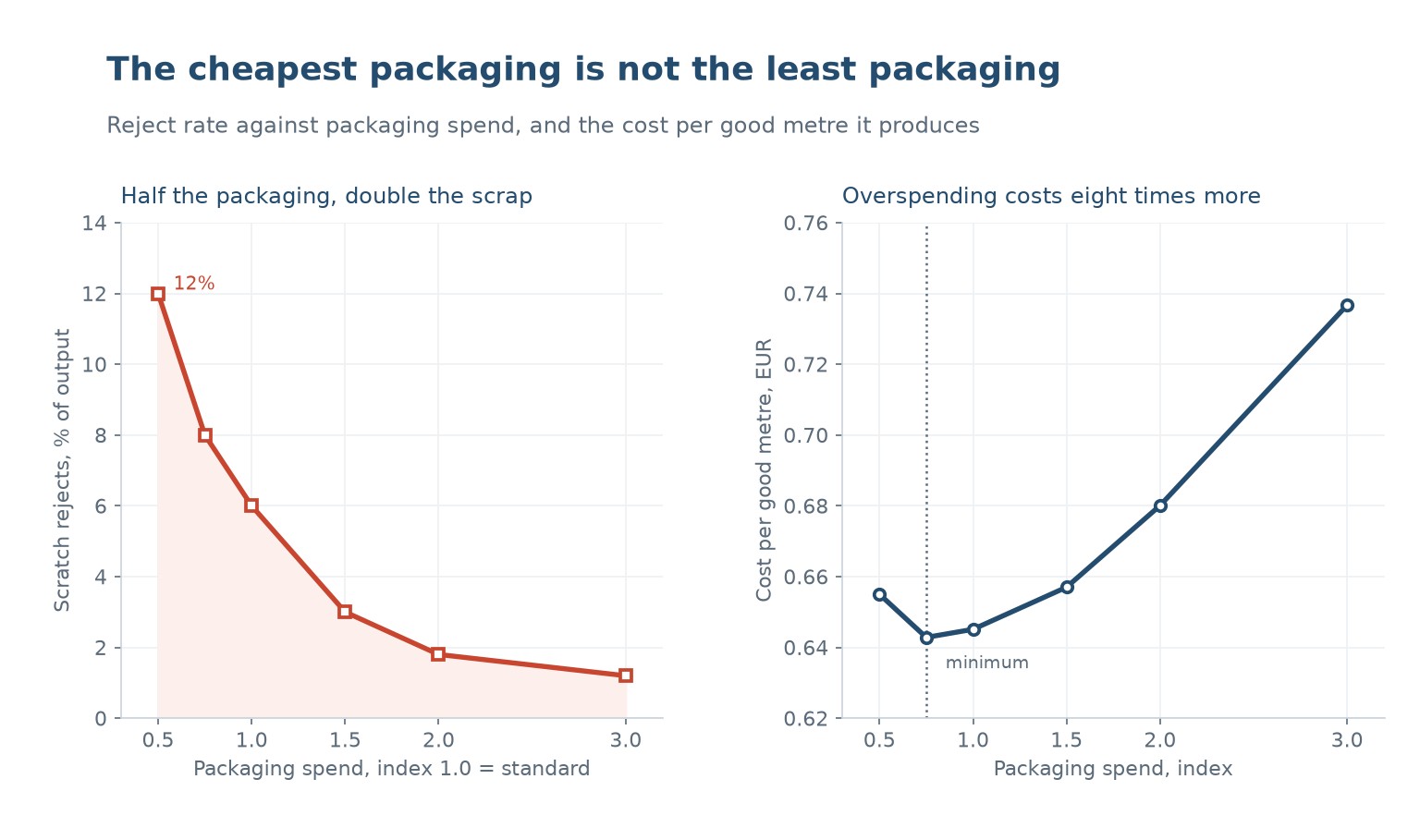
Reject rate falls steeply with packaging spend and then flattens. At half the standard spend the scratch reject rate is 12 percent; at 0.75 it is 8, at standard 6, at 1.5 times 3, at double 1.8 and at triple 1.2.
The cost per good metre is a different curve, and it has a minimum. Every rejected metre still costs the full 0.55 of base cost, so the cost per good metre is the base divided by the yield, plus the packaging. At 12 percent reject that is 0.625 plus 0.03, at 8 percent 0.598 plus 0.045, and the total bottoms out around 0.643 at 0.75 of standard spend.
The shape of the curve is the point. Underspending costs 0.012 per metre over the minimum; overspending at triple the standard spend costs 0.094, which is eight times as much. Being under-packaged is expensive but it is bounded, because the reject rate cannot exceed 100 percent. Being over-packaged is unbounded, because the film cost keeps rising with no further yield to buy.
That asymmetry is the argument for spending slightly less than the optimum rather than slightly more. It is also the argument for measuring the reject rate by source, because a reject that comes from the die will not respond to film at all, and spending on film to fix it moves the cost curve up without moving the yield.
| Packaging spend | Rejects | Cost per good metre | Verdict |
|---|---|---|---|
| 0.5 x standard | 12 percent | 0.655 | Cheap film, expensive scrap |
| 0.75 x standard | 8 percent | 0.643 | The minimum |
| 1.0 x standard | 6 percent | 0.645 | Effectively the same |
| 1.5 x standard | 3 percent | 0.657 | Paying for reassurance |
| 2.0 x standard | 1.8 percent | 0.680 | Costs more than it saves |
| 3.0 x standard | 1.2 percent | 0.737 | Eight times the underspend penalty |
Table 2 — The cost curve, and why the minimum is not at the standard spend.
What film, and how much of it
The standard for a gloss PVC profile is a 50 micrometre polyethylene film, applied to the visible face, with the profile interleaved in the bundle so that the film faces are the ones that touch. Wrapping the whole profile in film costs more and protects less, because the film still rubs against itself.
For a matte or textured profile the film can be thinner, because a texture hides fine scratches. For a high-gloss or a wrapped profile it has to be thicker, and it has to be a film that does not plasticise the surface: a film with a migratory slip agent will leave a dull patch where it touched.
The ends need their own protection. A cut end has a burr, and a burr in contact with the face of the next profile is a scratch generator for the whole journey. End caps, or a wrap that covers the last 100 mm, cost very little and remove a whole category of damage.
Bundle design matters as much as the film. A bundle that is strapped too tightly crushes the profile at the strap; one that is too loose rubs. A load that is braced at the ends but not in the middle flexes in transit, and flexing under load is what produces the long, shallow scratches that are hardest to see in the factory and easiest to see in the customer's warehouse.
Three moves that damage profiles
Most handling damage happens in three moves. Lifting a bundle from the ends bows it, and the middle of the bundle rubs against whatever is underneath. Dragging a length across a table or another length scratches the face along its whole length. Stacking flat and high puts the bottom length under a load it was never designed for.
The fix for all three is mechanical rather than disciplinary. Lift with a spreader beam or a bundle lifter rather than by the ends. Move lengths on a roller table or a felt-lined trolley rather than by dragging. Stack on a cradle with supports at 500 to 600 mm centres and a height limit that the profile can take.
The stack height limit is worth calculating rather than guessing. A stack of 100 profiles carries 99 profiles of weight on the bottom one, and the load grows with the square of the count because each interface carries the weight above it. That is why a stack that is fine at 20 high fails at 50, and why the failure appears as a bow rather than a break.
What to specify
Packaging is usually left to the supplier, which is why it is usually the cheapest thing that will survive the journey. Six lines make it a specification.
- Film type, thickness and which face it is applied to.
- Interleaving: whether profiles are separated from each other, and with what.
- End protection, and whether cut ends are deburred before packing.
- Bundle size, strap positions and the maximum strap tension.
- Stack height and cradle spacing for storage.
- The acceptable reject rate by defect type, so the packaging can be judged against a number.
The last item is the one that turns packaging from a cost into a yield decision. Without a reject rate by defect, a supplier cannot know whether the film is doing its job, and the conversation defaults to the price per metre of film.
Why can't a scratched profile be repaired?
Because the visible surface is a 0.1 to 0.2 mm skin carrying the gloss and colour. Polishing removes the skin around the scratch and leaves a dull patch that is more visible than the scratch.
How much packaging should a profile have?
Around 0.75 to 1.0 times the standard spend. Below that the reject rate rises faster than the film cost falls; above it, the extra film buys very little.
Is it better to over-package or under-package?
Under-package slightly. Underspending costs 0.012 per metre over the optimum; overspending at triple the standard costs 0.094, which is eight times as much.
Where do most scratches come from?
About 30 percent from the die and calibrator, 25 from the saw and stacking, 25 from transport and 20 from the haul-off. Film only addresses the transport share.
Does wrapping the whole profile in film help?
Less than interleaving the visible faces. A fully wrapped profile still rubs film against film, and the film itself becomes the abrasive.
How high can profiles be stacked?
Set a limit from the load the bottom profile can take. The load grows with the square of the stack count, so a stack that is fine at 20 high can bow at 50.
Scratch rejects eating your margin?
Tell us the profile, the surface and the current reject rate by defect. We will work out whether the loss is packaging, handling or the die, and what the packaging spend should be.
Continue reading
- Profile Cutting and Punching: Length Tolerance and Burr Control
- Skirting Profile Extrusion: Surface Finish and the Joint That Shows
- CNC Fabrication of Extruded Profiles: Machining a Part That Was Never Flat
- Decking Profile Extrusion: Slip, Expansion and Hidden Fixing
- PVC Profiles: Extrusion, Tooling and Tolerances




 TR
 EN
 ES
 FR
 DE
 PT
 AR
 RU
 JA
 KO
 IT
 NL
 PL
 ID
