
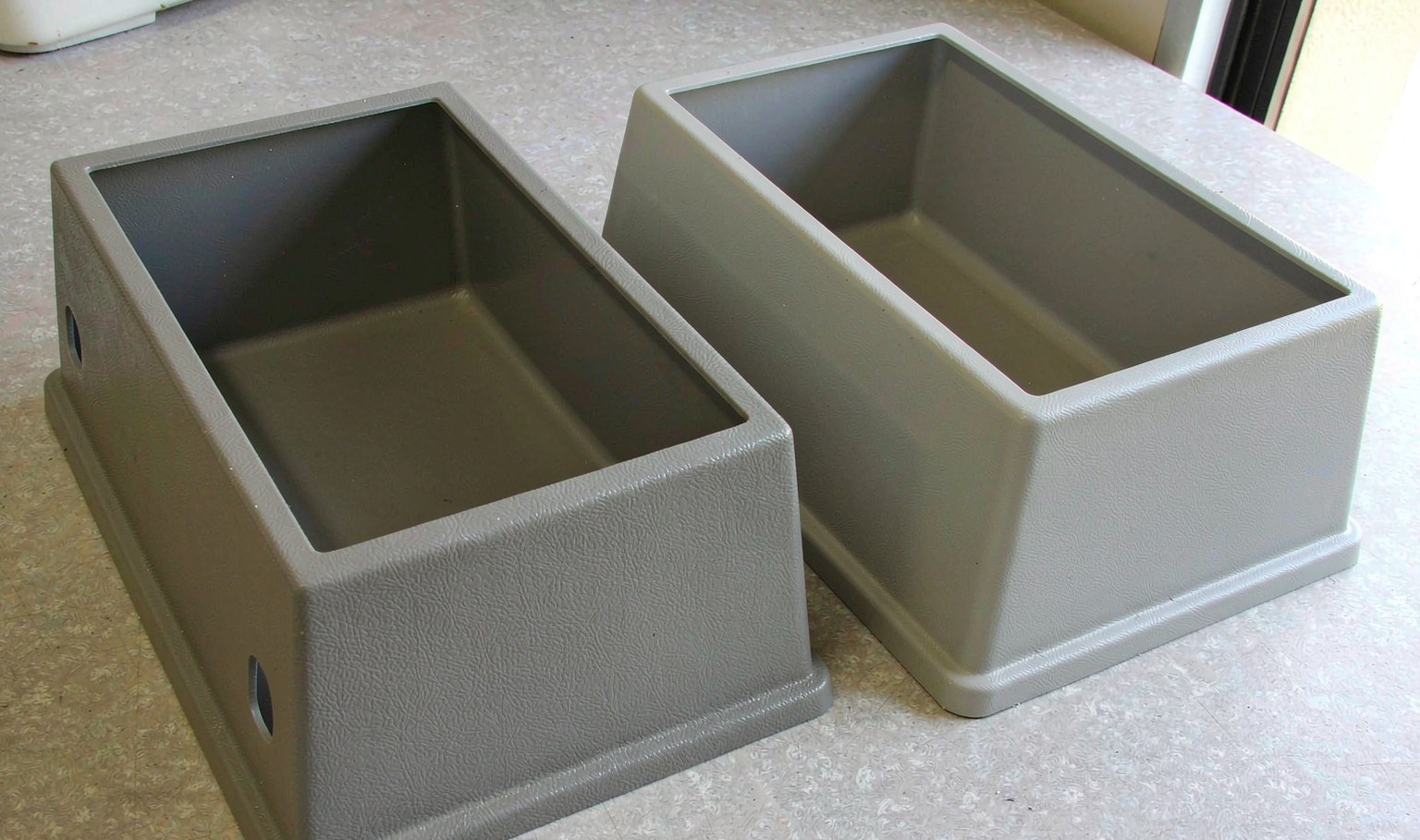
The physical difference is one atmosphere
Vacuum forming pulls the sheet onto the tool with a pressure difference of at most one atmosphere — about 1 bar, or 14.5 psi. Pressure forming adds compressed air on the sheet side, typically 3–6 bar, so the total driving pressure is 4–7 bar. That is the whole difference, and it changes everything downstream.
Four to seven times the pressure means the sheet is pushed into details it would otherwise bridge over. Sharp corners fill. Fine texture replicates. Moulded-in logos and surface grain come out legible instead of soft. The part looks closer to an injection moulding than to a vacuum forming.
The commercial trade: pressure forming roughly doubles the tooling cost and reduces the number of suitable machines. What it buys is a part that can compete with injection moulding at low volume. The decision is almost never technical — it is whether the part needs to look like a moulded component or whether a rounded thermoformed shell is acceptable.
Side by side
| Mülkiyet | Vakum şekillendirme | Pressure forming |
|---|---|---|
| Driving pressure | 1 bar (atmosphere) | 4 – 7 bar total |
| Minimum inside radius | 1 – 2 × sheet thickness | 0.3 – 0.5 × sheet thickness |
| Texture replication | Soft, low fidelity | Sharp, close to tool finish |
| Draft requirement | 3 – 5° | 1 – 3° |
| Wall thickness uniformity | Orta düzeyde | Better in corners, worse in some cases due to faster draw |
| Tooling cost | Baseline | 1.8 – 2.5 × |
| Tool material | Aluminium, epoxy, wood | Aluminium or steel; tool must withstand pressure |
| Machine requirement | Vacuum pump and platen | Pressure vessel, clamping, vacuum, compressed air |
| Çevrim süresi | Baseline | 5 – 15% longer (pressurise and vent) |
| Part cost at volume | Lower tooling, higher labour per part | Higher tooling, similar or lower per part at volume |
Table 1 — Vacuum forming versus pressure forming. The radius and texture rows are the ones that decide the process; the rest are consequences.
Why the tool costs more
A pressure forming tool has to resist 4–7 bar across its whole surface. On a 600 × 400 mm tool that is 1.7–2.9 tonnes of force, and the tool has to hold its shape under it without deflecting, because any deflection shows as a dimensional error in the part.
| Tool requirement | Vakum şekillendirme | Pressure forming |
|---|---|---|
| Structural strength | Moderate; 1 bar is gentle | High; needs ribs or a solid backing |
| Surface hardness | Orta düzeyde | High; texture must survive repeated pressure |
| Vent design | Simple holes | Precise; air must escape fast against pressure |
| Sealing | Not critical | Critical; the pressure chamber must seal on the sheet |
| Mounting | Simple platen | Pressure-tight platen with clamp frame |
| Malzeme | Aluminium 6082 is common | Aluminium 5083/7075 or steel inserts |
Table 2 — Tool differences. The sealing requirement is the one that most often causes a first-tool failure: a pressure tool that leaks will not form the detail it was bought for.
The vent design is worth separate attention. Under vacuum, air under the sheet has a full second to escape. Under pressure, the sheet is pushed down in a fraction of that time, so the vents have to move the same volume in less time. That means more vents, larger channels, or a vented tool material.
When pressure forming is the right answer
There is a recognisable set of situations where vacuum forming will not deliver and pressure forming will.
| Situation | Why vacuum fails | Why pressure works |
|---|---|---|
| Sharp cosmetic radii | 1 bar cannot pull sheet into a tight corner | Higher pressure fills the corner |
| Textured surfaces | Texture reads as a faint suggestion | Texture replicates at near-tool fidelity |
| Moulded-in lettering or logos | Letters bridge and blur | Letters come out crisp and legible |
| Parts competing with injection mouldings | Looks obviously thermoformed | Looks like a moulded component |
| Thin sheet with fine detail | Sheet cools before it reaches the detail | Faster draw, less cooling time before contact |
| Low draft requirements | Needs 3–5° to release | Can run 1–3° |
Table 3 — Where pressure forming earns its cost. The first four rows are the commercial cases; the last two are the engineering cases.
The most common real-world case is a low-volume enclosure that has to look like a production part. Medical device housings, industrial control panels, kiosk fascias, automotive aftermarket trim — all of these are typically pressure formed in quantities where an injection mould would be unjustifiable and a vacuum formed part would look wrong.
When it is not worth it
Pressure forming is often specified when it is not needed, and the extra cost is real.
Large, shallow, simple shapes. A pallet, a tray, a liner, a machine guard — these have generous radii, no fine texture and no cosmetic requirement. Vacuum forming is cheaper and just as good.
Very large parts. Above about 1.5 m the pressure chamber becomes a structural problem, and the tool has to resist several tens of tonnes. The economics deteriorate quickly.
Thick gauge. Above about 6 mm the sheet is stiff enough that pressure does not help much, and the cycle time penalty of pressurising becomes significant.
Parts where the tool is likely to change. If the design is still moving, doubling the tool cost to get detail you may redesign away is poor sequencing.
The process differences in practice
| Adım | Vakum şekillendirme | Pressure forming |
|---|---|---|
| Sheet clamping | Clamp frame, moderate force | Pressure-tight clamp frame, high force |
| Isıtma | Same | Same, but often to a slightly higher temperature |
| Pre-stretch | Optional bubble | Usually needed; helps wall distribution |
| Şekillendirme | Vacuum applied, sheet drawn onto tool | Vacuum plus compressed air on the sheet side |
| Dwell | Kısa | Longer; pressure held while the sheet sets |
| Venting | Release vacuum | Vent pressure slowly, or the part balloons |
| Demould | Often assisted by air | Air assist essential; part grips the tool harder |
Table 4 — Process sequence differences. The venting step is where inexperienced operators damage parts: releasing 5 bar instantly makes the part balloon off the tool.
The pre-stretch bubble is more important in pressure forming because the sheet has to travel further into detail. A controlled bubble pre-stretches the sheet uniformly before it contacts the tool, which improves wall distribution in deep draws. Without it, the sheet contacts the tool at the centre first and the walls thin.
Cost comparison at different volumes
| Cilt | Vakum şekillendirme | Pressure forming | Injection moulding |
|---|---|---|---|
| 10 – 100 | Cheapest; tool is minimal | 2× tool cost, hard to justify | Tool cost dominates; not viable |
| 100 – 1,000 | İyi | Viable if detail is required | Tool cost still dominates |
| 1,000 – 10,000 | Good, if the part is simple | Best fit for cosmetic parts | Becoming competitive |
| 10,000 – 50,000 | Part cost starts to matter | Competitive | Usually cheapest per part |
| Above 50,000 | Only for very large parts | Only for very large parts | Cheapest; the tool amortises |
Table 5 — Process economics by volume. The 1,000–10,000 band is where pressure forming owns the cosmetic enclosure market outright.
The crossover with injection moulding is not fixed. It depends on part size, wall thickness and the number of moulded-in features. A large enclosure with a simple shape may never justify an injection mould; a small complex part may cross over at 3,000 units.
How to decide
Ask three questions in order.
Does the part need detail that 1 bar cannot produce? Sharp radii, legible text, real texture, tight draft. If yes, pressure forming. If the radii are generous and the surface is plain, vacuum forming.
Is the part cosmetic or structural? A structural part that happens to be thermoformed — a tray, a liner, a guard — rarely benefits from pressure. A part a customer will hold and judge does.
What is the volume and the design stability? Below 500 units with a design still moving, a vacuum formed prototype and a pressure formed production tool is often the right sequence, not a pressure tool straight away.
What is the main difference between vacuum forming and pressure forming?
The driving pressure. Vacuum forming uses at most one atmosphere of pressure difference. Pressure forming adds compressed air on the sheet side, giving 4–7 bar total. The higher pressure fills sharper details, replicates texture and allows less draft.
How much more does pressure forming tooling cost?
Typically 1.8–2.5 times a vacuum forming tool of the same size. The increase comes from structural strength, harder tool material, more precise venting and a pressure-tight mounting. On large parts the multiplier is higher.
Can any vacuum forming machine do pressure forming?
No. It needs a pressure chamber, a pressure-tight clamp frame, a compressed air supply and controls for controlled venting. Some machines are convertible; many are not. Retrofitting is possible but rarely economic compared with buying a machine designed for it.
Does pressure forming give more uniform wall thickness?
Not automatically. It draws faster, which can thin the walls more in some geometries. The improvement is in detail reproduction and corner fill, not in wall uniformity. Wall distribution is controlled by pre-stretch, plug assist and heating, in both processes.
What draft angle does pressure forming need?
1–3° is often enough, compared with 3–5° for vacuum forming. The higher pressure holds the sheet against the tool more firmly, and the part releases more cleanly. Textured surfaces still need more draft regardless of process.
Can I pressure form polycarbonate?
Yes, and it is a common combination for machine guards and medical housings. PC needs high sheet temperature and a hot tool, and it is prone to stress cracking if the tool is cold. Pressure forming actually helps because the faster draw reduces the time the sheet spends cooling before it contacts the tool.
Why does my pressure formed part balloon when I release the pressure?
Because the pressure is being vented too fast. The air inside the part cannot escape through the vents quickly enough, so it pushes the still-soft sheet away from the tool. Vent slowly, in stages, and hold vacuum until the part is below its softening point.
Is pressure forming suitable for large parts?
Up to about 1.5 m it works, though the tool and machine become expensive. Above that the pressure chamber and clamp forces become impractical, and vacuum forming or twin-sheet forming are better routes.
Need a thermoformed enclosure that looks moulded?
Send us the 3D model, the material and gauge, the cosmetic requirements and the annual volume. We will tell you whether vacuum forming will carry the detail or whether the part needs pressure forming — and what each route costs.
Continue reading
- Vacuum Forming Tooling Cost: What Drives the Price of a Forming Tool
- Trimming Vacuum Formed Parts: CNC, Fixtures and Edge Quality
- Vacuum Forming Mold Design: Materials, Draft and Tool Life
- Thick Gauge vs Thin Gauge Thermoforming: Process and Economics
- Heavy Gauge Thermoforming for Large Enclosures: Sag, Wall and Warpage




 TR
 EN
 ES
 FR
 DE
 PT
 AR
 RU
 JA
 KO
 IT
 NL
 PL
 ID
