
A bell is a re-formed pipe end
Belling takes the end of an extruded pipe, heats it to its softening range, expands it over a mandrel and cools it in the expanded shape. The result is a socket that accepts the spigot of the next pipe, either with a rubber ring seal or with solvent cement.
It is a forming operation, not a joining operation, and that is the source of most of its problems. The material at the socket has been heated, stretched and cooled, so its properties are not the properties of the pipe. A bell is only as good as the thermal history it was given.
The process is used on PVC, PE, PP and ABS drainage and pressure pipe. PVC is the most common because solvent-weld and rubber-ring systems both need a precise socket, and because PVC softens in a narrow, controllable range.
Temperature: the whole specification
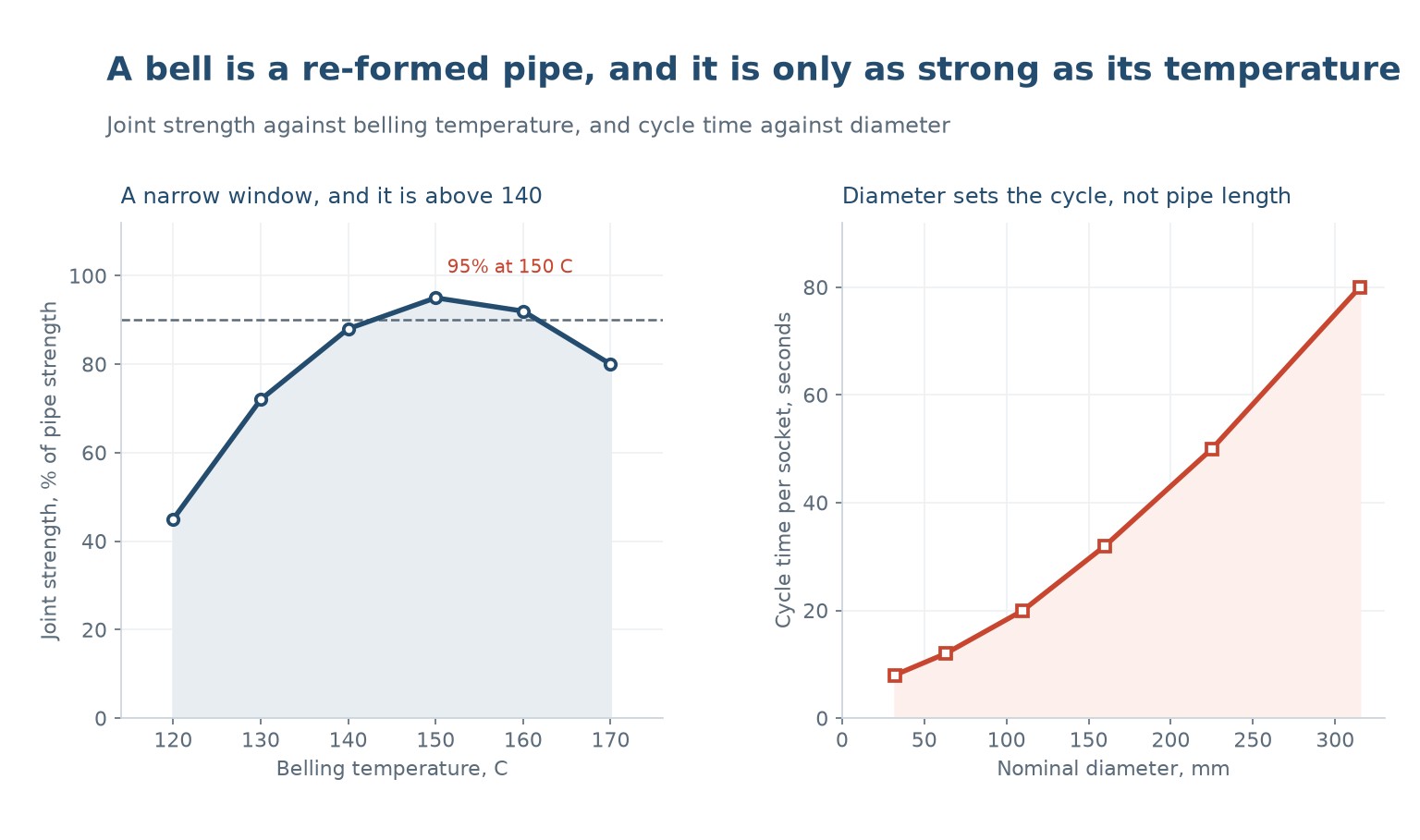
Joint strength against forming temperature is a curve with a sharp peak. At 120 degrees the material is not fully softened, the expansion is partly elastic, and the socket springs back: strength is 45 percent of the pipe. At 150 degrees it is 95 percent. At 170 the material has started to degrade and the strength falls back to 80.
| Belling temperature, C | Joint strength, % of pipe | What happens |
|---|---|---|
| 120 | 45 | Incomplete softening, elastic recovery, oval socket |
| 130 | 72 | Workable, but a narrow tolerance on the heater |
| 140 | 88 | Acceptable for drainage, marginal for pressure |
| 150 | 95 | The production point |
| 160 | 92 | Slight surface degradation, still acceptable |
| 170 | 80 | Visible degradation, wall thinning at the shoulder |
Table 1 - Joint strength against forming temperature for a PVC-U pressure pipe socket. The window is 30 degrees wide, and half of it is on the wrong side of 150.
The number that matters is the temperature of the pipe wall, not the setpoint of the heater. A hot air heater set to 300 degrees with a 20 second dwell gives a wall temperature that depends on the air flow, the distance, the ambient temperature and the wall thickness. Every one of those drifts.
Heating methods
Four methods are in use, and the choice is about cycle time and control rather than about quality.
- Hot air: cheap, simple, slow, and sensitive to draughts. The air temperature is high and the heat transfer is poor, so the wall heats unevenly and the outside is hotter than the inside.
- Infrared: fast, controllable, and heats the wall through its thickness more evenly. The lamps degrade and the reflector gets dirty, which changes the heat flux without changing the setpoint.
- Hot plate or contact: a heated mandrel inside and a heated sleeve outside. Fast and repeatable, and it needs contact on both surfaces, which limits it to shorter sockets.
- Salt bath: the old method, still used for large diameter PVC. Excellent heat transfer and uniform temperature, and a maintenance and disposal problem.
| Malzeme | Belling temperature, C | Usual method | Joint type |
|---|---|---|---|
| PVC-U | 140 to 160 | Hot air or infrared | Solvent weld or push-fit with EPDM |
| PE100 | 120 to 135 | Heated mandrel, cooled under pressure | Push-fit with NBR or EPDM |
| PP | 150 to 165 | Infrared or contact | Push-fit with EPDM |
| ABS | 130 to 145 | Hot air | Solvent weld with NBR |
Table 2 - Belling temperature and joint type by material. PE has the widest window in theory and the least tolerance for a cold mandrel in practice.
For pressure pipe, infrared or contact heating is the norm because both give a repeatable wall temperature. For drainage pipe at large diameters, hot air and salt baths still dominate because the equipment is simpler and the consequence of a marginal socket is lower.
Cooling and shrink-back
The socket must be cooled while it is still on the mandrel, because the material is above its softening point and will shrink back the moment it is released. The cooling time is set by the wall thickness and the mandrel temperature, not by the cycle time target.
Shrink-back is the failure that appears after the pipe has left the machine. A socket that is 0.3 mm oversize at the end of the line can be 0.2 mm undersize a day later, and the rubber ring that fitted in the factory will not seal in the trench. The socket must be measured after cooling to ambient, not at the machine.
Water cooling on the mandrel is standard. Air cooling is slower and gives more shrink-back. A mandrel that is too cold quenches the socket and leaves residual stress that cracks later, particularly in PVC at low ambient temperature.
The other cooling problem is the shoulder, where the socket meets the pipe. That transition is the thickest section and the last to cool, and it is where a crack starts if the part is handled while still warm.
The rubber ring groove
A push-fit socket has an internal groove that holds a rubber ring. The groove geometry is specified in the product standard, and it is not a place to improvise.
- Groove width and depth are set by the ring cross-section and the standard, typically EN 1401 or ISO 1452 for PVC drainage and pressure pipe.
- The groove must be formed while the material is soft, by a collapsible mandrel or a segmented former. A machined groove cuts the wall and removes the orientation.
- The ring must be retained: a groove that is too shallow lets the ring roll out during insertion, which is the most common field failure of a push-fit joint.
- Insertion depth must be marked on the spigot, and the chamfer must be generous, or the ring is damaged on assembly.
- Lubricant compatibility matters: some lubricants swell EPDM rings and some attack PVC.
The ring itself is usually EPDM for drainage and for potable water, and NBR where there is oil. The ring is the sealing element and the socket is only the housing, which is why a perfectly formed socket with the wrong ring still leaks.
Defects and what causes them
- Oval socket: uneven heating around the circumference, or a mandrel that is not concentric. Measure at three angles, not one.
- Cracks at the shoulder: too-cold mandrel, or handling while warm. The shoulder is the thickest section and the last to cool.
- Short bell: insufficient insertion depth or a mandrel that is too short for the socket length.
- Wall thinning at the shoulder: over-expansion, or a pipe that was already at the thin end of its tolerance.
- Ring groove out of tolerance: mandrel wear, which is gradual and invisible. Gauge the mandrel, not the socket.
- Surface degradation: heater too hot or dwell too long, showing as a chalky or discoloured patch inside the socket.
The pattern is that half the defects are thermal and half are tooling, and the two are distinguishable by whether they vary around the circumference. A defect that is always in the same angular position is a tooling problem; one that moves is a heating problem.
Quality checks that catch a bad socket
A belled pipe is inspected at the machine, again after cooling, and again as a joint. The three checks are different and none of them replaces the others.
- Socket diameter and ovality, measured at ambient after cooling, at three angles and two depths.
- Socket length and insertion depth mark, checked against the standard.
- Ring groove dimensions with a go/no-go gauge, on the mandrel and on the socket.
- Visual on the inside of the socket, with a light, looking for cracks, chalk marks and thinning.
- Joint test: assemble a sample with the specified ring and lubricant, pressure test at 1.5 times the nominal rating for one hour, and pull the joint apart to check the insertion depth.
- Impact test at 0 degrees for PVC, because a cold socket is where a brittle failure starts.
The joint test is the one that matters and the one most often skipped, because it needs a ring, a lubricant and an hour. A socket that gauges perfectly and leaks at 1.5 bar has failed, and the gauge did not see it.
What temperature should pipe be belled at?
150 degrees for PVC-U pressure pipe, measured on the pipe surface rather than the heater. Joint strength is 95 percent at 150 and falls to 45 percent at 120.
Why does my socket shrink after belling?
It was released from the mandrel before it had cooled below the softening range. Cool on the mandrel, and measure at ambient rather than at the machine.
Can PE pipe be belled?
Yes, but PE has a much lower softening point and a narrower window than PVC, and the socket is usually formed with a heated mandrel and cooled under pressure. Butt fusion is more common for PE pressure pipe.
What causes cracks at the shoulder?
A mandrel that is too cold, quenching the socket, or handling the pipe while the shoulder is still warm. The shoulder is the thickest section and cools last.
How is the rubber ring retained?
By a formed groove of the dimensions in the product standard. A shallow groove lets the ring roll out during insertion, which is the most common push-fit failure.
Does belling affect the pressure rating?
It should not, if the socket is formed at the right temperature and the wall is not thinned. A socket formed cold has 45 percent of the pipe strength and does not meet the rating.
Extruding pipe that needs a socket or a bell?
Tell us the material, the diameter and the joint standard. We will tell you the forming temperature, the cooling time and whether the groove can be formed in line or needs a separate operation.




 TR
 EN
 ES
 FR
 DE
 PT
 AR
 RU
 JA
 KO
 IT
 NL
 PL
 ID
