A mount is a filter, not a cushion
The mental model most buyers bring to a vibration mount is a cushion: soft rubber soaks up shaking the way a mattress soaks up weight. That model is wrong in a way that produces failed projects, because a mount is a spring with a mass on it, and a spring with a mass on it has a natural frequency. The mount does not remove vibration. It moves it, from a frequency you care about to a frequency you may not.
The number that describes this is transmissibility: the ratio of the motion that reaches the machine frame to the motion arriving at the mount. A transmissibility of 0.3 means the mount passes thirty percent of the shaking and turns seventy percent into heat in the rubber. A transmissibility of 3.0 means the mount triples the shaking, which is exactly what a badly chosen mount does at the wrong frequency.
So the first question about any isolation job is not what rubber, it is what frequency. A pump running at 1 450 rpm has a fundamental at 24 Hz. A fan at 2 900 rpm runs at 48 Hz. A press with a 40 stroke per minute cycle excites at 0.67 Hz. Those three machines need three different mounts, and a mount that is excellent for one is a liability for the next.
The second question is what happens at start-up and shut-down, when the machine passes through every frequency on its way to running speed. It will pass through resonance twice per start, and whatever the mount does at resonance decides whether the job survives the first week.
The curve every mount is judged on
The chart on the left plots transmissibility against frequency ratio, which is excitation frequency divided by the mount's natural frequency. Three damping ratios are shown, 0.10, 0.15 and 0.25, which covers the range silicone mounts actually deliver.
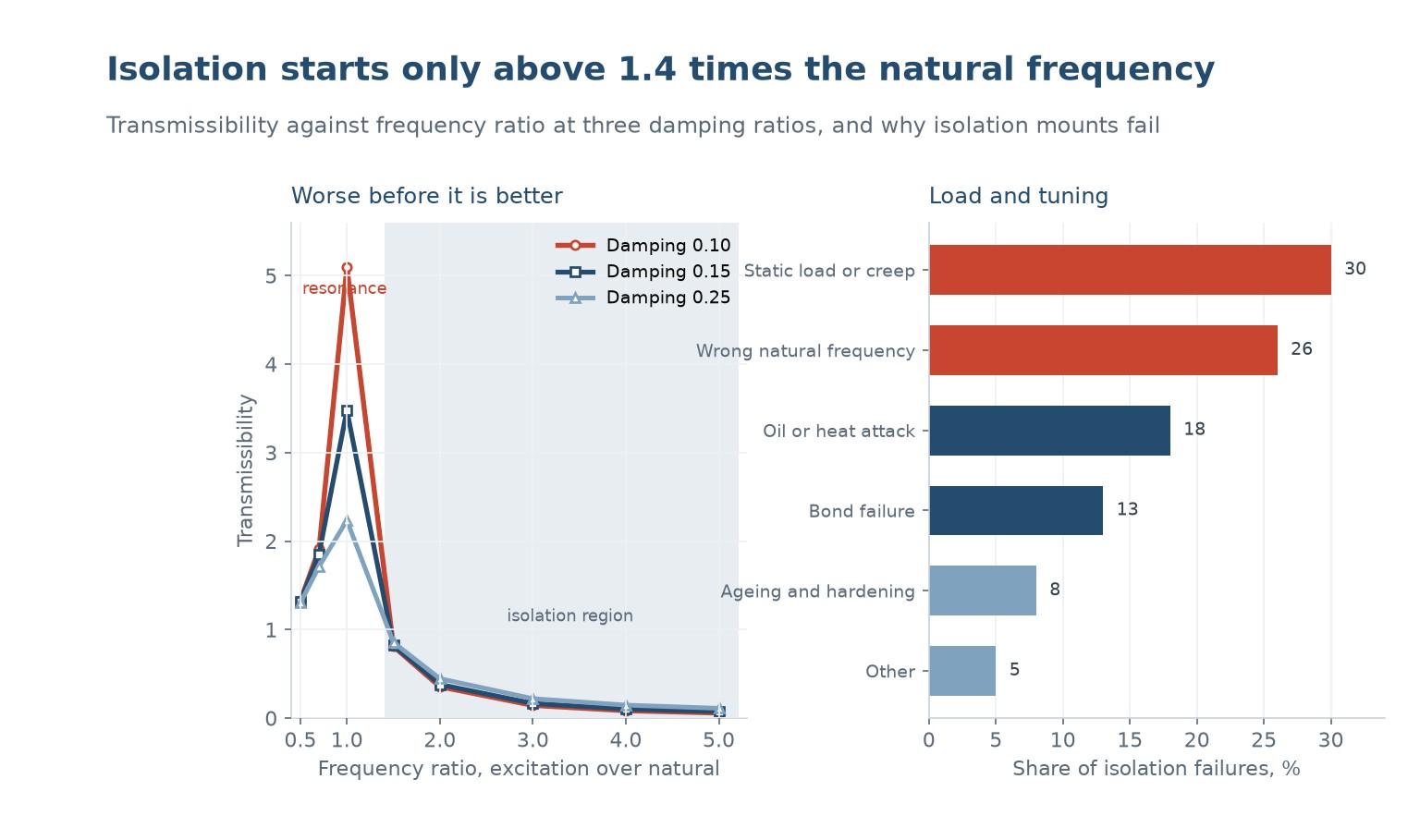
Every curve has the same shape. At low ratio the transmissibility is about one, meaning the mount is rigid and the machine might as well be bolted to the floor. At ratio one the curve peaks: 5.1 times the input at damping 0.10, 3.5 at 0.15, 2.2 at 0.25. Then it falls, crosses one at a ratio of 1.414, and from there on more ratio means less transmission.
The shaded region on the right is the only part of the chart where a mount is doing its job. To get a transmissibility of 0.10 with a damping ratio of 0.10 you need a frequency ratio of about 3.3, meaning the natural frequency has to be roughly a third of the excitation. For a 24 Hz pump that means a mount tuned to 7 Hz.
The trade is visible on the same chart. Lower damping gives a better isolation region and a far worse peak. At ratio 5 the damping 0.10 curve transmits 0.059 and the damping 0.25 curve transmits 0.112, so low damping is twice as good in service. At ratio 1 the same comparison is 5.1 against 2.2, so low damping is more than twice as bad at resonance.
Resonance is the price of isolation
A mount soft enough to isolate a 24 Hz pump at 7 Hz will be driven through 7 Hz every time the pump starts and stops. At that moment the machine sees five times its normal vibration, and if the structure can take five times the running load for two seconds twice a day, the design is fine. If it cannot, the mount will crack its bracket or the pipework will fatigue, and the failure will be blamed on the rubber.
There are three standard answers. The first is to accept the peak and make the bracket strong enough, which is usually the cheapest and is what most industrial installations do. The second is to add a damper or a second stage, which flattens the peak and costs isolation performance. The third is to start and stop quickly through the resonance band, which is possible on a motor with a soft start but not on a machine with a long spin-up.
The peak is also where most field failures are born, which the right hand panel reflects. Static load or creep accounts for 30 percent of isolation failures, wrong natural frequency for 26, oil or heat attack for 18, bond failure between rubber and insert for 13, ageing and hardening for 8. Load and tuning together are 56 percent, and both of those are specification errors rather than material errors.
Static load failure is worth spelling out, because it looks like a rubber problem and is not. A silicone mount loaded beyond its rated static deflection creeps: the rubber continues to deform slowly over months, the machine settles, pipework strains, and eventually the mount bottoms out on its own centre tube and stops isolating altogether. The mount is still intact and the isolation is gone.
Static deflection sets the natural frequency
There is a shortcut that avoids the whole frequency calculation, and it comes from the physics of a simple spring. For a mount loaded by its own share of the machine weight, the natural frequency in hertz is about 15.76 divided by the square root of the static deflection in millimetres. Ten millimetres of static deflection gives 4.98 Hz. One millimetre gives 15.8 Hz. Nothing else matters, not the shape of the mount, not the compound, not the hardness.
That single relation is why soft mounts are physically large. A mount that deflects 10 mm under load has to be tall enough to allow 10 mm of travel plus a safety margin, and it has to be wide enough that the rubber is not sheared beyond its strain limit at that deflection. A 5 mm deflection mount is roughly half the height and can carry more load per unit footprint.
The table works through a 24 Hz pump and shows what each deflection buys at running speed. The step from 1 mm to 2 mm is dramatic, because it moves the operating point from just outside the isolation boundary to well inside it. The step from 10 mm to 20 mm buys very little and doubles the height of the mount.
| Static deflection | Natural frequency | Ratio at 24 Hz | Transmissibility | Verdict |
|---|---|---|---|---|
| 1 mm | 15.8 Hz | 1.52 | 0.72 | Barely isolating, not worth the mount |
| 2 mm | 11.1 Hz | 2.16 | 0.29 | Workable, the usual industrial choice |
| 5 mm | 7.05 Hz | 3.40 | 0.12 | Good isolation, needs a taller mount |
| 10 mm | 4.98 Hz | 4.82 | 0.06 | Best practical point for most machines |
| 20 mm | 3.52 Hz | 6.82 | 0.03 | Diminishing return, awkward geometry |
Table 1 — What static deflection buys on a 24 Hz machine, at a damping ratio of 0.10.
The practical target for general industrial equipment is 5 to 10 mm of static deflection, which puts the natural frequency between 5 and 7 Hz and covers excitation from 8 Hz upward. Below 8 Hz the machine needs something other than a rubber mount, because the mount would have to deflect more than 40 mm and at that point a steel spring or an air mount is the honest answer.
Where silicone wins and where it loses
Silicone's advantage over other elastomers is temperature range: minus 55 to plus 200 degrees Celsius continuously, with peaks higher. That matters because a mount near a hot machine or outdoors in a cold climate is a mount whose hardness is changing, and hardness change means natural frequency change. A compound that stiffens by 30 percent in the cold has moved its natural frequency up by 14 percent, which on a marginal design is the difference between isolation and amplification.
Silicone's disadvantage is mechanical. It has modest tear strength, poor resistance to oils and fuels, and it creeps under sustained load more than natural rubber. For a machine base indoors at ambient temperature, EPDM or natural rubber is usually the better engineering choice and the cheaper one. Silicone earns its price when temperature or outdoor UV is the constraint.
There is a third option that buyers forget: no elastomer at all. A steel spring isolator handles very low frequencies and very heavy loads with no creep and no ageing, at the cost of almost no damping and a need for a separate damper. For a 3 tonne machine that needs 25 mm of deflection, a spring is the correct answer and a silicone block is a compromise that will not hold its height.
| Property | Silicone | EPDM | Natural rubber | Steel spring |
|---|---|---|---|---|
| Temperature range | -55 to 200 C | -45 to 120 C | -40 to 80 C | No limit |
| Oil and fuel | Poor | Poor | Fair | Excellent |
| Damping ratio | 0.10 to 0.25 | 0.05 to 0.10 | 0.05 to 0.08 | 0.005 |
| Creep under load | Moderate | Low | Low | None |
| Very low frequency | Not practical | Not practical | Not practical | Native |
Table 2 — Elastomer choice for an isolation mount, ignoring cost.
Specifying a mount in six questions
A mount specification that a supplier can actually work from answers six questions. What is the excitation frequency, in hertz, including harmonics and the start-up sweep. What is the mass carried by each mount. What is the required transmissibility, as a number rather than a feeling. What is the temperature range in service and at rest. What will the mount be exposed to, oil, coolant, sunlight, washdown. And what is the failure mode if the mount collapses, because that decides how much redundancy and how much travel margin is needed.
The most common omission is the second question. A machine with four mounts does not divide its weight equally between them if its centre of gravity is off centre, and the mount carrying 40 percent of the load will deflect 40 percent more and have a lower natural frequency than its neighbours. The result is a machine that rocks at one corner, and no amount of compound tuning fixes a load distribution that was never calculated.
The second most common omission is the third question. Transmissibility is a number, and asking for the number forces a conversation about what the vibration is actually damaging: a bearing, a weld, a neighbouring instrument, or a person's ears. Each of those has a different threshold, and a mount chosen for the loudest complaint is often over-specified for the actual damage mechanism.
One last piece of arithmetic worth doing before ordering. Calculate the natural frequency of the mount on the machine, then list every excitation source in the installation, including the ones you do not own: a nearby compressor, a forklift route, a pump on the same skid. If any of them sits between 0.8 and 1.2 times the natural frequency, the design will be in or near resonance in service and the mount needs to be retuned before it is ordered, not after.
Does a softer silicone mount always isolate better?
No. Softness lowers the natural frequency, which is good, but a mount that is too soft for the load bottoms out and stops isolating, and it also creeps until the machine settles onto its centre tube. The target is a natural frequency about a third of the lowest excitation frequency, with enough travel left over for start-up.
Why does my machine shake more after fitting isolation mounts?
Almost always because the operating frequency is between 0.8 and 1.2 times the natural frequency of the new mounts. In that band a mount amplifies rather than isolates, and the peak can be five times the input. Either use a softer mount to move the natural frequency down, or a stiffer one to move it up, but check the ratio before changing anything.
How much static deflection should I aim for?
Five to ten millimetres for general industrial equipment, which gives a natural frequency of 5 to 7 Hz and covers machines running at 8 Hz and above. Below 8 Hz of excitation the deflection needed exceeds what a rubber mount can provide and a steel spring isolator is the correct choice.
Can silicone mounts be used outdoors?
Yes, and that is one of their main advantages: silicone resists UV, ozone and weathering far better than natural rubber, and it keeps its hardness from minus 55 to plus 200 Celsius. The limitation outdoors is not the weather but oil, fuel or hydraulic fluid on the floor, which silicone tolerates poorly.
What causes a silicone mount to fail in service?
In order of frequency: static overload and creep, a natural frequency that was never matched to the machine, oil or heat attack on the compound, and bond failure between the rubber and the metal insert. Load and tuning together account for more than half of all failures, and both are specification errors rather than manufacturing defects.
How many mounts does a machine need?
Enough that no single mount carries more than its rated load, which is a centre of gravity calculation rather than a rule of thumb. Four is common, but a machine with an offset centre of gravity may need six or a different layout, and the corner mounts may need different stiffnesses to keep the machine level.
Tuning a mount to a machine, not to a catalogue
Send us the machine mass, the running speed and the temperature at the mounting points. We will come back with a compound, a hardness and a mount geometry, plus the natural frequency you will actually get.







 EN
 ES
 FR
 DE
 PT
 AR
 RU
 JA
 KO
 IT
 NL
 TR
 PL
 ID