

What a forming slide actually is
A slide is a block of tool that moves out of the way before the part is demoulded. It sits in a pocket in the mould, it is pushed into position before the sheet is formed, and it is withdrawn before the part is lifted. On the face that touches the sheet it carries the geometry that creates the undercut: a lip, a window, a return flange or a snap feature.
The movement is usually pneumatic, sometimes hydraulic, and occasionally mechanical through a cam or a toggle. Pneumatic is the default because it is cheap, fast and easy to control with a solenoid valve tied into the machine sequence. Hydraulic is used where the force is high or the stroke is long, and it brings oil, hoses and a power unit into a tool that was previously clean.
The important thing to understand is that the slide is not a feature of the part, it is a feature of the tool that allows the part. The part drawing shows an undercut; the tool drawing shows a slide, a pocket, a cylinder, a wear plate and a set of stops. Each of those is a place where the tool can fail, and each has to be maintained.
That is why a slide is best thought of as a mechanism rather than as a mould surface. It has clearances, it wears, it needs lubrication that will not contaminate the sheet, and it needs a sensor to confirm that it is where the sequence thinks it is. A tool with a slide is a tool with a machine inside it.
The payback calculation
The chart on the left plots cumulative cost against annual volume for three ways of dealing with an undercut. A manual secondary operation starts cheap, because the tool is simple, and becomes expensive quickly, because every part carries a handling cost that does not fall with volume. A slide starts expensive, because the tool carries the mechanism, and stays almost flat, because the per-part cost is close to that of an unmodified part.
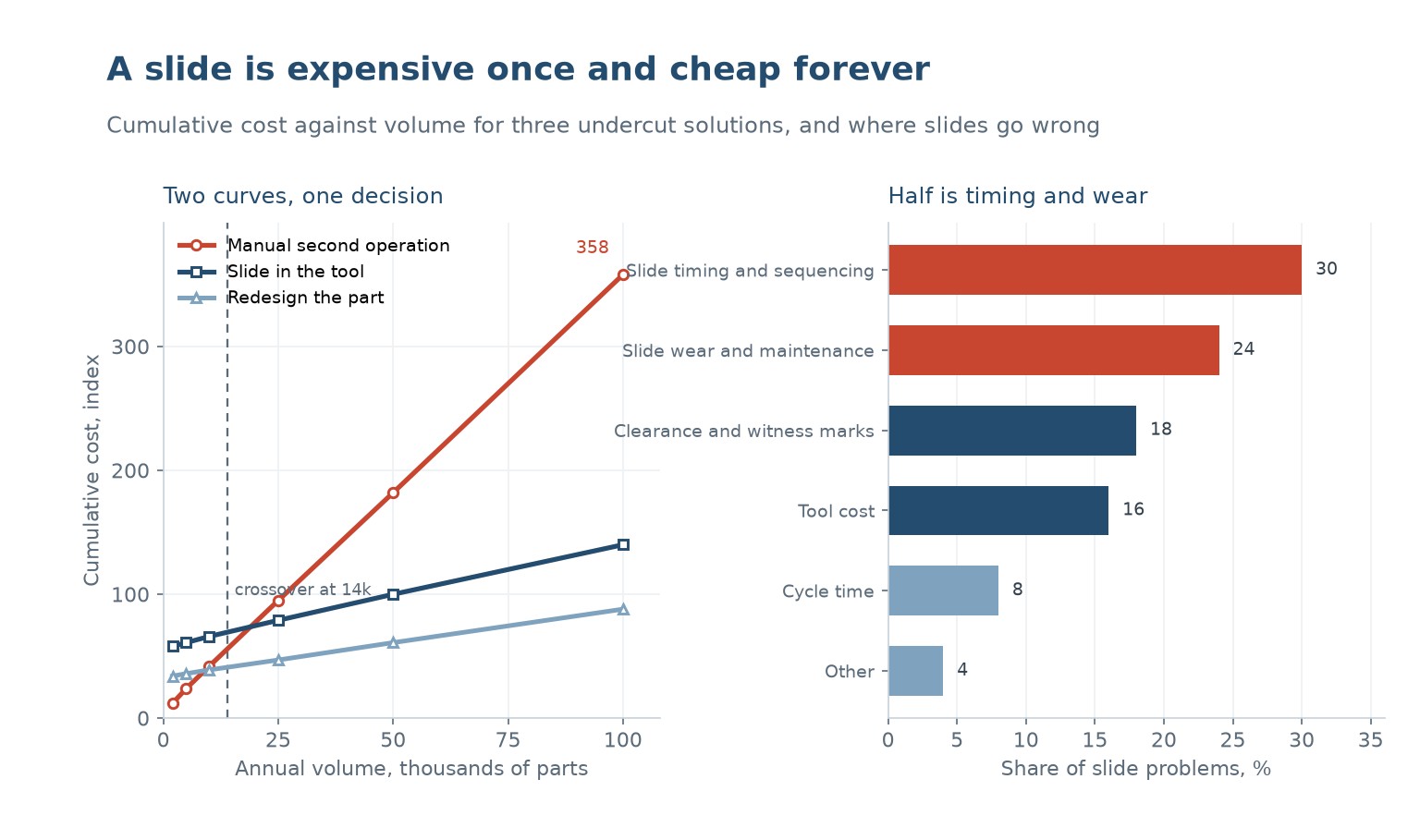
The two lines cross at about fourteen thousand parts a year on these numbers. Below that, the manual operation wins. Above it, the slide wins, and the gap widens every year the part stays in production. The redesign line sits below both at every volume shown, which is the argument for doing the design review before the tool is ordered rather than after.
The crossover moves with the cost of the secondary operation. If the undercut needs a skilled trim, a fixture and a check, the manual route costs more per part and the crossover moves down. If the undercut can be produced with a simple punch in the same trim station, the manual route is cheaper for longer and the slide has to justify itself on quality rather than on cost.
There is a second cost that the curve does not show: the secondary operation adds a queue. Every part has to be moved, staged, processed and moved back, and the lead time grows by a day or two. For a part that is made to order and shipped weekly, that queue is often the real reason to buy the slide.
Timing: the sequence that decides success
A slide has to be in position before the sheet touches it and out of position before the part is lifted. That sounds trivial and it is the source of most slide problems. If the slide arrives late, the sheet forms over the pocket and the undercut is missing or distorted. If it retracts late, the part is dragged and the undercut is torn.
The sequence is normally driven by the machine's programmable controller, with the slide advanced during the heat cycle and retracted after the vacuum is released but before the platen opens. The critical numbers are the advance time and the retract time, and both have to be measured rather than assumed. A slide that takes 0.4 seconds to advance needs to be commanded 0.4 seconds before the form, plus a margin.
Confirmation matters as much as command. A proximity switch on the slide, wired into the machine's safety circuit, stops the cycle if the slide is not home. Without it, a sticky valve produces one good part, then a run of parts formed over a protruding block, and the operator sees the problem at the trim station rather than at the press.
The retract has to happen while the part is still on the mould and still under control. Retracting after the platen opens means the part is already free and the slide drags across it. Retracting too early, before the part has cooled enough to hold its shape, lets the undercut relax and the feature springs back. The window is narrow and it is worth a trial with a slow cycle to find it.
| Решение | Tool cost | Cost per part | Best volume |
|---|---|---|---|
| Redesign to avoid the undercut | Низкий | Lowest | Any, if the product allows |
| Manual second operation | Lowest | Highest | Below about 10 000 a year |
| Pneumatic slide in the tool | Высокий | Низкий | Above about 15 000 a year |
| Hydraulic slide | Highest | Низкий | Large parts, long stroke, high force |
| Collapsible or articulated core | Высокий | Низкий | Complex internal undercuts |
Table 1 — Four routes and the volume each one suits
Clearance, witness marks and cosmetic limits
A slide needs clearance to move, and clearance shows on the part. The gap between the slide face and the surrounding mould is typically 0.05 to 0.10 mm, and the sheet is thin enough and hot enough to flow into it. The result is a witness line, a slight step or a thin fin along the edge of the undercut, and it appears on every part in the same place.
Whether that is acceptable is a product decision, and it should be taken before the tool is cut. A witness line on a hidden internal feature is irrelevant. The same line on a visible A-surface is a reject. If the undercut is on a visible face, the tool needs a shut-off designed to hide the joint, which means a step rather than a gap, and that costs more.
The slide face also has to match the sheet thickness at the point where it seals. If the sheet thins as it draws over the slide, the seal is loose and the undercut is poorly formed. If the sheet is thick, the slide has to press harder and the witness line becomes a crease. Slides near a deep draw are the ones that give trouble, and they are the ones where the sheet thickness at that point should be calculated first.
Venting is the last detail and it is easily forgotten. A slide creates an enclosed pocket, and air trapped in that pocket prevents the sheet from reaching the slide face. A vent hole through the slide, or a groove along its edge, is cheap to add at the design stage and awkward to add afterwards.
Maintenance and the wear parts
A slide wears in three places: the guideways, the stop faces and the seal edge. The guideways wear because they carry the side load of the sheet pulling against the slide. The stop faces wear because the slide hits them every cycle. The seal edge wears because it is the thinnest section and it takes the heat.
Wear shows up as a change in the witness line, a slower advance, or a part that starts to show a fin where it previously did not. All three are visible in the parts before they are visible in the tool, which is why the inspection plan should include the undercut feature rather than just the overall dimensions.
Lubrication is the awkward part. The guideways need grease, and grease migrates. On a thermoforming tool the sheet is hot and tacky and will pick up anything on the mould surface, so the lubricant has to be chosen for the temperature and applied sparingly, and the slide area has to be wiped every shift. A dry-film lubricant or a self-lubricating wear plate avoids the problem entirely and is worth the extra cost.
The wear parts should be replaceable without remaking the tool. A slide that runs on a bolted wear plate can be brought back to tolerance in an hour. A slide that runs directly in a pocket machined into the mould plate has to be re-machined or replaced, and that is a tool repair rather than a maintenance task.
| Symptom | Likely cause | Fix |
|---|---|---|
| Undercut missing or shallow | Slide advanced late or not at all | Check valve, sensor and advance time |
| Undercut torn on demoulding | Slide retracts late | Retract before the platen opens |
| Fin along the undercut | Clearance too large, or sheet too hot | Reduce clearance, lower sheet temperature |
| Feature springs back | Slide retracts too early | Hold until the part is cool enough |
| Slide sticks intermittently | Guideway wear or dry lubrication | Replace wear plates, use dry film |
Table 2 — Five symptoms and where they come from
When a slide is the wrong answer
A slide is the wrong answer when the undercut can be removed by a small design change. A return flange that could be a separate clip, a window that could be a cut-out in a second operation, a lip that could be a snap-on trim: each of these is a redesign that removes the mechanism, the maintenance and the witness line at once.
It is also the wrong answer when the volume is low and the part is simple. A tool with a slide has to be set up, timed and maintained, and at two thousand parts a year the setup cost per part dominates. A manual punch and a fixture are less elegant and much cheaper.
And it is the wrong answer when the material cannot take the local stretching. A slide forces the sheet to form around a feature at the very edge of what the material can do, and some materials will thin to the point of a pinhole no matter how the tool is designed. In that case the undercut has to be formed in a secondary operation or the design has to change, and the trial will tell you which.
The decision is therefore three questions, in order. Can the design lose the undercut? If not, is the volume above the crossover? If it is, can the material form the feature? A yes to all three justifies a slide. A no at any point sends the part back to the design review, which is cheaper than sending it back from the trim station.
How much does a thermoforming slide add to a tool?
Roughly the cost of a second cavity, and it scales with the stroke and the force required. A small pneumatic slide is a modest addition; a hydraulic slide on a large part can double the tool cost.
At what volume does a slide pay for itself?
Around ten to fifteen thousand parts a year against a manual secondary operation, on typical numbers. The crossover moves down if the secondary operation needs a fixture and a check, and up if it can be done in the existing trim station.
Why is the undercut missing on some parts?
The slide is advancing late, usually because the valve is sticky or the advance time was set without measuring the actual stroke. Fit a proximity switch and confirm the slide is home before the form.
Can a slide leave a mark on the part?
Yes. The clearance needed for movement becomes a witness line or a thin fin. If the undercut is on a visible surface, the shut-off has to be designed to hide the joint, which costs more than a standard slide.
Does a slide need its own maintenance schedule?
Yes. Guideways, stop faces and the seal edge all wear, and the lubricant has to be chosen so it does not contaminate the sheet. Replaceable wear plates make the difference between an hour of maintenance and a tool repair.
Can any material be formed over a slide?
No. The slide forces local stretching at the edge of what the material can do, and some materials thin to a pinhole regardless of tool design. A trial is the only reliable answer.
An undercut that keeps costing you at the trim station?
Send the part drawing, the material and the annual volume. We will tell you whether a slide, a redesign or a manual operation is the cheaper route at your quantity.




 RU
 EN
 ES
 FR
 DE
 PT
 AR
 JA
 KO
 IT
 NL
 TR
 PL
 ID
