

The problem
Symptom. A low-temperature impact test is run on specimens that were not conditioned and drawn from a mixed batch, so the result does not represent the lot and a cold-climate failure follows.
What it costs. A field failure in cold weather forces an illustrative 12 h of investigation and a stop-ship while the sampling and conditioning are corrected.
This article quantifies the fail rate by conditioning state, sets the sampling and conditioning rule, and writes it into the test specification.
When the impact test missamples the batch
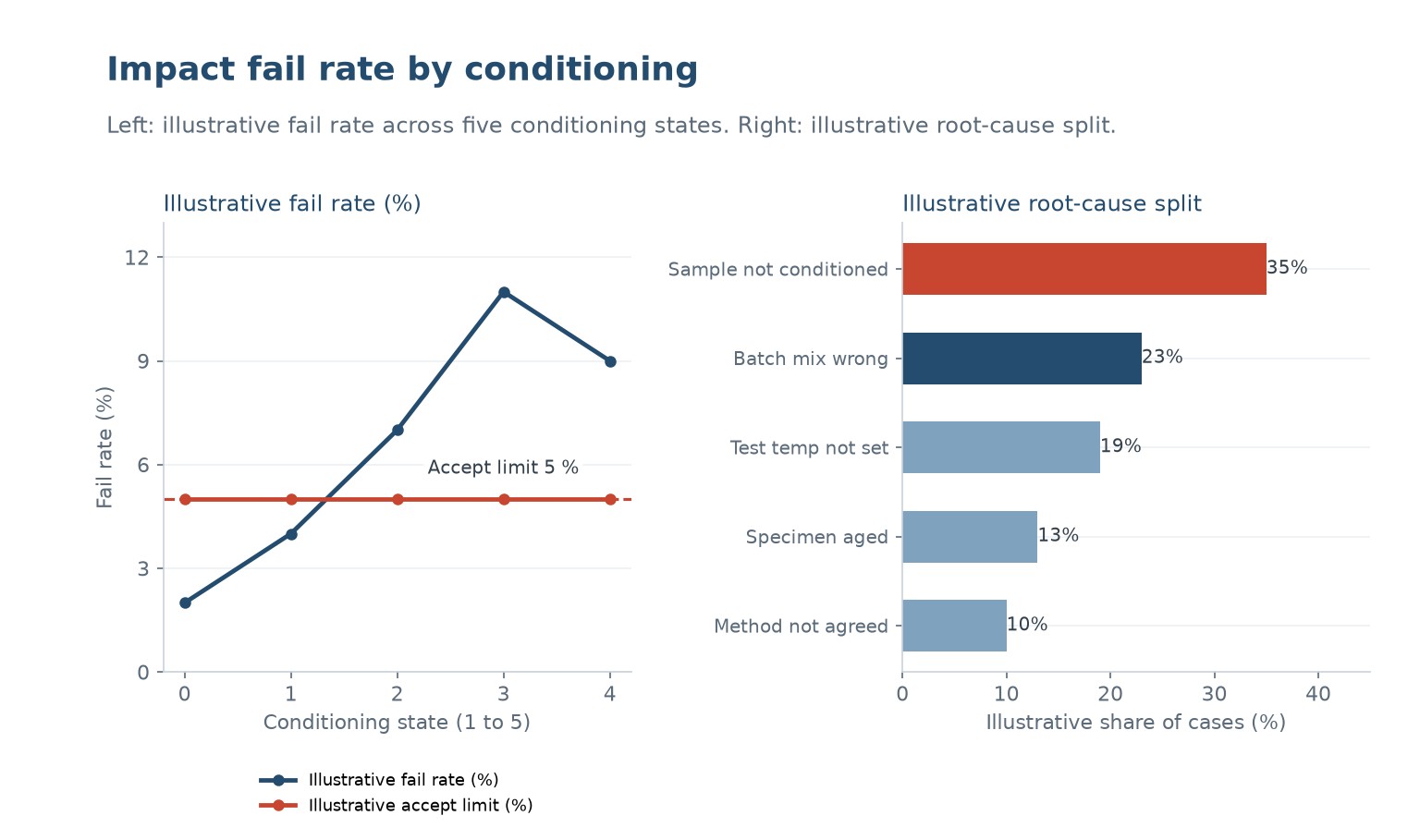
In one illustrative case a low-temperature impact test is run on unconditioned specimens drawn from a mixed batch, so the pass result hides a 11 % fail rate that shows up only after a cold-climate field failure.
| Sampling trigger | What it hides | First figure to check |
|---|---|---|
| Specimen unconditioned | Result not real | Fail vs 5 % limit |
| Mixed batch drawn | Lot misrepresented | Illustrative 12 h probe |
| Cold failure | Stop-ship raised | Test temperature |
| Pass misleading | Ships to field | Conditioning stated |
Table 1 - Reading a low-temperature sampling gap before correcting the test
Need a fixed price for this profile?
Send the cross-section drawing, material, cut length and annual volume. We will review die, calibration and tolerance, then return a written tooling and production quotation.
Quantify the fail rate by conditioning state
Quantify the exposure before correcting it. Five conditioning states return illustrative fail rates of 2, 4, 7, 11 and 9 %; the unconditioned mixed batch crosses the 5 % accept limit. These are illustrative worked values from stated assumptions, not a measured series or a quoted result.
A five-step diagnostic sequence
- Draw one batch.
Take the impact specimens from a single, identified production batch. - Condition the sample.
Run the stated conditioning before the low-temperature test. - Set the temperature.
Apply the stated test temperature so the result is comparable. - Test and record.
Run the impact test and record the fail rate against the 5 % limit. - File the rule.
Record the sampling and conditioning so the next test matches.
The chart below is a typical result from that measurement step. Use it to separate a design limit from a setting that can still be recovered.
Set the sampling and conditioning rule
Set the rule at a conditioned sample from a single batch with a stated test temperature. With the sample conditioned, the fail rate settles at 5 % at the limit; an illustrative 12 h of investigation is the cost of the missampling. These are illustrative worked values from stated assumptions, not a market survey, a quoted price or a measured series.
| Clause or parameter | Agreed value | What goes wrong outside it |
|---|---|---|
| Sampling | Single batch | Lot misrepresented |
| Conditioning | Stated per test | Misleading pass |
| Test temperature | Stated per spec | Result not comparable |
| Spec owner | Named per programme | Rule applied loosely |
Table 2 - Impact clauses for the test specification
A controlled test-sequence change
Run the change in a fixed order: draw one batch, condition, set the temperature, then test. The table ranks the actions by field-failure risk so the sample is never misdrawn.
| Control action | What it fixes | Cost or trade-off |
|---|---|---|
| Condition specimen | Real result | Conditioning step |
| Single batch | Lot represented | Sample to draw |
| State temperature | Comparable test | Temp to set |
| Review on change | No drift after change | One owner to maintain |
Table 3 - Impact controls ranked by field-failure risk
Write the test rule into the specification
Put the rule in the test specification: single-batch sampling, stated conditioning, and a stated test temperature. A written rule turns a misleading pass into a representative result.
Need the section checked before tooling?
Send us the section and the installation conditions. We will review wall balance, tolerance and fixing detail, then return a marked-up drawing with a tooling quotation.
What to send us
- Cross-section drawing with wall thicknesses
- Material and colour
- Installation temperature range
- Fixing method and run length
Keep the rule current between changes
Re-review the rule at each change, record the 12 h actually avoided, and re-forecast the test needs. A written specification reviewed on dated evidence settles the impact question at test rather than in the field.
Before you release this extruded profile
- The impact specimens are drawn from a single identified batch
- The sample is conditioned before the low-temperature test
- The test temperature is stated in the specification
- The fail rate is compared to the 5 % accept limit
- A named owner reviews the rule at each change
Write the measurement temperature and the tolerance into the drawing; most disputes are really about how the part was measured.
Why condition the specimen?
An unconditioned specimen does not represent cold-climate use, so a pass can hide a real fail rate that appears only in the field.
How much does the missampling cost?
Using illustrative assumptions the field failure and stop-ship cost 12 h of investigation. These are worked example values, not a measured series.
What limit applies?
A stated 5 % impact fail limit. In this illustrative case the unconditioned batch reads 11 %, over the line.
Can I mix batches?
No, a mixed batch hides which lot is at risk. Single-batch sampling keeps the result representative.
Who owns the rule?
A named programme owner reviews it at changes. Without one owner the sampling drifts.
Does the rule expire?
It is valid until the change. Re-reviewing at each change keeps the test evidence current.
Get a profile that holds its dimension
Send us the profile section, the length and the service conditions. We will review die, calibration and tolerance, then quote tooling and production with a defined measurement method.
To get an accurate quote, send:
- Profile cross-section drawing
- Material and colour
- Cut length and annual volume
- Service temperature and exposure
Why buyers work with Uplastech
ISO 9001, ISO 14001 and ISO 45001 certified. Founded in 2016, with injection moulding lines in Shanghai and an extrusion plant in Jiangsu. Moulding machines from 90T to 1100T and a maximum shot weight of 5100 g. Samples and a written quotation are available on request.
Continue reading
- Extrusion dimensional drift
- Extrusion profile tolerance
- Profile calibration and cooling
- PVC profile weathering and colour
- PVC window profile design
Ready to specify? See our plastic profile extrusion services или request a written quotation.



 RU
 EN
 ES
 FR
 DE
 PT
 AR
 JA
 KO
 IT
 NL
 TR
 PL
 ID
