

The problem
Symptom. A buyer shipping 48,000 nested trays per 40 ft container is told a 3 mm deeper nest could cut the per-unit freight bill, but nobody has costed the denesting risk.
What it costs. A shallow nest wastes container cube, so the buyer pays air-freight-like cost on empty space and locks a carton height that no filling line needs.
This article sets out how nest pitch sets stack height and container utilisation, and how to price the freight gain against a safe denesting limit.
Why a nest pitch is a freight number
At a 15 mm nest pitch, 60 trays stack 900 mm high, but a 12 mm pitch drops the same 60 trays to 720 mm and lets one more layer fit the carton.
| What the shipment shows | Cause behind it | First figure to check |
|---|---|---|
| 48,000 trays per container | 68 % cube utilisation | Nest pitch and stack height |
| Carton height fixed | Pallet pattern not re-cut | Layers per pallet |
| £0.18 per tray freight | Air shipped as cube | Container cost divided by count |
| Stacks lock on the filler | Nest deeper than draft | Denest-lift limit |
Table 1 - Reading a freight-cube gap before changing the nest
Converting stack height into container cube
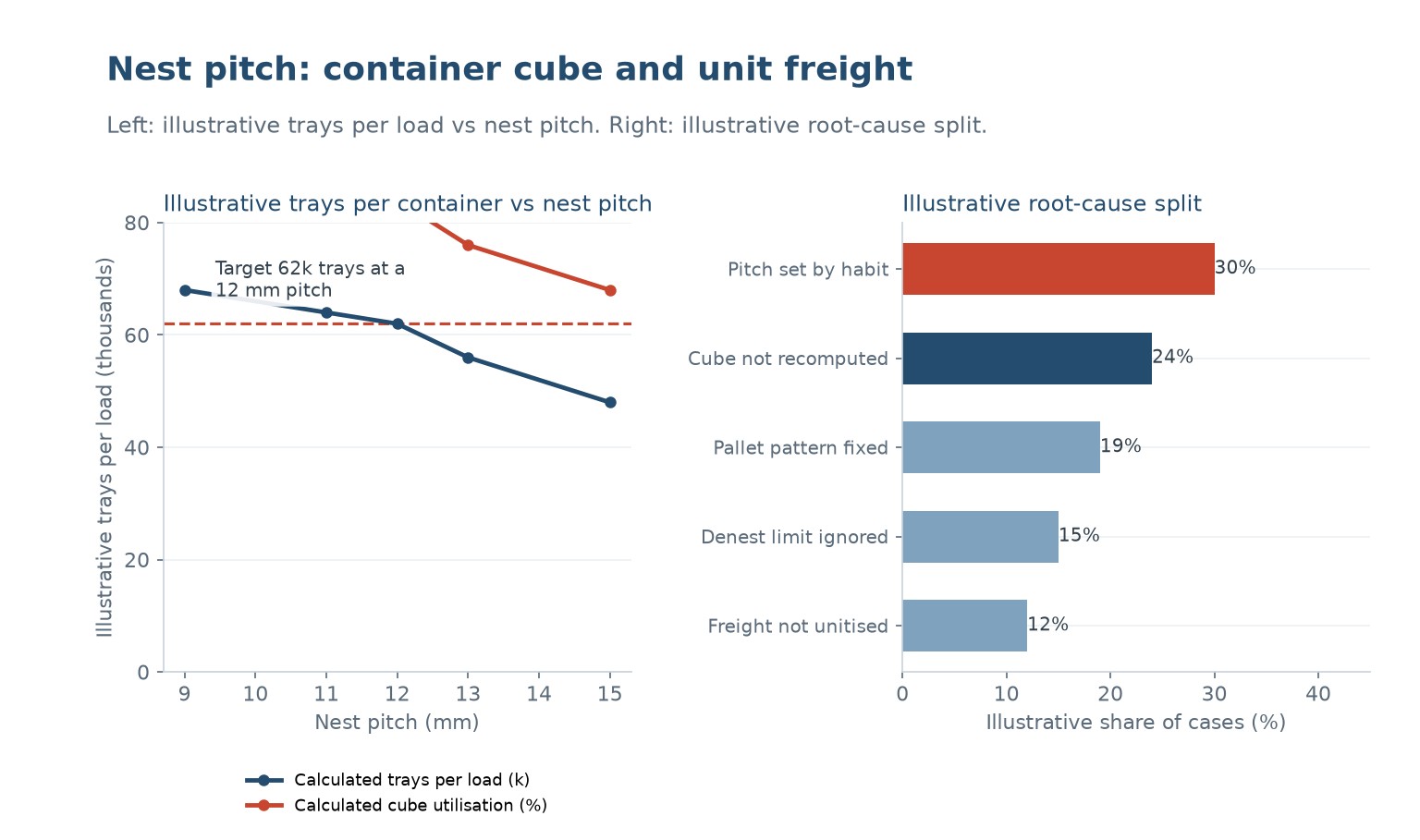
A 40 ft high-cube container holds about 76 m³; at 68 % utilisation it carries 48,000 trays, while a deeper nest lifts that to 84 % and about 62,000 trays.
A five-step diagnostic sequence
- Measure the pitch.
Confirm the current 15 mm pitch and the 900 mm height of 60 stacked trays. - Recompute the cube.
At 12 mm the same 60 trays reach 720 mm, so an extra carton layer fits 76 m³. - Price the unit.
Divide an assumed £8,640 by 48,000 and by 62,000 to get £0.18 and £0.14 a tray. - Test the denest.
Keep a 0.5 mm denest lift and re-run the first-article before deepening. - Amend the spec.
Re-cut the pallet pattern and bind pitch, height and cube into the carton drawing.
The chart below is a typical result from that measurement step. Use it to separate a design limit from a setting that can still be recovered.
Pricing the per-unit freight difference
At an assumed £8,640 per container, per-unit freight falls from £0.18 to about £0.14. The figures are illustrative worked values from the stated assumptions, not a market survey, a quoted rate or a measured freight series.
| Параметр | Assumed value | What goes wrong outside it |
|---|---|---|
| Nest pitch | 12 mm, from 15 mm | Air shipped as empty cube |
| Stack height | 720 mm for 60 trays | Carton layer wasted |
| Container cube | 76 m³, 84 % target | Under 50,000 trays a load |
| Denest lift | 0.5 mm minimum, FAI | Stacks lock on the filler |
Table 2 - Nest and freight parameters for the carton specification
Finding the denesting limit before deepening
Cap the deepening at the point where a 0.5 mm denest lift still separates trays, because a pitch below the drawn draft or wall taper makes stacks lock on the filler.
| Действие | What it fixes | Cost or trade-off |
|---|---|---|
| Deepen nest from 15 to 12 mm | Fits an extra carton layer | Medium: a nest trial and FAI |
| Re-cut the pallet pattern | Lifts cube to 84 % | Low: a carton spec change |
| Hold the 15 mm pitch | Protects denesting | High: 68 % cube utilisation |
| Ship a part-load by air | Covers a shortfall | High: premium freight |
Table 3 - Nesting options ranked by cube and risk
Phasing a nest change through the carton spec
Transition by trialling the 12 mm pitch for one carton layer, re-running the denest FAI, and only then amending the carton height and the pallet pattern.
Want the tray checked against your line?
Send us the tray drawing and the line conditions. We will flag the geometry and material choices that cause jams, and quote a tool with an acceptance test.
What to send us
- Tray drawing with draft and radii
- Sheet grade and gauge
- Stack depth and line speed
- Drawings of the magazine or denester
Clauses for cube and freight in the supply agreement
Bind the nest pitch, the stack height, the 76 m³ cube, the £0.14 target and the denest-lift limit into the carton specification, and gate any pitch change on a fresh FAI.
Before you sign off this thermoformed tool
- Nest pitch, stack height and layers per pallet are measured, not assumed
- Container cube and the 68 % to 84 % utilisation range are written down
- Per-unit freight is recomputed from an assumed £8,640 container cost
- A 0.5 mm denest-lift limit and a fresh first-article gate any deeper nest
- Carton height and pallet pattern are amended only after the FAI passes
A tray that looks right in the carton can still stop a filling line. Test the stack, not a single part.
Why does 3 mm matter?
A 15 to 12 mm pitch drops 60 trays from 900 to 720 mm, which frees a whole carton layer in a 76 m³ container.
How many more trays fit?
Here an assumed 48,000 rises to about 62,000 as utilisation moves from 68 % to 84 %.
What happens to unit freight?
At an assumed £8,640 a container, the worked figure falls from £0.18 to about £0.14 a tray.
Is deeper always better?
No. Below the drawn draft or wall taper stacks lock, so the agreement keeps a 0.5 mm denest-lift limit.
What has to change on paper?
The carton height, the pallet pattern and the nest pitch in the drawing, each released by a fresh first-article.
Is £8,640 a quoted rate?
No. It is an assumed container cost for one example shipment, used to show the division, not a carrier quotation.
Get a tray that runs on your filling line
Send us the tray drawing or a sample stack. We will review draft, trim and material, then quote a production tool with a measurable line-acceptance test written into it.
To get an accurate quote, send:
- Tray drawing or sample stack
- Sheet material and gauge
- Line speed and denesting method
- Annual volume and target unit price







 RU
 EN
 ES
 FR
 DE
 PT
 AR
 JA
 KO
 IT
 NL
 TR
 PL
 ID
