

What die swell is
Polymer melts are viscoelastic. When the melt is forced through a die it is stretched and sheared along the flow direction, and the polymer chains align with the flow. On leaving the die the constraint disappears, the chains recoil towards their coiled state, and the extrudate expands in every direction that is free to expand.
The result is an extrudate larger than the die orifice. The ratio of the two is the swelling ratio, usually quoted as the diameter of the extrudate divided by the die diameter for a circular die, and as a linear ratio on a given dimension for a profile.
The swell is not instantaneous. Most of it happens within a few millimetres of the die exit, and the rest develops over the next few centimetres as the melt relaxes. That is why the measurement position matters, and why a profile measured at the die face reads differently from the same profile measured at the first cooling tank.
For a circular die the swell is roughly uniform and the extrudate stays round. For a profile it is not: thin sections swell more than thick ones because they experienced higher shear, and corners swell less than the walls between them because the flow there was slower. The die has to be cut to compensate, which is why profile dies are a trial and error process.
The memory of the melt
The physical quantity behind swell is the residence time in the die compared with the relaxation time of the polymer. If the melt spends much longer in the die than its relaxation time, the chains have time to relax before they exit and the swell is small. If it spends less, the chains arrive at the exit still stretched and the swell is large.
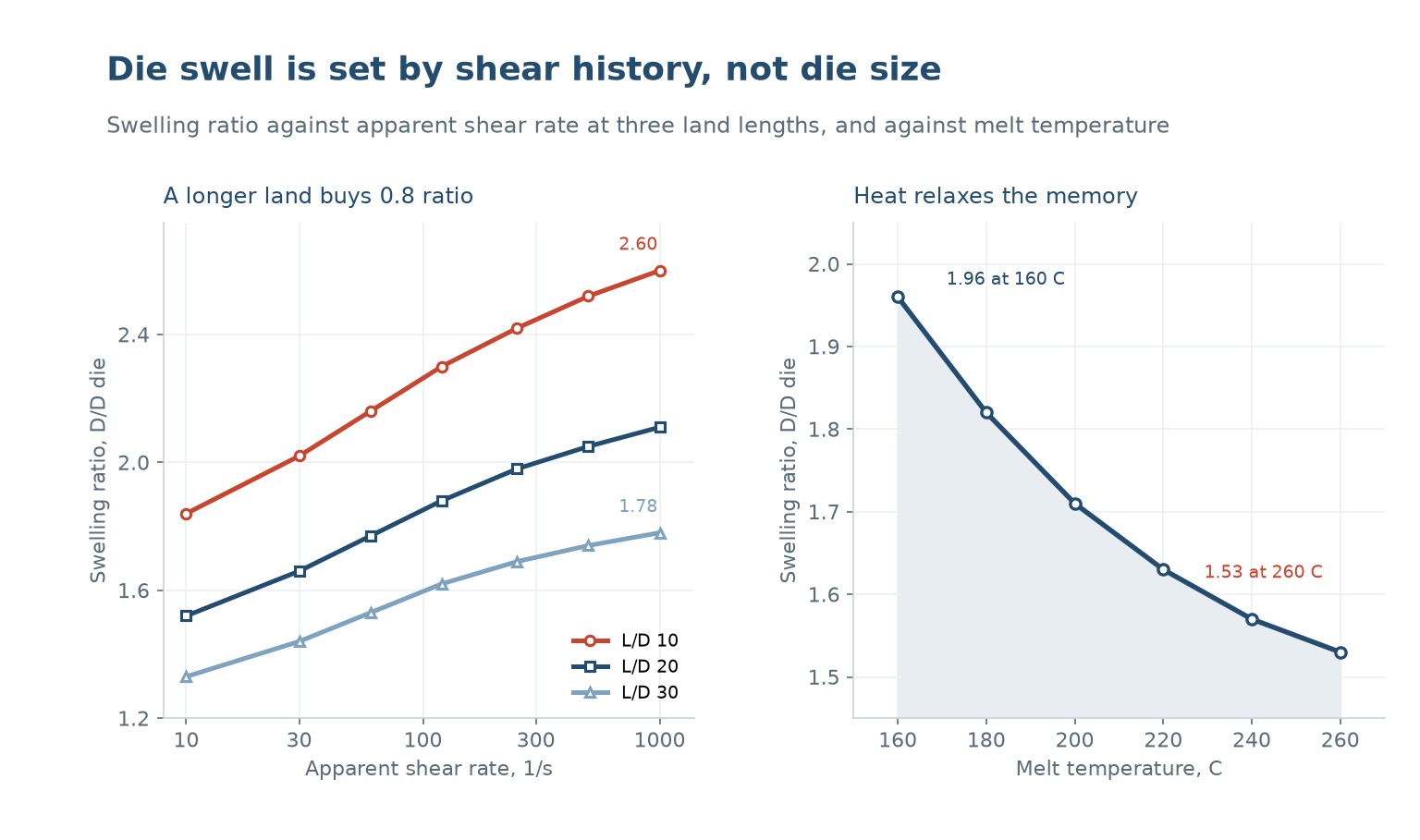
This is why land length dominates. A long land gives the melt time to relax, and the chart on the left shows the effect: at a shear rate of 1,000 per second, an L/D of 10 gives a swelling ratio of 2.60 while an L/D of 30 gives 1.78. The same polymer, the same temperature, the same flow rate, and a difference of 0.8 in the ratio.
The other side of the same coin is shear rate. Higher output means higher shear, shorter residence time and more swell, which is why a line that runs well at 60 percent of its rated output can go out of tolerance at 90 percent. The operator sees a profile that grows as the line speeds up and blames the haul-off.
Temperature works in the opposite direction. A hotter melt has a shorter relaxation time, so it recovers before it exits. Raising the melt from 160 to 260 C takes the swelling ratio from 1.96 to 1.53 in the right hand chart, which is a 22 percent reduction in the size of the extrudate.
Land length and the relaxation it buys
Land length is the parallel section at the end of the die, and its job is to straighten the flow and let the melt relax. A land that is too short produces a swollen, rough extrudate with poor dimensional control. A land that is too long produces a smooth extrudate but also a very high pressure drop, which limits output and can overheat the melt.
The usual starting point for a new profile is an L/D of 10 to 15 for the land, adjusted after the first trial. PVC needs a shorter land than polyolefins because it is shear sensitive and degrades in long residence times. Polyamide and polycarbonate need longer lands because their relaxation times are long.
Land length also interacts with the die swell correction. If a die is cut undersize to compensate for swell and the land is then lengthened to improve surface finish, the swell drops and the profile comes out undersize. The two changes have to be made together, which is why a die trial is not a one variable experiment.
On a profile with varying wall thickness, a single land length cannot be optimal everywhere. Thick sections need longer lands, thin sections need shorter ones. Die makers handle this by machining different land lengths around the profile, which is skilled work and is why a good profile die costs what it does.
Temperature and shear rate together
Temperature and shear rate are not independent levers. Raising the temperature lowers the viscosity, which for a fixed output lowers the pressure and raises the shear rate at the wall, because the velocity profile becomes flatter. The two effects partly cancel, which is why temperature has a smaller effect on swell than land length does.
The practical consequence is that temperature is a weak control and a risky one. Using it to fix a swell problem means running the melt hotter than the material wants, which risks degradation, increases cooling load and changes the shrink behaviour downstream. Land length is the right lever; temperature is the one you use when the die is already cut.
Output rate is the lever that gets ignored. A line running at 90 percent of capacity has a different swell from the same line at 60 percent, and the difference can be 10 percent of the profile dimension. Lines that run a range of outputs need either a die that is tolerant of the range or a way to adjust the sizing.
Swell is not uniform
On a rectangular profile, the corners swell less than the flats and the thin walls swell more than the thick ones. The result is a profile that is not a scaled up version of the die: it is a distorted one. A die that is a scaled down copy of the part will not produce the part.
The mechanism is shear history. A thin wall has a high shear rate for the same flow, so its chains are more oriented and it swells more. A corner has a low shear rate because the velocity there is near zero, so it swells less and often rounds off. A thick section has a low shear rate and a long cooling time, so it sags under its own weight before it sets.
This is why profile dies are cut by hand and adjusted on the bench. The die maker starts from a calculated shape, runs a trial, measures the extrudate, and files or shims the land until the profile matches. A complex profile can take several trials, and each trial costs a day of machine time.
The compensation is not symmetric either. A die for a profile with a visible face and a hidden face is often cut to favour the visible face, because the hidden face can be tolerated larger. That is a design decision that should be written down, because a die maker who does not know which face matters will optimise the wrong one.
Sizing and draw-down
After the die, the profile is pulled through a sizing sleeve or a calibrator that sets the final dimensions. The sizing has to take up the swell and then some, because the profile is also being drawn down by the haul-off, and the two effects work in opposite directions.
Draw-down is the ratio of the die opening to the final profile size, achieved by pulling faster than the melt exits. It is used deliberately: a die can be cut larger than the part and the profile drawn down to size, which gives a smoother surface and better dimensional control than running the die at final size.
The combination is what matters. A die cut at final size plus 20 percent swell, drawn down by 15 percent, ends up about 2 percent oversize, and the sizing sleeve has to absorb that. A sizing sleeve that is too tight causes high pull force, which causes slip and dimensional variation; one that is too loose lets the profile wander.
Vacuum sizing adds another variable because the vacuum pulls the profile against the sleeve and removes the remaining swell. The vacuum level has to be high enough to shape the profile and low enough not to collapse thin walls, and on a profile with varying wall thickness there is no single right value.
| Переменная | Effect on swell | Practical range | Note |
|---|---|---|---|
| Land length | Strong, inverse | L/D 10 to 20 | The main design lever |
| Температура расплава | Moderate, inverse | Within the material band | Weak control, risk of degradation |
| Shear rate and output | Strong, direct | 60 to 90 % of rated output | Swell grows as the line speeds up |
| Die angle | Moderate, direct | 30 to 60 degrees included | Sharper entry means more swell |
| Material molecular weight | Strong, direct | Fixed by the grade | Higher MW swells more |
| Filler content | Moderate, inverse | Fixed by the grade | Filler reduces swell |
Table 1 — What moves the swelling ratio and by how much
Setting a line for a new profile
The first run of a new die is an experiment, and it should be run as one. Fix the temperature, fix the output, and measure the extrudate at the die exit and again after the first cooling tank. The two measurements give the swell and the draw-down separately, which is what the die maker needs to make the correction.
Measure at a defined distance from the die face, and write that distance down. Swell develops over the first few centimetres, so a measurement taken at 10 mm from the die and one taken at 100 mm will disagree, and the disagreement is not a fault.
Run the trial at the output the line will actually use, not at a convenient low rate. Swell depends on shear rate, and a die corrected at half output will be wrong at full output. If the line has to run a range, run the trial at the top of the range and accept that the low end will be slightly undersize.
| Шаг | Measurement | Почему |
|---|---|---|
| 1 | Extrudate dimension at 10 mm from the die | Gives the die swell before any cooling |
| 2 | Extrudate dimension after the first tank | Gives the size entering the sizing sleeve |
| 3 | Finished dimension after haul-off | Gives the draw-down ratio |
| 4 | Wall thickness at three points | Shows whether the swell is uniform |
| 5 | Surface roughness | Confirms the land is long enough |
| 6 | Output and screw speed | Swell is only meaningful at a known shear rate |
Table 2 — A die trial that produces usable numbers
Record all six numbers against the die number and the material grade. After a few dies the shop has its own swell data for each polymer, and the next die can be cut closer to size on the first attempt. That record is worth more than any handbook value, because it reflects the actual machine, the actual cooling and the actual material.
Why is my profile bigger than the die?
Die swell. The melt is stretched and sheared on its way through the die, and the polymer chains recoil when the constraint is removed at the exit. The extrudate expands, typically by 20 to 160 percent in diameter depending on the polymer, the land length and the shear rate.
How do I reduce die swell?
Lengthen the land, lower the output or raise the temperature. Land length is the effective lever and the one to design in. Temperature works but risks degradation, and lowering output costs production. Filler content also reduces swell, which is why filled grades swell less than unfilled ones.
Is die swell the same all round a profile?
No. Thin walls swell more than thick ones because they see higher shear, and corners swell less because the velocity there is near zero. A profile die is not a scaled copy of the part, it is a compensated shape that requires trial and adjustment.
Does die swell change during a run?
Yes, if anything that affects shear history changes. A gradual output increase, a drifting temperature or a partially blocked screen all change the swell. A profile that grows over a shift is usually showing a screen building up pressure, not a die problem.
Can I compensate for swell by cutting the die undersize?
Yes, that is standard practice, but the compensation has to be calculated from a measured swell at the production output rate. A die cut undersize using a handbook value and then run at a different rate will be wrong, and the error may be larger than the swell itself.
Why does the profile get rough when I speed up?
That is melt fracture, not swell, although the two appear at the same time because both are driven by shear rate. Roughness at high output means the shear stress has passed the critical value for the polymer. Reduce the output, raise the temperature, or accept a larger die and more draw-down.
New profile die not coming out to size?
Send the profile drawing, the material grade and the output rate. We will tell you what swell to expect and how much draw-down the sizing should take.




 RU
 EN
 ES
 FR
 DE
 PT
 AR
 JA
 KO
 IT
 NL
 TR
 PL
 ID
