
The problem
Symptom. ESD-sensitive trays pass surface resistivity at goods-in but fail the same test 90 days later, because a topical antistat coating has migrated or been wiped away during storage.
What it costs. A line-side ESD audit then rejects a full pallet of 20 000 trays that cannot be reworked, and the buyer disputes who owns a coating that met specification on delivery.
This guide shows how to measure resistivity decay, distinguish a topical coating from an internal additive, and write a 90-day ESD clause into the purchase order.
- 1. The failure is a coating-durability dispute, not an ESD-programme fault
- 2. Measure surface resistivity at receipt and after conditioning
- 3. Coating type, target resistivity and storage conditions to specify
- 4. Why resistivity climbs after a humidity or packaging change
- 5. A 90-day ESD clause for the purchase order
- 6. Costing an internal antistat against a disputed pallet
The failure is a coating-durability dispute, not an ESD-programme fault
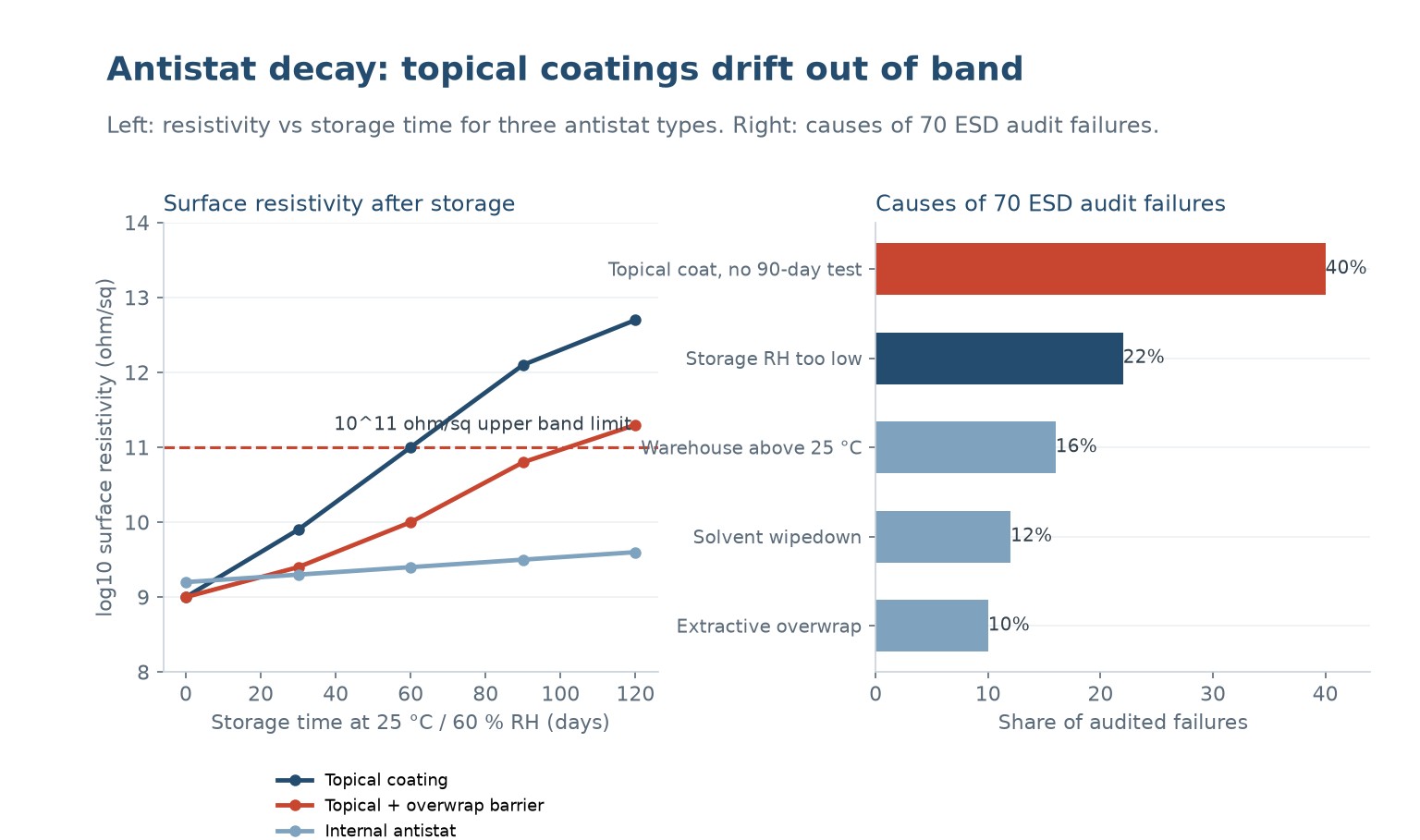
A topical antistat is a thin, hygroscopic layer that can be rubbed off or absorbed into the sheet. A PET tray reading 10^9 ohm/sq at goods-in can climb past 10^12 ohm/sq after 90 days.
| What the audit finds | What is physically happening | First measurement |
|---|---|---|
| Pass at receipt, fail at 90 days | Topical coating migrated or was rubbed away | Resistivity at receipt and after 90 days at 25 °C |
| Fail only in dry winter months | Hygroscopic coat starved of moisture at 20 % RH | Resistivity at 20 % and 50 % RH |
| Some trays pass, some fail | Uneven coating or a wipedown on one layer | Five-point probe map across the tray surface |
| Both topical and internal lots drift | Storage at 30 °C exceeds the qualified window | Logged warehouse temperature and RH |
Table 1 - Classifying an ESD failure before changing suppliers
Measure surface resistivity at receipt and after conditioning
Measure with a concentric-ring probe per IEC 61340-2-3 at 23 °C and 50 % RH, five points per tray. One audit logged 8 x 10^8 at receipt and 3 x 10^12 after 90 days at 30 °C.
A five-step diagnostic sequence
- Condition the sample.
Hold trays at 23 °C and 50 % RH for 24 h before any measurement. - Map five points.
Use a concentric-ring probe per IEC 61340-2-3 at five sites per tray. - Record at receipt.
Log resistivity on 20 trays from three lots within 48 h of delivery. - Store and re-test.
Repeat at 30, 60 and 90 days at the declared storage conditions. - Stress one variable.
Re-test a subset at 20 % RH to expose a moisture-dependent coating.
The chart below is a typical result from that measurement step. Use it to separate a design limit from a setting that can still be recovered.
Coating type, target resistivity and storage conditions to specify
Three parameters belong in the specification: a 10^9-10^11 ohm/sq band after conditioning, an internally dosed antistat, and storage at 25 °C and 60 % RH for 90 days. A topical coat cannot hold it.
| Параметр | Typical target | What goes wrong outside it |
|---|---|---|
| Surface resistivity after 90 days | 10^9 - 10^11 ohm/sq | Higher values fail an ESD-protective packaging audit |
| Antistat type | Internally dosed, not topical | Topical coats migrate or wipe off in storage |
| Storage conditions | 25 °C, 60 % RH, 90 days | Heat and low humidity accelerate resistivity drift |
| Test method | IEC 61340-2-3, five points | Single-point readings hide an uneven coating |
Table 2 - ESD parameters to write on the tray specification
Why resistivity climbs after a humidity or packaging change
Resistivity climbs faster when storage shifts. A warehouse at 20 % RH starves a hygroscopic coat, a PE overwrap extracts the additive, and an isopropyl wipedown strips it outright.
| Process variable | Effect on the coating | Practical control |
|---|---|---|
| Storage RH at 20 % | Hygroscopic coat loses its conductive layer | Hold warehouse at 50 % RH or use an internal grade |
| Warehouse at 30 °C | Additive migrates faster into the sheet | Cap storage at 25 °C and log temperature |
| PE overwrap in contact | Film extracts the antistat from the surface | Specify a non-extractive wrap or a barrier layer |
| Isopropyl wipedown | Solvent strips a topical coat instantly | Ban solvent cleaning in the handling instruction |
Table 3 - Variables that raise resistivity after sign-off
A 90-day ESD clause for the purchase order
A goods-in reading alone cannot settle the dispute. Add a clause: resistivity within 10^9-10^11 ohm/sq after 90 days at 25 °C and 60 % RH, measured on 20 trays from three lots.
Want the tray checked against your line?
Send us the tray drawing and the line conditions. We will flag the geometry and material choices that cause jams, and quote a tool with an acceptance test.
What to send us
- Tray drawing with draft and radii
- Sheet grade and gauge
- Stack depth and line speed
- Drawings of the magazine or denester
Costing an internal antistat against a disputed pallet
An internally dosed masterbatch adds roughly 4-7 p per tray but holds the band for the full shelf life. One quarantined 20 000-tray pallet costs more than that premium across the whole order.
Before you sign off this thermoformed tool
- A resistivity band is stated after 90 days of conditioning, not only at goods-in
- The antistat is named as internally dosed or topical on the material specification
- Storage temperature, RH and duration are defined on the purchase order
- The test method and five-point probe map are written into the acceptance clause
- Resistivity is re-tested at 30, 60 and 90 days across three production lots
A tray that looks right in the carton can still stop a filling line. Test the stack, not a single part.
Why did the trays pass at goods-in and fail later?
A topical antistat is a surface layer, and its resistivity depends on moisture and physical integrity. It can read perfectly on day one, then migrate, be wiped or dry out over 90 days. Only a time-qualified test catches that.
Is a higher initial resistivity always a bad batch?
Not necessarily. Measure at a controlled 23 °C and 50 % RH first, since a dry reading can be an order of magnitude high. If it stays high after conditioning, the coating or the dose is at fault.
Does an internal antistat cost much more?
Typically 4-7 p per tray in masterbatch. Set against one quarantined 20 000-tray pallet and a disputed order, it is usually the cheaper specification, and it removes the durability argument entirely.
Can we just re-apply an antistat coating?
A re-applied topical coat resets the clock but is uneven, easily wiped and hard to qualify. For ESD-protective packaging, an internally dosed grade with a 90-day clause is more defensible in an audit.
What role does humidity play?
Topical antistats are hygroscopic, so at 20 % RH they lose the moisture layer that conducts charge and resistivity can jump by two or three decades. Control RH or specify a humidity-independent internal grade.
What should the ESD clause say?
Resistivity within 10^9-10^11 ohm/sq after 90 days at 25 °C and 60 % RH, measured by IEC 61340-2-3 at five points on 20 trays from three lots, with 30 and 60 day interim records.
Get a tray that runs on your filling line
Send us the tray drawing or a sample stack. We will review draft, trim and material, then quote a production tool with a measurable line-acceptance test written into it.
To get an accurate quote, send:
- Tray drawing or sample stack
- Sheet material and gauge
- Line speed and denesting method
- Annual volume and target unit price







 RU
 EN
 ES
 FR
 DE
 PT
 AR
 JA
 KO
 IT
 NL
 TR
 PL
 ID