
Three dimensions, one weak link
A silicone tube is specified on inside diameter, outside diameter and wall thickness, and the three are not independent. If the mandrel or the die centres drift, the wall becomes eccentric and both diameters still measure within tolerance at the point where they are checked.
That is the trap. A tube with a 0.5 mm nominal wall and 15 percent eccentricity has a thin side of 0.425 mm and a thick side of 0.575 mm. Measured at four points and averaged, it passes. Measured at the thin side, it fails a burst or a peristaltic life test.
So the specification has to include concentricity or minimum wall, not just average wall. That single change removes most of the arguments about whether a delivery is in specification.
The second trap is that silicone is soft. Any measurement that compresses the tube gives a different answer from one that does not, which is why two parties measuring the same tube can disagree by 0.1 mm without either being wrong.
Where the variation comes from
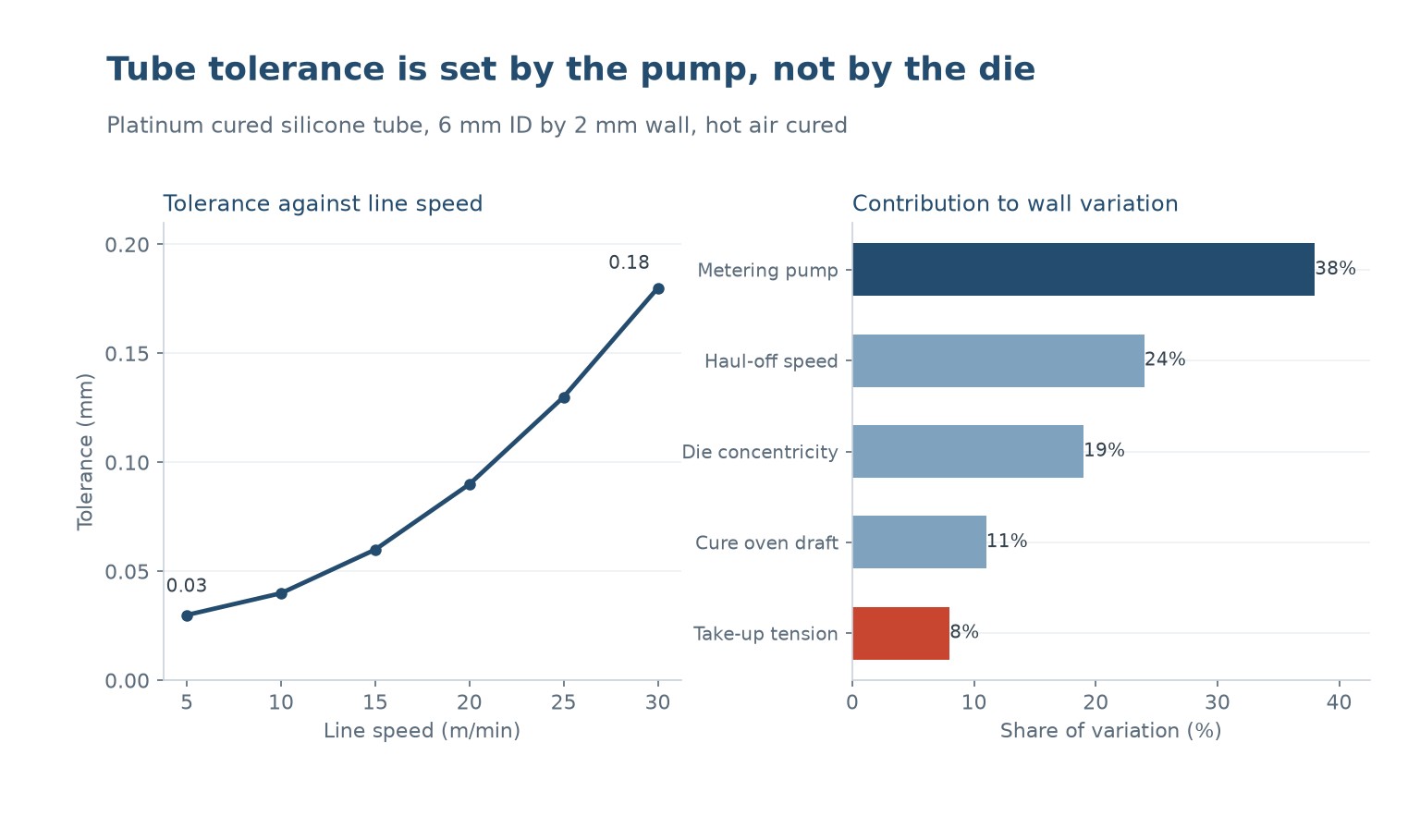
The chart on the left is wall tolerance against line speed for a platinum cured silicone tube, 6 mm inside diameter by 2 mm wall, hot air cured. At 5 metres per minute the achievable tolerance is plus or minus 0.03 mm, at 15 it is 0.06, at 25 it is 0.13 and at 30 it is 0.18.
The relationship is close to linear above 10 metres per minute and it is the single most important trade in silicone tube extrusion. Speed is what makes the line profitable and speed is what destroys the tolerance.
The right hand panel breaks down the contribution to wall variation. The metering pump is 38 percent, haul-off speed 24, die concentricity 19, cure oven draft 11 and take-up tension 8.
That ranking is the useful part. Two thirds of the variation is in the pump and the haul-off, which are both speed related, and less than a fifth is in the die, which is what most people adjust first.
The pump is the first suspect
A silicone extruder is fed by a metering pump, usually a gear pump or a progressive cavity pump, and the tube wall is directly proportional to its delivery per revolution. Any pulsation in that delivery becomes a wall variation along the length.
Gear pumps produce a small pulse at the mesh frequency. At low speed the pulse is slow and the tube has a visible ripple; at high speed it is fast and averages out. That is one reason tolerance improves at moderate speed before it degrades again at high speed.
Progressive cavity pumps deliver more smoothly but wear, and a worn stator produces a slow drift in output that looks like a temperature problem. Checking the pump output by weighing a timed sample is the only reliable test.
The pump also has to be matched to the die. A pump that is running at 15 percent of its capacity is running slowly and pulsing visibly; one at 85 percent is smooth but has no headroom for a speed increase.
| Fonte | Share | Symptom | Check |
|---|---|---|---|
| Metering pump | 38% | Ripple along the length | Weigh a timed sample |
| Haul-off speed | 24% | Drift over a run | Tachometer against setpoint |
| Die concentricity | 19% | Thin side in one place | Section four points |
| Cure oven draft | 11% | Sag or ovality | Airflow at the entry |
| Take-up tension | 8% | Stretch near the end | Tension against spec |
Table 1 — Sources of wall variation and how to check each.
Die and cure oven
The die sets concentricity, and a die that is off centre produces a thin side that stays in the same angular position along the whole length. That is the diagnostic: a thin side that rotates is a pump or a draft problem, a thin side that stays put is the die.
The mandrel has to be centred with a micrometer on the annular gap, not by eye and not by feel. The gap is often under a millimetre and a 0.05 mm error is a 10 percent wall variation on a 0.5 mm wall.
The cure oven is the other half. Silicone is uncured and unsupported as it leaves the die, so any air movement across it deforms it before it sets. A draft at the oven entry produces ovality and a wall that is thin on the side facing the draft.
Oven temperature also matters. Too cool and the tube sags under its own weight; too hot and the surface skins before the interior cures, which produces a tube that looks correct and splits later.
| Parâmetro | Typical setting | Effect on tolerance |
|---|---|---|
| Die gap | Per drawing, +/- 0.02 mm | Direct wall thickness |
| Mandrel centring | Within 0.03 mm | Concentricity |
| Line speed | 10 to 20 m/min | Trade against tolerance |
| Oven temperature | 200 to 250 C entry | Sag and surface skin |
| Oven airflow | Low and even | Ovality from draft |
Table 2 — Settings that decide tube tolerance.
Measuring tube properly
Use non-contact measurement or a controlled low-force gauge. A caliper squeezed onto soft silicone reads low, and the amount it reads low depends on the operator, which is why caliper readings on silicone tube are almost worthless.
Measure at four points around the circumference at three positions along a two metre length. That gives twelve readings, enough to catch eccentricity and enough to see a drift along the run.
For inside diameter, use a plug gauge or an air gauge rather than a caliper across the bore. The bore deforms under a caliper and the reading is optimistic.
And record the temperature. Silicone expands significantly with temperature, and a tube measured warm off the line is larger than the same tube measured the next morning.
Setting a tolerance you can hold
Start from the application. A peristaltic pump tube needs a tight wall and a tight bore because the flow rate depends on both; a sleeve needs almost nothing. Specify to the function, not to a habit.
Then check the tolerance against the speed curve. A specification of plus or minus 0.03 mm on a 2 mm wall implies a line speed under about 8 metres per minute, and if the volume needs 20 metres per minute the specification and the price are inconsistent.
Specify minimum wall as well as average wall. That is what protects the customer against eccentricity, and it is what allows a supplier to run at a sensible speed without shipping a marginal product.
And agree the measurement method in writing. Non-contact or low-force, four points, twelve readings, at a stated temperature. A tolerance without a method is an argument waiting to happen.
What tolerance can extruded silicone tube hold?
About plus or minus 0.03 mm on a 2 mm wall at 5 m/min, widening to 0.13 mm at 25 m/min. Tolerance and line speed trade directly against each other.
Why does silicone tube wall vary along its length?
Mostly metering pump pulsation, which accounts for 38 percent of the variation, followed by haul-off speed at 24 percent. Die concentricity is only 19 percent.
How do I tell a die problem from a pump problem?
Look at where the thin side sits. A thin side that stays in the same angular position along the length is the die; a thin side that rotates is the pump or an oven draft.
Why do caliper readings on silicone tube disagree?
Because the caliper compresses soft material. Use non-contact measurement or a controlled low-force gauge, and record the temperature.
Should I specify average wall or minimum wall?
Both. Average wall alone lets an eccentric tube pass; minimum wall is what protects the application and what allows a sensible line speed.
What causes ovality in silicone tube?
Air draft across the tube before it cures, usually at the oven entry. The tube is unsupported and uncured, so any airflow deforms it.
Tube dimensions drifting at speed?
Send the tube drawing and the line speed. We will tell you whether the limit is the pump, the die or the cure oven.




 PT
 EN
 ES
 FR
 DE
 AR
 RU
 JA
 KO
 IT
 NL
 TR
 PL
 ID
