
What regrind actually is
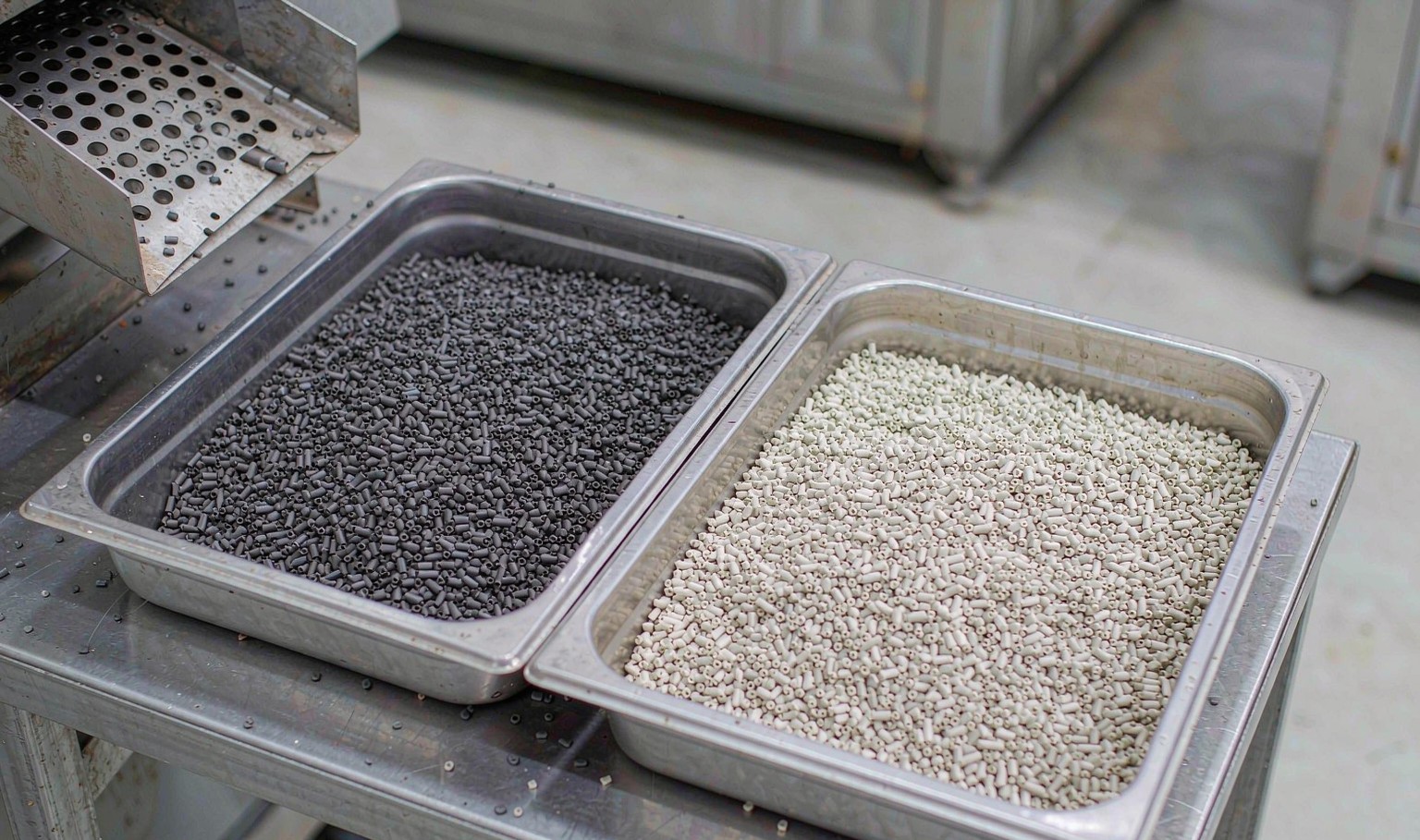
Regrind is polymer that has already been through a melt. It has been heated, sheared, cooled and cut, and every one of those steps has left a mark. The molecule is shorter than it was, the additive package is partly consumed, and the material has picked up whatever was in the machine and the granulator.
That history is the whole problem. Virgin resin arrives with a defined molecular weight and a full additive package, and the processor knows what it is working with. Regrind arrives with an unknown history, and the only thing that is certain is that it is not the same as it was.
The commercial argument for regrind is simple: it costs a fraction of virgin resin and it is already in the building. The technical argument against it is also simple: every property that depends on molecular weight falls, and some of them fall faster than others.
Most extrusion shops run some regrind because the alternative is throwing away the skeleton, the start-up scrap and the rejects. The question is not whether to use it, it is how much, of what, and with what checks. A shop that answers those three questions runs regrind safely; a shop that does not runs it until a customer complains.
Thermal history and the first property to go
The chart on the left plots property retained against regrind ratio for two properties. Tensile strength holds 99 percent at 10 percent regrind, 97 at 20, 95 at 30, 91 at 50 and 84 at 100. Notched impact holds 94, 86, 78, 64 and 42 over the same range.

The gap between the curves is the point. At 30 percent regrind the tensile strength has lost five percent, which is inside most specifications and invisible in a datasheet. The impact strength has lost 22 percent, which is a different material in any application where toughness matters.
The reason is molecular weight. Tensile strength depends on the number of chain entanglements and it is fairly tolerant of a moderate reduction in chain length. Impact strength depends on the energy absorbed before a crack propagates, which depends on long chains and on the tie molecules between them, and those are the first things a second melt pass destroys.
That is why the specification has to be written on the property that fails first. A drawing that calls out tensile strength and an elongation minimum will pass a compound that has lost a third of its impact strength, and the part will break in service in exactly the way the specification was meant to prevent.
The ratio question
The safe ratio depends on the polymer and on how many times the material has been through a melt. A polyolefin tolerates two or three passes at 20 to 30 percent before the loss becomes visible. A polycarbonate tolerates one pass at 15 to 20 percent and loses impact quickly after that. A PBT or a PET loses viscosity fast and is usually limited to 10 percent.
The ratio also depends on where the regrind comes from. Skeleton and edge trim from a clean line is the best material available, because it has been through one melt and has not been contaminated. Start-up scrap is worse, because it has been hot for longer. Rejects from a customer return are the worst, because their history is unknown.
Mixing is the practical control. A 20 percent ratio is easy to hold if the regrind is fed from a dedicated hopper with a gravimetric doser; it is impossible to hold if an operator adds a scoop to the virgin hopper. The ratio that is actually achieved matters more than the ratio that is written down.
The other control is the number of passes. A closed loop that feeds regrind back into the same product without limit will accumulate thermal history until the material fails, because the regrind contains regrind. Limiting the loop, or blending with virgin at a fixed ratio, is what keeps the history bounded.
| Material | Practical regrind ratio | What limits it |
|---|---|---|
| PP and PE | 20 to 30 percent | Impact and odour after three passes |
| PS and ABS | 20 to 25 percent | Impact, colour drift |
| PVC rigid | 10 to 20 percent | Thermal degradation, colour |
| PC | 15 to 20 percent, one pass | Impact and yellowness |
| PET and PBT | 10 percent | Intrinsic viscosity, acetaldehyde |
| PA | 15 to 20 percent, dry | Moisture, molecular weight |
Table 1 — Starting points by polymer
Contamination, gels and specks
The chart on the right breaks down regrind complaints. Impact and elongation account for 30 percent, gels and black specks for 24, colour drift for 18, odour and volatiles for 13, contamination for 10, and dust and bridging for 5. Half the complaints are toughness and specks, and both are visible before the material reaches a customer.
Gels are the most diagnostic defect. A gel is a piece of cross-linked or highly entangled polymer that does not melt at the processing temperature, and it appears as a lens or a lump in the extrudate. Gels come from overheated material in a dead spot, from a different polymer in the regrind, or from cross-contamination between two products on the same line.
Black specks are the same story with carbon. A degraded layer on a screw or a die, a burnt ring in a hot runner, a dirty granulator: all of them produce specks that end up in the regrind and then in the product. The specks are a maintenance signal as much as a material signal.
Colour drift is the one that is hardest to argue about. Regrind from a coloured product cannot go into a natural one, and regrind from a light colour cannot go into a dark one without a pigment correction. Most shops separate by colour and most shops get it wrong once, which is enough to produce a batch of parts that do not match.
Setting a regrind specification
A regrind specification has four parts: the source, the ratio, the physical form and the acceptance test. The source defines what may go in, the ratio defines how much, the physical form defines the particle size and the fines content, and the acceptance test defines what has to be measured.
The source is the part that most specifications leave out. A regrind stream that accepts skeleton from one line is a known material; a stream that accepts whatever is in the scrap bin is a mixture. Writing down which products may contribute, and which may not, is the single most effective control.
The physical form matters more than it looks. Regrind with a wide particle size distribution segregates in the hopper, so the ratio at the screw is not the ratio in the blend. Fines below 0.5 mm melt too fast and cause surging; flakes above 10 mm feed unevenly. A screen change in the granulator fixes both.
The acceptance test should be the property that fails first, measured on a moulded or extruded sample made from the blend at the specified ratio. For a polyolefin that is notched impact; for a PC it is impact plus yellowness; for a PVC it is thermal stability. Testing tensile strength alone will pass material that has lost its toughness.
Running it without surprises
The first rule is to dry regrind as carefully as virgin. Regrind has more surface area per kilo and it picks up moisture faster, so a material that needed two hours of drying as virgin may need three as regrind. Skipping the drying step is the most common cause of a silver streak in a regrind blend.
The second is to keep the ratio constant rather than to use regrind as a filler. A line that runs 20 percent regrind and then jumps to 40 percent to use up a bin produces a step change in properties that shows up as a customer complaint a month later. If a bin has to be cleared, clear it slowly.
The third is to watch the pressure. A regrind blend with a lower molecular weight has a lower melt viscosity, so the die pressure falls and the output rises slightly for the same screw speed. That change is a useful early indicator that the blend has shifted, and it is visible on the screen before any part is measured.
The fourth is to record the passes. A simple log of which batch went through how many times is enough, and it is what lets you answer the question when a customer asks why the parts from March were tougher than the parts from June.
| Complaint | What it usually means | What to check |
|---|---|---|
| Parts break in service | Impact loss from too many passes | Ratio, pass count, impact test |
| Lenses and lumps in the extrudate | Gels from degraded material | Screw and die cleanliness, cross contamination |
| Black specks | Burnt material in a dead spot | Purge, inspect screw, clean granulator |
| Colour does not match | Regrind from a different colour | Segregation, pigment correction |
| Silver streaks | Moisture in the regrind | Drying time, hopper condition |
| Surging output | Fines and wide particle size | Granulator screen, blend uniformity |
Table 2 — Six complaints and where to look
How much regrind can I add to an extrusion?
Twenty to thirty percent for polyolefins, ten to twenty for PVC, PC and PA, and around ten for PET. The limit is set by how many times the material has been through a melt, not by the price of resin.
Which property falls first with regrind?
Notched impact. Tensile strength is fairly tolerant of a moderate drop in molecular weight; impact depends on long chains and tie molecules and falls much faster.
Can I run 100 percent regrind?
Only if the material has been through a single pass and the application is undemanding. At 100 percent, impact is typically 42 percent of virgin and the material is a different grade in every practical sense.
Why do I get gels in regrind blends?
Gels are cross-linked or highly entangled polymer that will not melt. They come from overheated material in a dead spot, from a different polymer in the stream, or from cross contamination between products.
Does regrind need drying?
Yes, and for longer than virgin. Regrind has more surface area per kilo, so it absorbs moisture faster and needs a longer drying cycle to reach the same level.
How many times can plastic be recycled?
Two to three passes for a polyolefin before the loss is significant, one to two for a polycarbonate. Each pass shortens the chains, and the effect accumulates rather than resetting.
Regrind that is costing you more than it saves?
Tell us the polymer, the ratio and the property that is failing. We will tell you whether it is thermal history, contamination or the blend ratio, and what to test next.




 PT
 EN
 ES
 FR
 DE
 AR
 RU
 JA
 KO
 IT
 NL
 TR
 PL
 ID
