
What makes polycarbonate different
PC is the toughest transparent thermoplastic in common use. Its notched impact strength is 600 to 900 J/m, against 20 for acrylic, and it holds that toughness from −40 to +120 °C. That combination is why it appears in machine guards, helmet visors, aircraft interiors and medical device housings.
It is also the most demanding of the common thermoforming materials. It absorbs moisture aggressively, it has a narrow forming window, it is notch-sensitive despite its toughness, and it stress-cracks in contact with many solvents and cleaning agents.
The apparent contradiction — very tough, but cracks — resolves when you understand that PC toughness comes from chain mobility at the molecular level. Anything that restricts that mobility, including frozen-in orientation or solvent penetration, removes the toughness locally and the part fails like glass.
| Grade | Characteristic | Forming note |
|---|---|---|
| General purpose | Clear, standard viscosity | Widest window |
| High flow | Lower molecular weight | Easier forming, less tough |
| UV stabilised | Coextruded or bulk | For outdoor use |
| Flame retardant | V-0 to V-2 | Narrower window, more stress |
| Abrasion resistant | Hard coat | Coat can crack if overformed |
| Static dissipative | Conductive additive | Dries differently |
Table 1 — PC sheet grades. High flow grades form more easily and are measurably less impact resistant, which matters for a guard or a visor.
Drying: 0.02 percent, and it takes hours
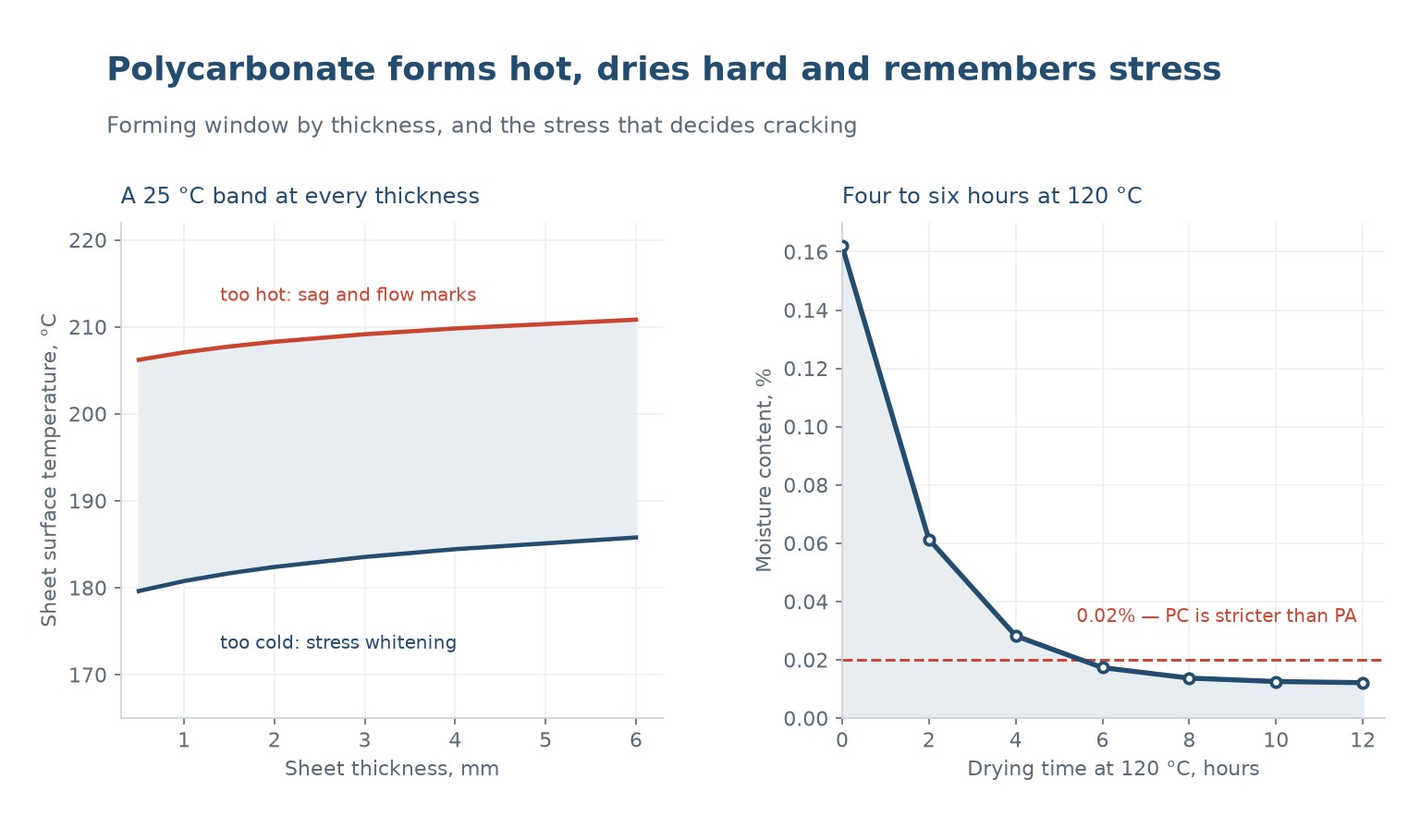
PC absorbs up to 0.35 percent moisture and must be dried to 0.02 percent — stricter than nylon in relative terms. At 120 °C in a desiccant dryer, a 2 mm sheet reaches that in about six hours; a 4 mm sheet needs eight to ten.
The failure mode is different from ABS. Instead of blisters on the surface, moisture in PC produces a fine haze through the thickness and a loss of impact strength that is not visible at all. A part formed from under-dried PC looks acceptable and fails a drop test that a properly dried part passes.
This is the most dangerous defect in the process because it is invisible. A blister is caught at inspection; a 40 percent loss of impact strength is caught by the customer.
The forming window: 180 to 210 °C
PC forms between 180 and 210 °C at the surface. Below 180 the sheet is too stiff and you get stress whitening at every radius. Above 210 the sheet sags, the surface takes on flow marks, and the material begins to degrade.
The window is narrower than PVC's in absolute terms and it is narrower still in practice, because PC has a sharp softening rather than a gradual one. A sheet at 175 °C is not slightly too cold; it is unusable. A sheet at 215 °C is not slightly too hot; it is sagging 40 mm across the span.
Heating must be two-sided and even. PC's low thermal conductivity means a single-sided oven produces a sheet with a 30 °C gradient through the thickness, and the hot face forms while the cold face resists. The result is a part with differential wall thickness that no amount of vacuum will correct.
| Espessura | Surface temperature | Tempo de aquecimento | Mould temperature |
|---|---|---|---|
| 1.0 mm | 185 – 200 °C | 25 – 40 s | 90 – 110 °C |
| 2.0 mm | 185 – 205 °C | 60 – 90 s | 90 – 110 °C |
| 3.0 mm | 190 – 210 °C | 110 – 160 s | 95 – 115 °C |
| 5.0 mm | 195 – 210 °C | 200 – 280 s | 100 – 120 °C |
| 8.0 mm | 195 – 210 °C | 340 – 460 s | 100 – 120 °C |
Table 2 — PC forming parameters. Mould temperature is high because a cold mould produces stress whitening at every radius.
Stress: the failure that arrives after delivery
PC parts fail in three ways that all trace back to stress. Stress whitening at a radius, which is visible immediately. Cracking at a trimmed edge, which appears within days. And environmental stress cracking, which appears weeks later wherever the part touches a solvent, an adhesive or a cleaning agent.
Stress whitening is the most useful of the three because it is a warning. A white, slightly opaque band at a radius means the material was stretched below its forming temperature. It cannot be polished out and it is a line of reduced toughness. The fix is a hotter sheet or a larger radius, and the fix must be made before the tool is cut.
Environmental stress cracking is the one that damages reputations. PC is attacked by ketones, esters, chlorinated solvents, many alcohols and most alkaline cleaners. A part that is perfectly formed and correctly annealed will crack in a week if it is wiped with the wrong cleaner. This is not a material defect; it is an incompatibility, and it belongs in the specification.
Annealing after forming helps. Two hours at 120 °C for a 2 mm part, longer for thicker, followed by slow cooling, relaxes the frozen orientation. It does not make the part immune to solvent attack, but it raises the threshold substantially.
Moulds: hot tools, generous radii
PC moulds run at 90 to 120 °C, which is hot enough that most tooling is aluminium with cartridge or oil heating rather than water. A cold mould chills the sheet on contact, and the contact point whitens. The mould temperature is not a refinement; it is what prevents the most common defect.
Radii must be generous. The minimum inside radius for PC is one times the sheet thickness, and two times is better. A sharp radius on a PC part is a stress concentration in a material that will find it. This is the design rule that gets argued about most often, because the part often looks fine with a 0.5 mm radius and fails six months later.
Draft is 3 to 5 degrees on textured surfaces and 1.5 to 2 on polished. PC grips a polished tool more than most materials, and a part that is dragged out of the mould is scratched on a surface that is the product.
Trimming and assembly
PC trims well with a router or a saw but poorly with a steel rule die, because the material is tough enough to resist the cut and the edge tears. The trimmed edge should be sanded or finished, because a rough edge is a crack initiator.
Assembly options are limited by solvent sensitivity. Solvent bonding works only with a PC-compatible solvent such as methylene chloride, which is hazardous and must be controlled. Ultrasonic welding works well. Adhesive bonding requires a compatible adhesive and careful surface preparation.
Mechanical fasteners need clearance holes and a compliant washer. A screw tightened against a PC flange will crack the flange at the hole, either immediately or when the assembly sees its first temperature cycle.
The defect table
| Defeito | Causa | Fix |
|---|---|---|
| Stress whitening at radii | Sheet too cold | Raise 10 °C, increase radius |
| Haze through the thickness | Moisture above 0.02% | Extend drying, check dew point |
| Cracking at trimmed edges | Residual stress | Anneal after trimming |
| Environmental cracking | Solvent contact | Change cleaner or material |
| Sag before forming | Sheet overheated | Drop 10 °C, shorten heating |
| Flow marks on the surface | Overheated sheet or cold mould | Balance temperature both ways |
| Part sticks in the mould | Insufficient draft | Add draft, polish the wall |
| Warp after demould | Uneven cooling | Check mould temperature uniformity |
Table 3 — PC thermoforming defects. Two of them are invisible at inspection, which is why drying and annealing records matter.
How long does polycarbonate sheet need to dry before forming?
Six hours at 120 °C for a 2 mm sheet, eight to ten hours for 4 mm. The target is 0.02 percent moisture. Under-dried PC loses impact strength without showing any visible defect.
What is stress whitening in polycarbonate?
A white, opaque band at a radius or a bend where the material was stretched below its forming temperature. It is a line of reduced toughness and cannot be polished out. It means the sheet was too cold or the radius too tight.
Why does my PC part crack weeks after installation?
Environmental stress cracking. PC is attacked by ketones, esters, chlorinated solvents and alkaline cleaners. Combined with residual forming stress, the part cracks at the point of contact. Check what the part is cleaned with.
What mould temperature does PC thermoforming need?
90 to 120 °C. A cold mould causes stress whitening wherever the sheet touches it, and the mark is permanent.
Can PC be annealed after forming?
Yes. Two hours at 120 °C for a 2 mm part, longer for thicker sections, then slow cooling. Annealing relaxes frozen orientation and raises the threshold for stress cracking.
Is polycarbonate better than acrylic for outdoor use?
Acrylic holds clarity better outdoors; PC yellows under UV unless it is UV stabilised or coated. PC wins on impact, acrylic wins on optical stability and scratch resistance.
Forming polycarbonate and fighting stress cracks?
Send us the part drawing, the sheet grade and where it will be used. We will tell you the radius, the mould temperature and the annealing schedule the part needs.




 PT
 EN
 ES
 FR
 DE
 AR
 RU
 JA
 KO
 IT
 NL
 TR
 PL
 ID
