
What the former receives
ABS sheet for thermoforming is either extruded flat and wound, or extruded and cut to length. It arrives with a gloss level, a colour and a texture that were set by the chill roll or the embossing roll, and the former's job is to keep all three while changing the shape.
The two grades that matter are general-purpose and high-impact. General-purpose ABS has higher stiffness and better gloss; high-impact has more butadiene and takes a deeper draw without cracking. For a part with a draw ratio above 0.6, specify high-impact.
Sheet thickness tolerance matters more in thermoforming than in most processes, because the final wall is a fraction of the original. A sheet specified at 2.0 mm ± 0.15 will produce a base wall that varies by 7 percent before the mould does anything. If the finished part has a minimum wall requirement, the sheet tolerance has to be tighter than the number you would normally accept.
| Grade | Butadiene | Draw ratio limit | Melhor para |
|---|---|---|---|
| General purpose | 10 – 14% | 0.5 | Shallow trays, covers, signage |
| High impact | 16 – 22% | 0.9 | Deep draws, luggage, machine housings |
| Heat resistant | 8 – 12% | 0.5 | Parts that see 90 °C |
| Flame retardant | 12 – 18% | 0.7 | Electrical housings |
Table 1 — ABS sheet grades and the draw ratio each will take before the base thins below 35 percent.
Drying: the step that separates a good shop from a bad one
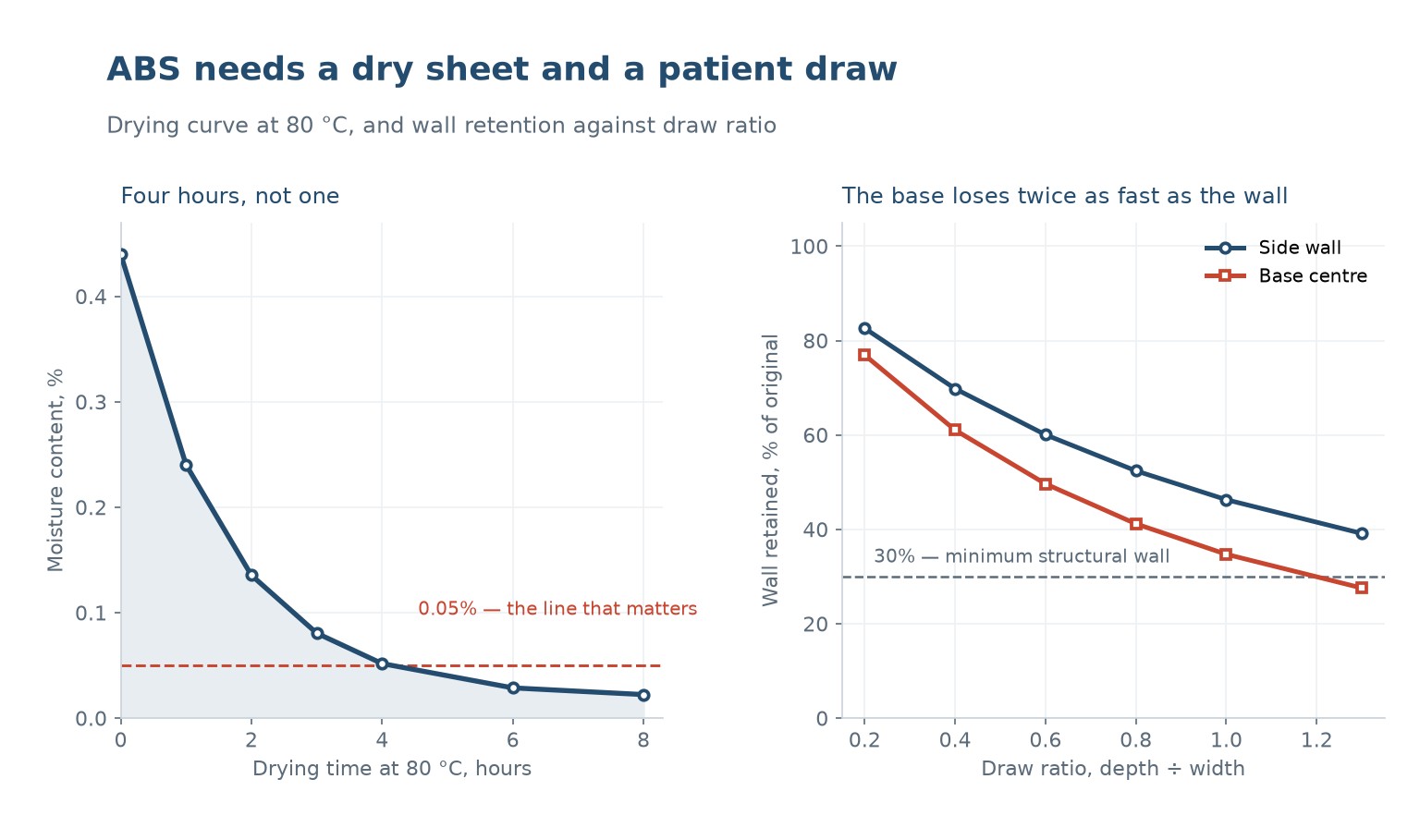
ABS absorbs up to 0.4 percent moisture from the air, and moisture in a thermoforming oven does something specific: it boils at the sheet surface and leaves a bubble. Not a small bubble — a blister 2 to 5 mm across, with a thin skin, that appears during heating and cannot be removed.
The target is 0.05 percent or below. At 80 °C in a forced-air dryer, a 2 mm sheet reaches that in about four hours. A 4 mm sheet needs six to eight hours. Sheet stored in a humid warehouse can start at 0.4 percent and needs the full cycle; sheet from a sealed pallet may reach the target in three.
The failure mode is always the same: someone shortens the drying time because the job is late, the first few sheets look fine, and then the bubbles appear once the oven has reached steady state. Drying is not a step you can do faster by turning up the temperature either — above 90 °C the sheet softens and can block the dryer airflow.
Heating, sag and the temperature that is not uniform
ABS forms between 150 and 180 °C at the surface. Below 150 the sheet is too stiff to draw and springs back; above 180 it sags badly between the clamps and the texture starts to level out.
Sag is worse in ABS than in PVC at the same thickness because ABS softens over a wider range and has less green strength at temperature. A 2 mm ABS sheet at 175 °C will sag 20 to 30 mm across a 600 mm span, which changes the geometry before the mould touches it. Two-sided heating reduces the gradient and therefore the sag.
Heater zoning matters. The corners of the sheet lose heat to the clamp frame and the centre receives the full radiant load. A sheet that reads 170 °C at the centre may be 150 at the corner, and the corner will not form. Zoned heaters with reduced power at the edges are the standard solution, and on a machine without zoning, a reflective shield is the workaround.
| Espessura | Surface temperature | Tempo de aquecimento | Sag limit |
|---|---|---|---|
| 1.0 mm | 155 – 170 °C | 20 – 30 s | 10 mm |
| 1.5 mm | 155 – 175 °C | 30 – 45 s | 18 mm |
| 2.0 mm | 160 – 178 °C | 45 – 65 s | 28 mm |
| 3.0 mm | 165 – 180 °C | 75 – 105 s | 45 mm |
| 4.5 mm | 170 – 185 °C | 120 – 170 s | 70 mm |
Table 2 — ABS heating parameters on a radiant oven. Sag limits are for a 600 mm unsupported span and are the point at which the part geometry starts to move.
Draw ratio and where the wall goes
ABS follows the same geometric rule as every thermoformed polymer: the material over the cavity is spread over the cavity surface, so the deepest point loses the most. The difference is the exponent, which for ABS is slightly worse than for PVC because ABS strain-hardens less at forming temperature.
At a draw ratio of 0.5, the base centre retains about 62 percent of the original thickness and the side wall about 82. At 1.0, the base retains 40 and the wall 62. Below 35 percent the base is flexible enough to oil-can, and the part loses the rigidity that ABS was chosen for.
Plug assist changes the distribution without changing the draw ratio. A plug that pre-stretches the sheet mechanically before vacuum is applied moves material from the side wall into the base, raising the base from 40 to 55 percent at a draw of 1.0. The plug must be heated to 60 to 90 °C, or it will chill the sheet on contact and leave a mark.
| Draw ratio | Base, vacuum only | Base, plug assist | Side wall |
|---|---|---|---|
| 0.3 | 80% | 80% | 92% |
| 0.5 | 62% | 68% | 82% |
| 0.7 | 49% | 60% | 72% |
| 0.9 | 41% | 56% | 64% |
| 1.2 | 34% | 50% | 55% |
Table 3 — Wall retained in ABS against draw ratio, with and without a heated plug. Plug assist buys 10 to 15 points at the base, which is the difference between a part and a reject.
Texture and gloss: what survives the oven
ABS takes texture better than any other thermoformed commodity. An embossed sheet with a fine grain will reproduce that grain through the forming process if the sheet is not overheated and the mould is not too cold.
Two things destroy texture. Overheating levels the surface, because the embossed peaks relax before the valleys do; a sheet formed at 185 °C has visibly less grain than the same sheet at 165 °C. A cold mould does the opposite: it freezes the sheet on contact before it has fully conformed, and the texture becomes patchy.
Gloss is a separate variable and it comes from the mould surface, not the sheet, on the side that touches the tool. A polished aluminium tool gives a gloss part; a bead-blasted tool gives a matte one. If both sides must match, both need a tool surface, which means a matched mould rather than a female-only tool.
Trimming and assembly
ABS trims cleanly with a router, a steel rule die or a matched punch. The edge quality from a router is better than from a steel rule, and the cost is a fixture that holds a part which is not flat.
The assembly methods that work are the ones that do not put the trimmed edge in tension. Solvent bonding with MEK or a ABS cement gives a joint as strong as the sheet. Ultrasonic welding works but requires a designed joint geometry. Adhesive works if the surface is abraded and cleaned, and fails if it is not.
Screws need a boss, and a thermoformed boss is a thin-wall cone. A self-tapping screw in a 1.5 mm formed boss will strip at low torque. The reliable route is a metal insert or a bonded boss, and it should be in the design before the tool is cut.
The defects and what each one tells you
| Defeito | Causa | Fix |
|---|---|---|
| Bubbles or blisters | Moisture above 0.05% | Extend drying, verify with a meter |
| Webbing between features | Sheet too hot or draw too deep | Drop 8 °C, add plug assist |
| Chill marks | Mould too cold | Raise mould to 60 – 80 °C |
| Gloss variation | Uneven mould temperature | Check water flow per circuit |
| Cracking at a corner | Corner radius too small for the draw | Increase radius or reduce draw |
| Part sticks in the mould | No draft, or vacuum not released | Add 2° draft, check venting |
| Texture flattening | Sheet overheated | Reduce surface temperature 10 °C |
| Warp after trimming | Residual stress from fast cooling | Slow the cooling, anneal the part |
Table 4 — ABS thermoforming defects. Each one points at a different stage, which is why the table is more useful than a list of settings.
The one that is misdiagnosed most often is webbing. It looks like a material problem and is almost always a temperature-distribution problem: the sheet is hotter in the region between two deep features than over the features themselves, so it stretches first and folds. Fixing it by lowering the overall temperature produces a part that does not form at all. The correct fix is to profile the heaters so the web region is cooler.
How long does ABS sheet need to dry before thermoforming?
Four hours at 80 °C for a 2 mm sheet, six to eight hours for 4 mm. The target is 0.05 percent moisture. Verify with a meter rather than by the clock, because starting moisture varies with how the sheet was stored.
What is the maximum draw ratio for ABS?
0.9 with high-impact grade and plug assist, 0.5 with general-purpose and vacuum only. Beyond that the base drops below 35 percent and the part loses rigidity.
Why does my ABS part have a white mark where the plug touched it?
The plug was too cold. Heat it to 60 to 90 °C. A cold plug chills the sheet on contact, and the localised stress shows as a whitened or matte patch that cannot be polished out.
Can ABS be thermoformed without drying?
Only if the sheet is fresh from a sealed, dry pallet and the part is not cosmetic. In practice, always dry. The cost of four hours of drying is far below the cost of a rejected batch.
What mould temperature should I use for ABS?
60 to 80 °C. Below 60 you get chill marks and poor texture transfer; above 90 the part stays soft at demould and distorts.
Does ABS thermoforming need a plug assist?
Only above a draw ratio of about 0.6. Below that, vacuum alone gives an acceptable wall distribution and the plug adds tooling cost for no benefit.
Forming ABS parts and fighting blisters or webbing?
Send us the part drawing, the sheet grade and the draw depth. We will tell you the draw ratio you can hold, where the wall will thin, and whether the tool needs a plug.




 PT
 EN
 ES
 FR
 DE
 AR
 RU
 JA
 KO
 IT
 NL
 TR
 PL
 ID
