
What a family mould is, and when it pays
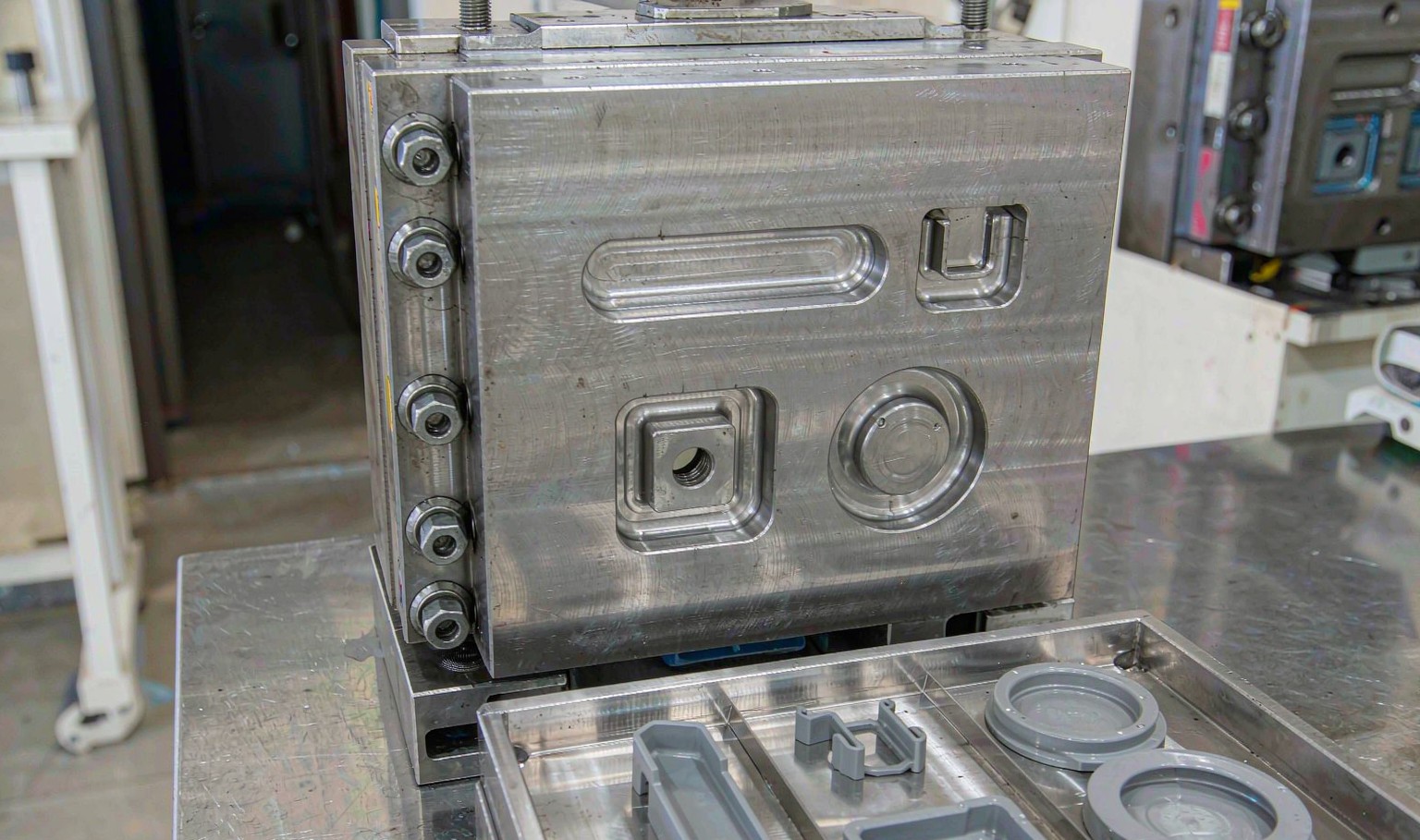
A family mould, sometimes called a multi-part tool, puts two or more different parts into one mould. The parts belong to the same product: a housing and its cover, a bracket and its clip, a body and its cap. They are moulded together because they are consumed together.
The economics are simple. One tool instead of three, one setup instead of three, one machine instead of three, and a matched set of parts arriving in the same box in the same colour. For a product with a bill of materials of five plastic parts at modest volume, a family tool is often the only way the project is affordable.
The cost is equally simple, and it is paid every cycle rather than once. The parts are different, so their walls are different, so their cooling times are different. The cycle is set by the slowest cavity. Every part in the tool pays for the thickest wall in the tool.
That is the trade: capital against cycle time. A family tool is right when the volumes are low enough that tooling dominates, and wrong when they are high enough that seconds dominate.
The tool is balanced by the slowest cavity
A family tool is never perfectly balanced, and it does not need to be. What it needs is for every cavity to fill at the same moment, so that the pressure at the end of fill is the same everywhere and no cavity is over-packed while another is still filling.
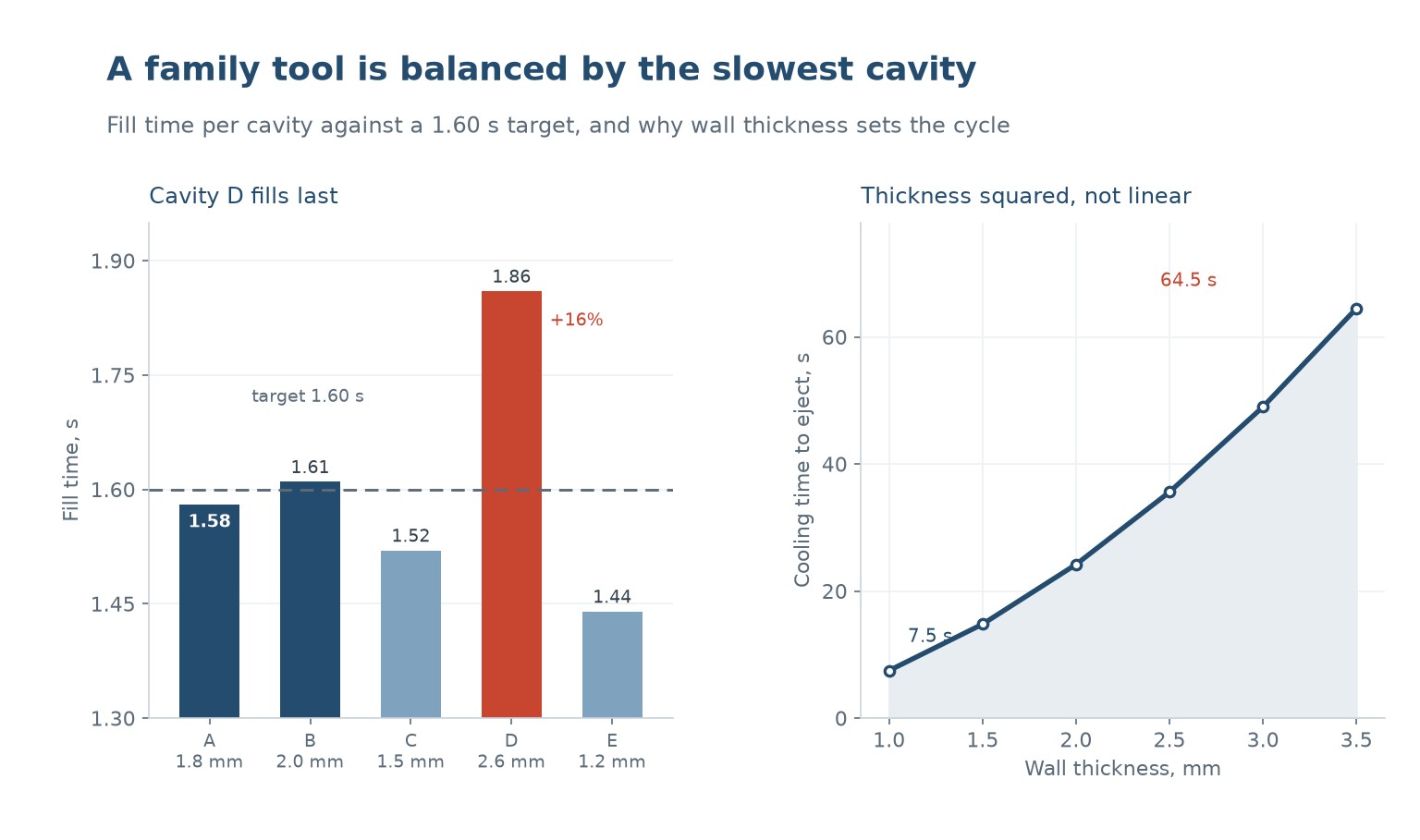
On a measured five-cavity family tool with a 1.60 second target, the fill times were 1.58, 1.61, 1.52, 1.86 and 1.44 seconds. The 2.6 mm bracket was 16 percent slow. The 1.2 mm clip was 10 percent fast. The three middle parts were within 6 percent, which is the normal spread on a tool balanced by runner size alone.
The slow cavity is the problem. It is the last to fill, so it sees the highest pressure, so it flashes first, and it is the cavity that shows sink and warp when the pack pressure is raised to fix a short shot elsewhere. On a family tool the slow cavity is usually the thick one, because a thick wall needs more volume and fills more slowly at the same flow rate.
The fix is runner balance first and gate size second. A family tool is balanced by giving the thin, fast cavities smaller gates and longer runners, so that all five arrive together. That is counter-intuitive, and it is the reason a family tool's runner layout looks nothing like a uniform one.
Wall thickness decides the cycle, not the part count
Cooling time scales roughly with the square of wall thickness. On a measured set, a 1.0 mm wall needed 7.5 seconds to reach ejection temperature, 1.5 mm needed 14.8, 2.0 mm 24.2, 2.5 mm 35.6, 3.0 mm 49.0 and 3.5 mm 64.5 seconds.
Doubling the wall from 1.5 to 3.0 mm multiplies the cooling time by 3.3. That is why a family tool with one thick part runs at the thick part's cycle, and why the thin parts in the same tool are cooled long before the tool opens.
There is a design response, and it is to keep the walls similar. A family tool whose parts range from 1.2 to 2.6 mm is a tool with a 60 percent spread in cooling time. A family tool whose parts are all within 1.8 to 2.2 mm is a tool that runs close to a single-part cycle. The second is worth designing for, even if it means thickening a thin part for no functional reason.
The second response is differential cooling. A thick cavity can be given a separate cooling circuit with colder water and higher flow, which shortens its cooling time without touching the thin cavities. It costs a manifold and a second temperature controller, and it is often cheaper than the seconds it recovers.
| Part | Wall | Volume | Fill time | Arrefecimento | Verdict |
|---|---|---|---|---|---|
| A bracket | 1.8 mm | 18.4 cm3 | 1.58 s | 19 s | Balanced |
| B cover | 2.0 mm | 12.1 cm3 | 1.61 s | 24 s | Sets the cycle |
| C clip | 1.5 mm | 3.2 cm3 | 1.52 s | 15 s | Fast, small gate |
| D body | 2.6 mm | 31.6 cm3 | 1.86 s | 38 s | Slow, needs help |
| E cap | 1.2 mm | 2.4 cm3 | 1.44 s | 9 s | Fast, small gate |
Table 1 — A five-cavity family tool, and which cavity owns the cycle
Shot weight, cushion and the machine match
A family tool has a large shot weight because it fills all the cavities at once. The shot weight is the sum of the parts plus the runner, and it has to sit in the middle of the machine's capacity: not below 20 percent, where residence time and control suffer, and not above 80 percent, where there is no cushion.
The cushion is the material left in front of the screw at the end of injection. A family tool with a big shot and a small cushion has no room to compensate for check valve leakage, and the parts at the far end of the runner go short. A cushion of 5 to 10 percent of shot size is the target.
The clamp force is the sum of the projected areas times the cavity pressure, and on a family tool the projected area is the sum of five parts, which is often larger than the platen looks. A tool that needs 180 tonnes and is quoted on 150 will flash on the largest part and nowhere else, which is a confusing symptom.
The third machine issue is plasticising capacity. The shot has to be ready in the cooling time, and a family tool's shot is large. A machine that can inject the shot but cannot plasticise it in 24 seconds will run slower than its clamp force suggests.
| Check | Rule | What goes wrong |
|---|---|---|
| Shot weight | 20 to 80 percent of barrel capacity | Degraded melt at low end, no cushion at high end |
| Cushion | 5 to 10 percent of shot | Short shots at the far cavities |
| Clamp force | Sum of projected areas x cavity pressure | Flash on the largest part only |
| Plasticising | Shot ready within cooling time | Cycle runs longer than cooling needs |
| Tie bar spacing | Tool plus 50 mm each side | Tool cannot be hung |
Table 2 — Matching a family tool to a machine
Where the family tool stops paying
The break-even is arithmetic, and it is worth doing before the tool is cut. A family tool costs roughly what the largest of its parts would cost alone, plus 30 to 50 percent. Three separate tools cost roughly the sum of three tools, which is usually two to three times as much.
Against that, the family tool costs cycle time every shot. If the thickest part needs 38 seconds of cooling and the average of the parts alone would need 24, the family tool loses 14 seconds per shot for the life of the tool. At 5,000 shots a year that is 19 hours; at 200,000 shots it is 780 hours.
So the crossover is volume. Below about 20,000 shots a year, tooling dominates and the family tool wins clearly. Above about 100,000, the cycle time dominates and separate tools win, even though they cost more to build.
There is a middle case that is often the right answer: a family tool with two cavities of the same part and one of its cover, rather than four different parts. That keeps the walls close, keeps the cycle close, and still removes two tools from the project.
Quality control when one cavity is a different part
A single-part tool is inspected by sampling one cavity and assuming the rest. A family tool cannot be inspected that way, because cavity four is a different part with a different drawing and a different critical dimension.
The practical answer is cavity identification. Every part carries a cavity number, either from a small engraved insert in the tool or from the runner layout, and the inspection plan treats the five cavities as five parts. A first-article inspection on a family tool is five first-article inspections.
The second issue is traceability. If a batch fails on the bracket, the whole shot is suspect, including the covers that were fine. That is the hidden cost of a family tool: a defect in one part quarantines four others.
The third is colour. All cavities share one melt, so a colour drift affects all of them equally, which is an advantage. But a thick part and a thin part of the same colour look different because of light transmission, and a customer comparing a cap to a body may report a colour mismatch that is really a thickness difference.
What is a family mould?
A tool that produces two or more different parts in one shot, usually parts of the same product such as a housing and its cover. It saves tooling and setup at the cost of cycle time.
How is a family tool balanced?
By runner and gate size, not by making the runners equal. The thin, fast cavities get smaller gates and longer runners so that every cavity fills at the same moment.
Why is my thick part flashing while the thin parts are fine?
Because the thick part fills last and sees the highest pressure. The pack pressure needed to fill it is more than the thin cavities can take, so they flash or the thick one does, depending on which is weaker.
Can I run different cooling to different cavities?
Yes, with separate circuits and separate temperature controllers. It is the standard fix for a family tool with one thick part, and often cheaper than the seconds it recovers.
Is a family tool good for high volume?
Usually not. At high volume the cycle time dominates and a dedicated tool per part is faster. A family tool pays when tooling cost dominates, which is low to medium volume.
How do I inspect a family tool?
As five separate parts. Each cavity needs its own first-article inspection and its own cavity identification, because a defect in one part quarantines the whole shot.
Designing a product with five plastic parts and a modest volume?
Send the part drawings, the annual volumes and the wall thicknesses. We will tell you whether a family tool pays or whether two tools run cheaper.




 PT
 EN
 ES
 FR
 DE
 AR
 RU
 JA
 KO
 IT
 NL
 TR
 PL
 ID
