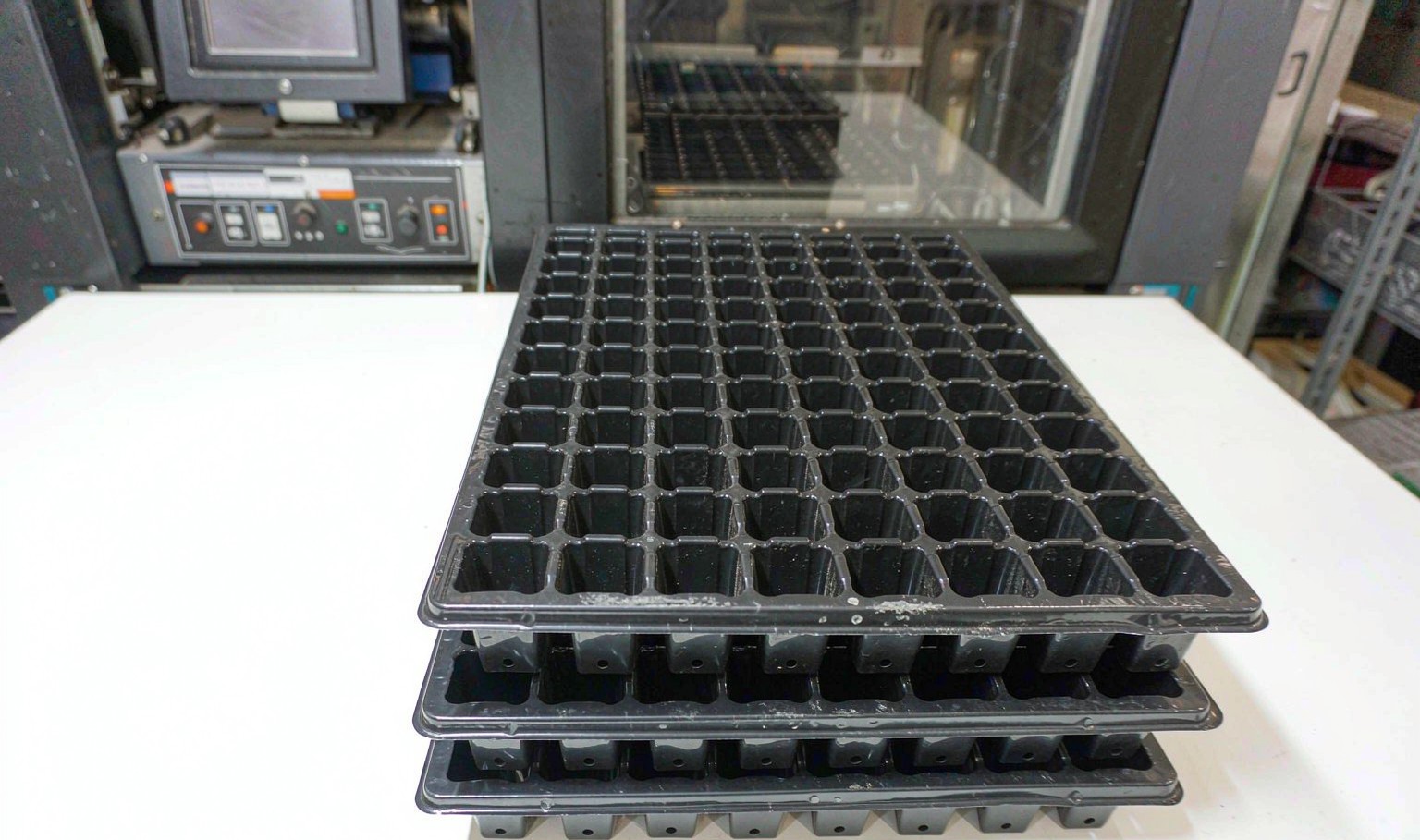
A seedling tray is a thin-wall problem
A horticultural tray is a grid of small cells formed from a single sheet. A 128-cell tray is 540 by 280 mm with 128 cells of about 30 mm square and 45 mm deep. The sheet is 0.8 to 1.2 mm, and the cell walls come out at 0.3 to 0.6 mm.
That is the whole difficulty. The cell walls are the thinnest feature in any thermoformed product, they are the feature that has to survive handling, and they are the feature that the draw thins most because every cell is a small deep draw competing with its neighbours for material.
A tray also has to do several things at once. It has to hold soil and water without collapsing when lifted. It has to drain, which means a hole at the bottom of every cell. It has to stack when empty and nest when full. And it has to release the root ball when a seedling is transplanted, which means a taper and a smooth wall.
Those requirements pull against each other. A thinner wall is cheaper and lighter; a thicker wall survives. A deeper cell holds more soil; a deeper cell thins the wall more. A tighter cell pitch fits more plants per tray; a tighter pitch leaves less material for each wall.
Breakage is a corner thickness problem
A tray fails at a corner. The corner of the tray, the corner of a cell, the point where the base meets a wall. Those are the places where the draw is deepest, the wall is thinnest and the handling load concentrates.
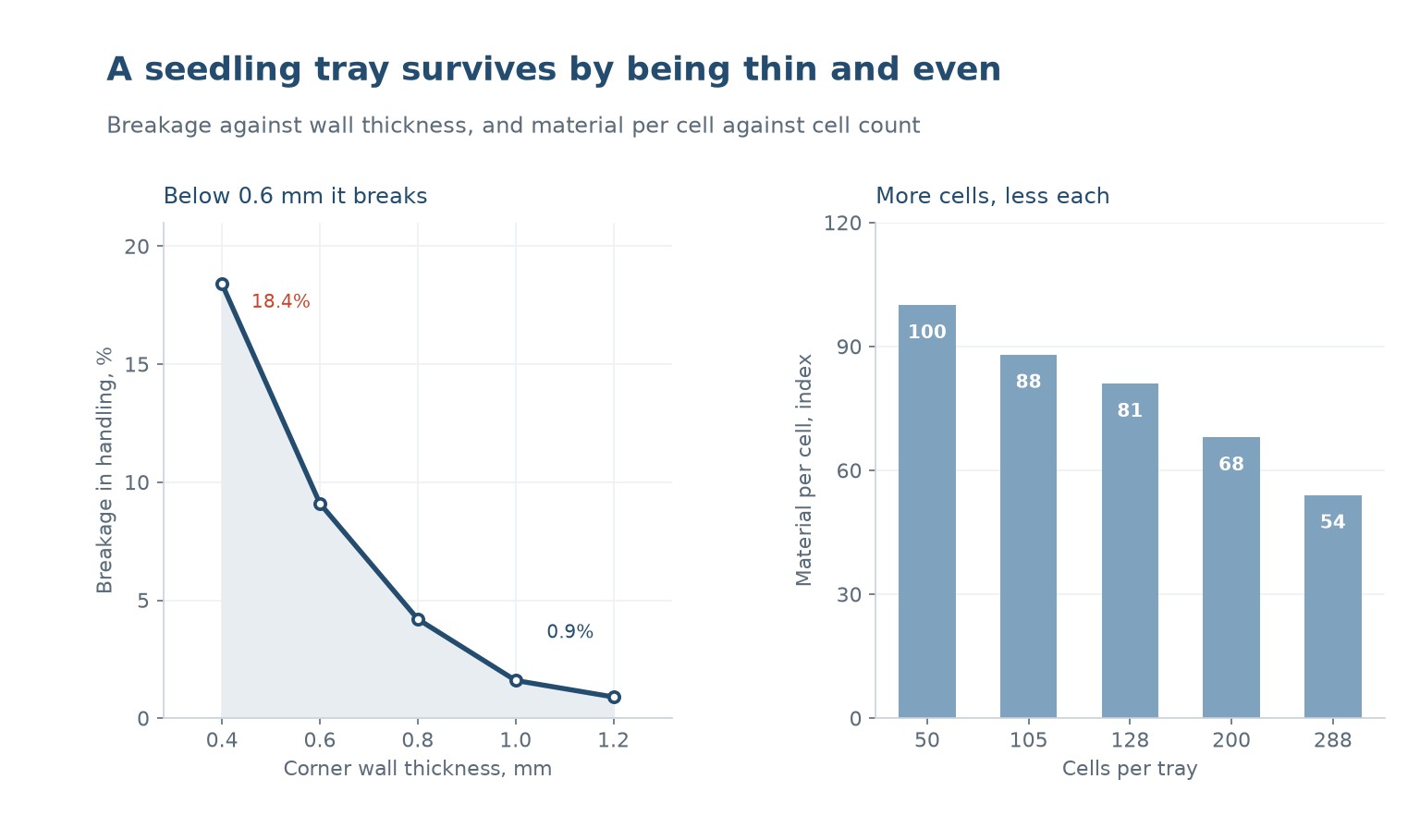
The relationship between corner thickness and breakage is steep. At 0.4 mm the breakage rate in handling is 18.4 percent. At 0.6 mm it is 9.1, at 0.8 mm 4.2, at 1.0 mm 1.6 and at 1.2 mm 0.9.
So the practical floor is about 0.6 mm at the corner, and 0.8 mm if the tray is going to be machine-handled. Below 0.6 mm the tray survives on the bench and fails in the nursery, and the failure is a cracked cell wall that shows up as a collapsed seedling three weeks later.
The corner thickness comes from the sheet thickness and the draw. A 1.0 mm sheet drawn into a 45 mm deep cell of 30 mm square has a draw ratio of 1.5 and keeps about 45 percent of its thickness at the corner, which is 0.45 mm. That is below the floor, which is why a 128-cell tray is usually formed from 1.2 mm sheet.
More cells means less material for each
A tray is made from one sheet, and the sheet is a fixed area. More cells means the same material spread over more walls, and the material per cell falls. Measured as an index against a 50-cell tray, a 105-cell tray has 88 per cell, a 128-cell 81, a 200-cell 68 and a 288-cell 54.
That is why a 288-cell tray has thinner walls than a 128-cell tray made from the same sheet, and why a 288-cell tray needs a thicker sheet to reach the same wall. The two effects compound: more cells and a higher sheet gauge.
The design answer is to make the cell geometry work harder. A round cell has less wall per unit volume than a square one, so a round-cell tray uses less material for the same soil volume. A tapered cell releases the root ball better and needs less draft allowance. A cell with a ribbed wall is stiffer than a plain one at the same thickness.
The other answer is the tray base. A tray with a flat base and no ribs is a tray that flexes when lifted, and a flexing tray cracks at the cell walls. A base with a shallow rib grid stiffens the whole tray and lets the cell walls be thinner.
| Cell count | Typical sheet | Corner wall | Material per cell |
|---|---|---|---|
| 50 | 0.8 mm | 0.55 mm | 100 |
| 105 | 1.0 mm | 0.50 mm | 88 |
| 128 | 1.2 mm | 0.45 mm | 81 |
| 200 | 1.4 mm | 0.40 mm | 68 |
| 288 | 1.6 mm | 0.35 mm | 54 |
Table 1 — How cell count forces the sheet gauge up
Forming a grid of deep cells
A tray is the hardest draw in packaging. Every cell is a deep draw, they are all competing for material at the same time, and the material between them is the material that has to feed them. A sheet that is 1.2 mm thick and 540 mm wide has to supply 128 cells from the same area.
The draw has to be staged. A single vacuum pulls all the cells at once and the ones nearest the edge starve the ones in the middle. A staged vacuum, or a plug assist with a grid of pins that pre-stretches each cell, feeds the cells more evenly.
Temperature uniformity is critical. A sheet that is 10 C cooler at one edge produces cells that are 10 percent thinner at that edge, and the tray fails there. A tray oven needs zoning across the width, not just along the length.
The other forming variable is the sheet grade. A high-impact polystyrene with a higher rubber content draws further before it tears, which is what allows a 288-cell tray to be made at all. A general purpose polystyrene of the same thickness will tear at the cell corners.
What a nursery does to a tray
A tray is filled with soil by a machine, watered, stacked in a trolley, moved to a greenhouse, grown for four to eight weeks, moved again, and then the seedlings are pulled out. Each of those steps is a load, and the loads are not gentle.
The filling machine is the worst. A tray that is dropped onto a conveyor, filled with wet soil at 0.8 kilograms per litre and then lifted by one corner is a tray that sees its full load concentrated at one point. That is why a tray with a rigid base survives and one without does not.
Watering is the second. Wet soil is three times the weight of dry, and a tray that is lifted wet is a tray carrying 8 to 12 kilograms. A 128-cell tray at 1.2 mm handles that; a 288-cell tray at 1.6 mm handles it; a 288-cell tray at 1.2 mm does not.
Transplanting is the third. Pulling a seedling out of a cell puts a shear load on the cell wall, and a cell with a 0.35 mm wall tears. A tapered cell with a smooth wall releases the root ball with much less force, which is why the taper is a functional requirement and not a moulding convenience.
| Etapa | Load on the tray | What fails first |
|---|---|---|
| Machine filling | Point load on one corner | Base flex, cell wall crack |
| Lifting wet | 8 to 12 kg per tray | Base, handle edge |
| Stacking in a trolley | Compression on the cell rims | Rim crush, cell collapse |
| Transport | Vibration, edge impact | Outer cell walls |
| Transplanting | Shear on the cell wall | Cell wall tear at the taper |
Table 2 — What each handling step does to a tray
The economics of a tray
A tray is a consumable sold by the thousand, and it is bought on price. That makes the material the dominant cost and it makes every gram matter. A 128-cell tray at 1.2 mm weighs about 95 grams; at 1.0 mm it weighs 79, which is a 17 percent material saving.
The saving is only real if the thinner tray survives. A tray that cracks in the nursery costs the grower a seedling, a cell and a reputation, and it comes back as a complaint rather than a return. That is why growers specify a gauge and why the specification is usually conservative.
The tooling is cheap relative to the volume. A tray tool is a single aluminium plate with 128 cavities machined into it, and it costs a fraction of what a 128-cavity injection tool would. That is why thermoforming owns this product: a 128-cavity injection tool would cost more than the annual order.
The other economic factor is nesting. A tray that nests deeply ships more per pallet, and freight is a real cost on a bulky consumable. A tray that nests too deeply stacks so tightly that it is hard to separate, which costs labour. The draft and the stack height are a design compromise between the two.
What to specify
A tray specification needs the cell count, the cell size and depth, the cell shape, the sheet grade and gauge, the drainage hole size, and the stack height when empty and when nested. Those six things decide the tool, the material and the freight.
The drainage hole is often under-specified. A hole that is too small blocks with soil and the cell waterlogs; a hole that is too large lets the soil out. A 4 to 6 mm hole at the bottom of a 30 mm cell is the usual range, and it is formed rather than punched.
The stack height is the number that gets argued about last and costs the most. A tray that nests to 25 mm ships 40 per 1,000 mm of pallet; one that nests to 15 mm ships 66. The difference is freight, and the difference is set by the draft angle and the cell taper.
How thin can a seedling tray cell wall be?
About 0.6 mm at the corner for hand handling and 0.8 mm for machine handling. Below 0.6 mm the breakage rate in handling goes above 9 percent.
Why does a 288-cell tray need a thicker sheet?
Because the same material is spread over more walls, so material per cell falls to 54 against 100 for a 50-cell tray, and the corner walls come out thinner at the same gauge.
Why do trays crack at the corners?
Because the corner is where the draw is deepest, the wall is thinnest and the handling load concentrates. A 1.0 mm sheet drawn into a 45 mm cell keeps about 0.45 mm at the corner.
Should the cells be round or square?
Round uses less wall per unit of soil volume and releases the root ball better. Square packs more cells per tray area. The choice is a compromise between material and plant density.
Why is the cell taper important?
It releases the root ball at transplanting. A straight cell grips the root ball and the shear load tears the wall. A tapered, smooth cell lets it slide out.
What drainage hole size?
4 to 6 mm at the bottom of a 30 mm cell, formed rather than punched. Smaller blocks with soil, larger lets the soil out.
A tray that cracks in the nursery?
Send the cell count, the cell size and the handling method. We will tell you the sheet gauge and the corner thickness you will actually get.







 PT
 EN
 ES
 FR
 DE
 AR
 RU
 JA
 KO
 IT
 NL
 TR
 PL
 ID