
Two components, one ratio
A two-component silicone is supplied as part A and part B, and the cure only happens when they are combined at the right ratio. The ratio is stoichiometric: too little crosslinker and the network is incomplete, too much and the excess plasticises the cured rubber. Both errors reduce the properties, and neither is visible on the finished part.
The ratio is set by the metering pumps, and the pumps are the part of the system that decides whether the process is capable. A piston pump meters a fixed volume per stroke and is insensitive to viscosity; a progressive cavity pump delivers continuously but drifts as the stator wears; a peristaltic pump is cheap and inaccurate.
What matters on a dispense system is not the nominal accuracy of the pump but the accuracy at the shot size being dispensed. A pump that holds plus or minus 0.5 percent over a 50 gram shot is a different instrument from one that holds 0.5 percent over a 0.5 gram shot, and the second one usually does not exist.
Small shots lose accuracy
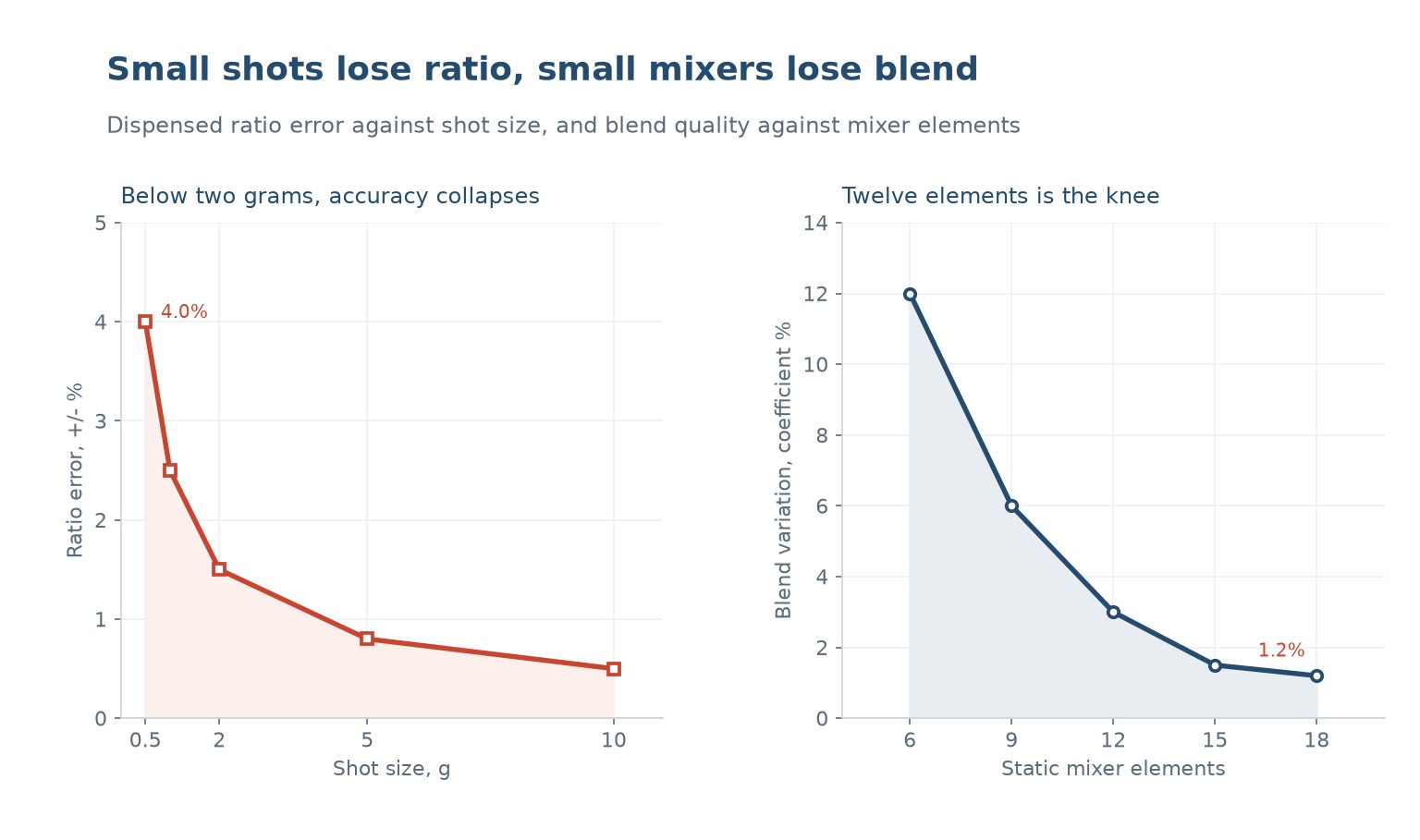
Ratio error grows sharply as the shot gets smaller. At 0.5 grams the dispensed ratio is typically plus or minus 4 percent, at 1 gram 2.5, at 2 grams 1.5, at 5 grams 0.8 and at 10 grams 0.5.
The reason is that every source of error in the system, the pump resolution, the valve response time, the compressibility of the material and the pressure transients at the start and end of the shot, is a fixed quantity. Spread over a large shot it is a small percentage; spread over half a gram it is the whole tolerance.
The practical consequence is that a dispense system has a minimum shot size, and it is usually about 2 grams per component. Below that the ratio is not controlled, and the answer is either a smaller pump, a continuous-flow system, or a different process altogether such as a pre-mixed frozen compound.
| Shot size | Ratio error | Verdict | What to do |
|---|---|---|---|
| 0.5 g | +/- 4.0 percent | Out of control | Change the pump or the process |
| 1 g | +/- 2.5 percent | Marginal | Check the properties on every lot |
| 2 g | +/- 1.5 percent | Workable | The usual minimum for a dispense system |
| 5 g | +/- 0.8 percent | Bom | Standard production |
| 10 g | +/- 0.5 percent | Excelente | Where the pump is specified |
Table 1 — Achievable ratio accuracy against shot size on a piston-metered system.
Mixer elements: twelve is the knee
The two components meet in a static mixer, a plastic tube with a helical element that repeatedly splits, rotates and recombines the flow. Each element halves the striation thickness, so the blend quality improves geometrically with the number of elements.
Measured as the coefficient of variation of a tracer in the dispensed bead, the blend variation is 12 percent with 6 elements, 6 with 9, 3 with 12, 1.5 with 15 and 1.2 with 18. Twelve elements takes it to 3 percent, and the next six elements only halve it again.
Twelve is the usual specification because it is the point where the variation drops below what the cure kinetics can average out. A slightly rich or lean pocket of 3 percent cures to within the property tolerance; a 12 percent pocket cures to a visibly different hardness, and that is what a streaky or tacky bead looks like.
The mixer is also a consumable. Silicone cures inside it, starting at the walls, and the pressure rises as the passages narrow. Replacing it on a schedule, rather than on failure, is the difference between a controlled process and a batch of parts with soft patches.
Volumetric against gravimetric
A volumetric system meters by pump displacement and assumes the density of each component is constant. A gravimetric system weighs each component as it is delivered and closes the loop on mass. The second is more accurate and slower, and it is the right choice when the ratio has to be proved rather than assumed.
The difference matters most with filled compounds. A silica-filled part B has a density that varies with filler loading and with entrained air, so a volumetric system can deliver the right volume and the wrong mass. On an unfilled compound the density is stable and volumetric metering is fine.
| Método | Exatidão | Velocidade | Melhor para |
|---|---|---|---|
| Volumetric, piston | +/- 0.5 percent | Rápido | Unfilled compounds, production |
| Volumetric, progressive cavity | +/- 1.5 percent | Rápido | Continuous dispensing |
| Gravimetric, loss in weight | +/- 0.2 percent | Mais lento | Filled compounds, validation |
| Cartridge, hand gun | +/- 5 percent | Manual | Repair and small batches |
Table 2 — Metering methods and what each one is good for.
Pot life is a clock, not a setting
Once the two components meet, the cure has started. The pot life is the time available before the mixture is too viscous to dispense, and it is set by the inhibitor in the formulation, not by the machine. A 20 minute pot life means the mixer, the hose and the needle have 20 minutes of useful life from the moment of first mixing.
This is why the mixer is at the point of use rather than back at the pump. Material that is mixed early and travels down a long hose arrives partly cured, and the bead that comes out is uneven. The correct arrangement is separate A and B lines to a mixer mounted on the robot or the gantry, as close to the needle as the geometry allows.
The needle matters too. A small needle gives a neat bead and a high back pressure, which heats the material and shortens the pot life. A large needle gives a faster shot and a coarser bead. On a bead that has to be 2 mm wide, the needle is 0.8 to 1.2 mm and the back pressure is whatever it is.
What to specify
A dispense system is specified by the bead it has to place, and the numbers that matter are the ones that decide whether the bead cures.
- Shot size per cycle, which sets the minimum pump resolution.
- Ratio and its tolerance, with the method used to verify it.
- Mixer element count and the replacement interval.
- Needle size and the bead width and height it produces.
- Pot life at the shop temperature, not at 23 C in a catalogue.
- Degassing: whether the material is supplied degassed or has to be degassed on the machine.
The shot size and the pot life are the two that get left out and cause the most trouble. A system bought for a 20 gram shot will not place a 0.5 gram bead, and a material with a 20 minute pot life will not run down a 3 metre hose.
Why does ratio accuracy fall on small shots?
Because the fixed errors in the system, pump resolution, valve response and material compressibility, become a larger fraction of a smaller shot. At 0.5 g the error is about 4 percent; at 10 g it is 0.5.
How many static mixer elements do I need?
Twelve for most two-component silicones. Blend variation falls from 12 percent at 6 elements to 3 percent at 12, and further elements buy little.
What is the difference between volumetric and gravimetric dispensing?
Volumetric meters by pump displacement and assumes constant density; gravimetric weighs each component. Gravimetric is more accurate and slower, and it matters with filled compounds.
How often should the static mixer be replaced?
Every shift on a busy line, and after any stop longer than the pot life. A partly cured mixer delivers slugs of soft material into the bead.
Why does the bead come out tacky in places?
Usually an off-ratio pocket from a mixer that is too short or partly blocked. A 12 percent variation in ratio cures to a visibly different hardness.
Can two-component silicone be dispensed by hand?
Yes, from a cartridge with a mixing nozzle, at about plus or minus 5 percent ratio accuracy. It is suitable for repair and small batches, not for production.
Dispensing a two-component silicone bead?
Tell us the bead size, the shot size and the pot life you need. We will quote the compound and the dispense route, and say which ratio accuracy is realistic at that shot size.
Continue reading
- Two-Roll Mill Mixing: Adding Filler, Curative and Heat History
- Liquid Silicone Rubber: LSR Grades, Curing and Design Rules
- RTV Silicone Rubber: One Part, Two Part and Where Each Fails
- Silicone Calendering: Sheet and Coated Fabric in One Pass
- Silicone Coating: Release Liners, Fabric and the Cure Window




 PT
 EN
 ES
 FR
 DE
 AR
 RU
 JA
 KO
 IT
 NL
 TR
 PL
 ID
