
The mill is a two-roll shearing device
A two-roll mill is two horizontal, water-cooled rolls turning toward each other at different speeds. The speed difference, usually about 1.2 to 1.4 to 1, produces the shear that breaks down filler agglomerates. The compound forms a band on the faster roll, and the operator cuts and folds it back into the nip.
Everything about the machine is designed to put shear into a viscous material while removing the heat that shear generates. The rolls are cooled from the inside, the nip is adjustable, and the operator controls the bank of material sitting above the nip. Too large a bank and the compound overheats; too small and the band breaks.
It is a batch process, and it is still used because it is flexible. A mill can make 20 kilograms of a special compound in an hour, which no internal mixer can do economically, and it can be cleaned between batches in minutes. For a silicone compounder running many small orders, that flexibility is the product.
Order of addition matters
Silicone gum is soft and cohesive, and it will not accept a large volume of dry filler at once. The filler has to be worked in gradually, and the order in which the ingredients go in decides whether the batch disperses or crumbles.
The usual sequence is: gum first, banded on the mill; then the filler in portions, each worked in until the band is smooth; then the processing aids and the pigment; then, last, the curative. Adding the curative early exposes it to the full heat history of the batch, which is exactly what a platinum catalyst should not see.
The filler addition is the slow part. A 60 percent filler loading means 1.5 kilograms of filler for every kilogram of gum, and it goes in over 20 to 40 minutes in portions of a few hundred grams. Rushing it produces a batch with visible white specks that no amount of extra milling will remove, because the agglomerates have been coated with gum and the shear can no longer reach them.
| Stage | Ingredient | Why this order | Typical time |
|---|---|---|---|
| 1 | Gum base | Forms the band that carries everything else | 3 to 5 min |
| 2 | Filler, in portions | Needs shear while the compound is still soft | 20 to 40 min |
| 3 | Processing aid | Lowers viscosity so the filler can still move | 3 to 5 min |
| 4 | Pigment | Disperses best in a filled, lubricated compound | 3 to 5 min |
| 5 | Curative and inhibitor | Last, to keep the heat history off the catalyst | 2 to 3 min |
Table 1 — The addition sequence, and the reason for each step.
Dispersion is asymptotic
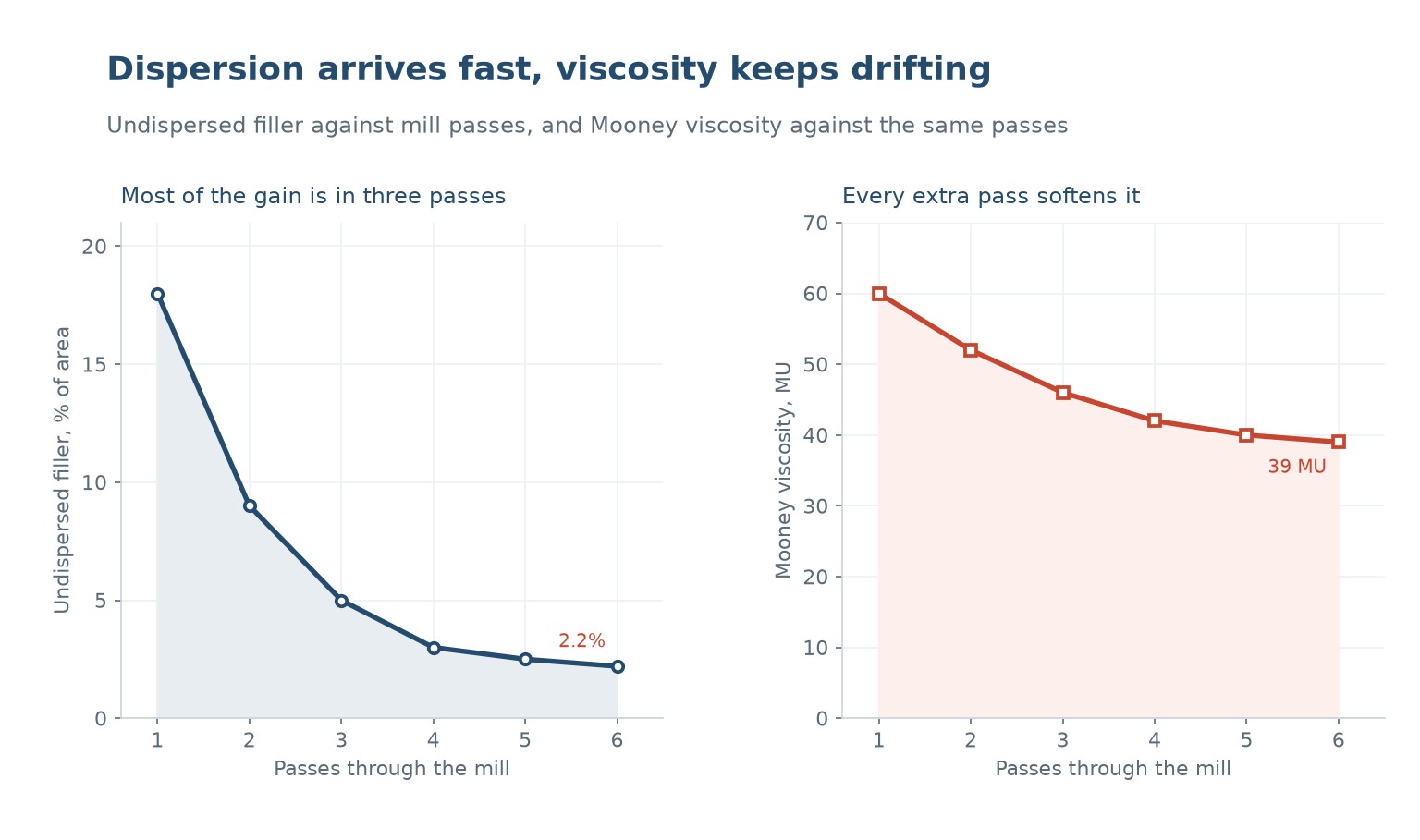
Dispersion is measured as the fraction of the surface that is still undispersed filler, either by a visual rating on a cut sheet or by an optical method. It falls from 18 percent after the first pass to 9 after the second, 5 after the third, 3 after the fourth, 2.5 after the fifth and 2.2 after the sixth.
The shape of that curve is the whole economics of milling. Two thirds of the available improvement happens in the first three passes, and the last three passes buy a fraction of a percent each while costing the same time and the same heat history. Beyond about four passes, the mill is not improving the compound; it is only damaging it.
The practical target depends on the part. A general mechanical part is fine at 3 to 5 percent undispersed. An optical part, a thin diaphragm or a medical component needs below 2 percent, and that is where the extra passes are justified. A compounder who runs six passes on everything is either making optical parts or wasting capacity.
Agglomerate size matters as much as the count. A 100 micrometre agglomerate is visible as a speck and is a cosmetic defect; a 10 micrometre one is invisible but is a crack initiation site. Dispersion ratings that only count specks above 50 micrometres will pass a batch that fails in a flex test.
Heat history is cumulative and invisible
Every pass puts work into the compound, and the work becomes heat. The rolls remove some of it, but not all, and the compound that comes off the mill is warmer than the compound that went on. Mooney viscosity tracks that history: 60 after the first pass, 52 after the second, 46 after the third, 42 after the fourth, 40 after the fifth and 39 after the sixth.
The drop is partly genuine dispersion and partly chain scission. Silicone gum breaks down under prolonged shear at temperature, and a compound that has been milled too long has a lower viscosity and a lower tear strength than the same formulation milled correctly. The batch looks fine, moulds easily, and fails a tear test.
The compound temperature is the number to watch. Below about 60 C the mill is doing useful work; above 90 C the breakdown accelerates and the risk of scorch rises. The rule is to keep the band under 80 C by controlling the bank size, the roll cooling and the number of passes, not by trusting the mill's thermometer.
| Passes | Undispersed filler | Mooney viscosity | Band temperature |
|---|---|---|---|
| 1 | 18 percent | 60 MU | 45 C |
| 2 | 9 percent | 52 MU | 58 C |
| 3 | 5 percent | 46 MU | 70 C |
| 4 | 3 percent | 42 MU | 82 C |
| 5 | 2.5 percent | 40 MU | 95 C |
| 6 | 2.2 percent | 39 MU | 108 C |
Table 2 — What each pass buys and what it costs in heat and viscosity.
The curative goes on last, and it goes on cold
The platinum catalyst and the inhibitor are added at the end, when the compound is as cool as the process allows. The catalyst starts the reaction as soon as it meets the hydride crosslinker, and the inhibitor holds it back, but the inhibitor is finite and heat consumes it. A batch that receives its catalyst at 100 C has already started to age before it is sheeted off.
The addition itself is short: two to three minutes, enough to distribute the catalyst without working the compound. Over-milling at this stage is the most damaging of all, because it is the stage where the material is most sensitive and the least dispersion benefit remains.
The batch is then sheeted off at a controlled thickness and either used within its pot life or frozen. A catalysed silicone compound has a shelf life measured in days at room temperature and months at minus 20 C, and the clock starts at the moment the catalyst goes in, not at the moment the batch is used.
What to record on the batch card
Milling is a craft process until it is documented, and the documentation is what turns a good batch into a repeatable one. Six fields cover it.
- Gum lot, filler lot and curative lot, so a failure can be traced to a supplier.
- Addition times and band temperature at each stage, not just the total time.
- Number of passes and the dispersion rating with the method used.
- Mooney viscosity or a hardness check on the finished sheet.
- Sheet thickness and the weight of the batch, as a yield check.
- Time and date of catalyst addition, which starts the pot life clock.
The band temperature at each stage is the field most often missing and the one that explains most batch-to-batch variation. Two batches with identical formulations and identical pass counts can differ by 15 percent in tear strength purely because one ran hot.
Why use a two-roll mill instead of an internal mixer?
Flexibility. A mill can make a small batch of a special compound in an hour and be cleaned in minutes, which suits a compounder running many short orders. An internal mixer is more efficient at high volume.
How many passes does silicone need on a two-roll mill?
Three to four for most parts, giving 3 to 5 percent undispersed filler. Optical and thin-wall parts need below 2 percent, which takes five or six passes at a cost in viscosity.
Why does Mooney viscosity fall with more passes?
Partly genuine dispersion and partly chain scission. Prolonged shear at temperature breaks the gum down, so the compound softens and loses tear strength.
When should the curative be added?
Last, and with the compound as cool as possible. The catalyst starts the cure clock, and heat consumes the inhibitor that is holding it back.
What band temperature is too hot?
Above 90 C the breakdown accelerates and scorch risk rises. Keep the band under 80 C by controlling bank size, roll cooling and the number of passes.
How is dispersion measured?
By a visual rating on a cut sheet, or optically by counting undispersed agglomerates. Both have to state a size threshold, because a 10 micrometre agglomerate is invisible but still a crack initiator.
Compounding a silicone batch that has to repeat?
Tell us the hardness, the filler loading and the properties you need to hold. We will quote the mill route and the dispersion rating we can certify, with the batch records that go with it.




 PT
 EN
 ES
 FR
 DE
 AR
 RU
 JA
 KO
 IT
 NL
 TR
 PL
 ID
