

Two processes, one question
Thermoforming takes a sheet, heats it and pulls it over a tool. Injection moulding melts pellets and pushes them into a closed tool. The first is a forming process with a cheap tool and an expensive sheet; the second is a moulding process with an expensive tool and a cheap pellet.
That difference inverts the economics. Thermoforming wins at low volume because the tool is cheap, and loses at high volume because the material is a sheet that has already been paid for once. Injection moulding wins at high volume because the tool is amortised and the material is cheap, and loses at low volume because the tool is not.
The geometry limits follow from the same difference. Thermoforming can only make shapes that can be drawn from a sheet, so undercuts, closed hollows and thick-to-thin transitions are difficult or impossible. Injection moulding can make almost anything, as long as the tool can open and the part can be ejected.
So the decision is not a preference, it is an intersection of volume, geometry and wall thickness. Get one of those wrong and the answer is wrong, however good the cost model is.
Volume and the crossover
The chart on the left plots cost per part against annual volume for three processes. Vacuum forming runs from 3.40 euro at five thousand parts to 1.22 at two hundred and fifty thousand. Pressure forming runs from 4.20 to 1.42. Injection moulding runs from 9.50 at five thousand to 0.92 at two hundred and fifty thousand.
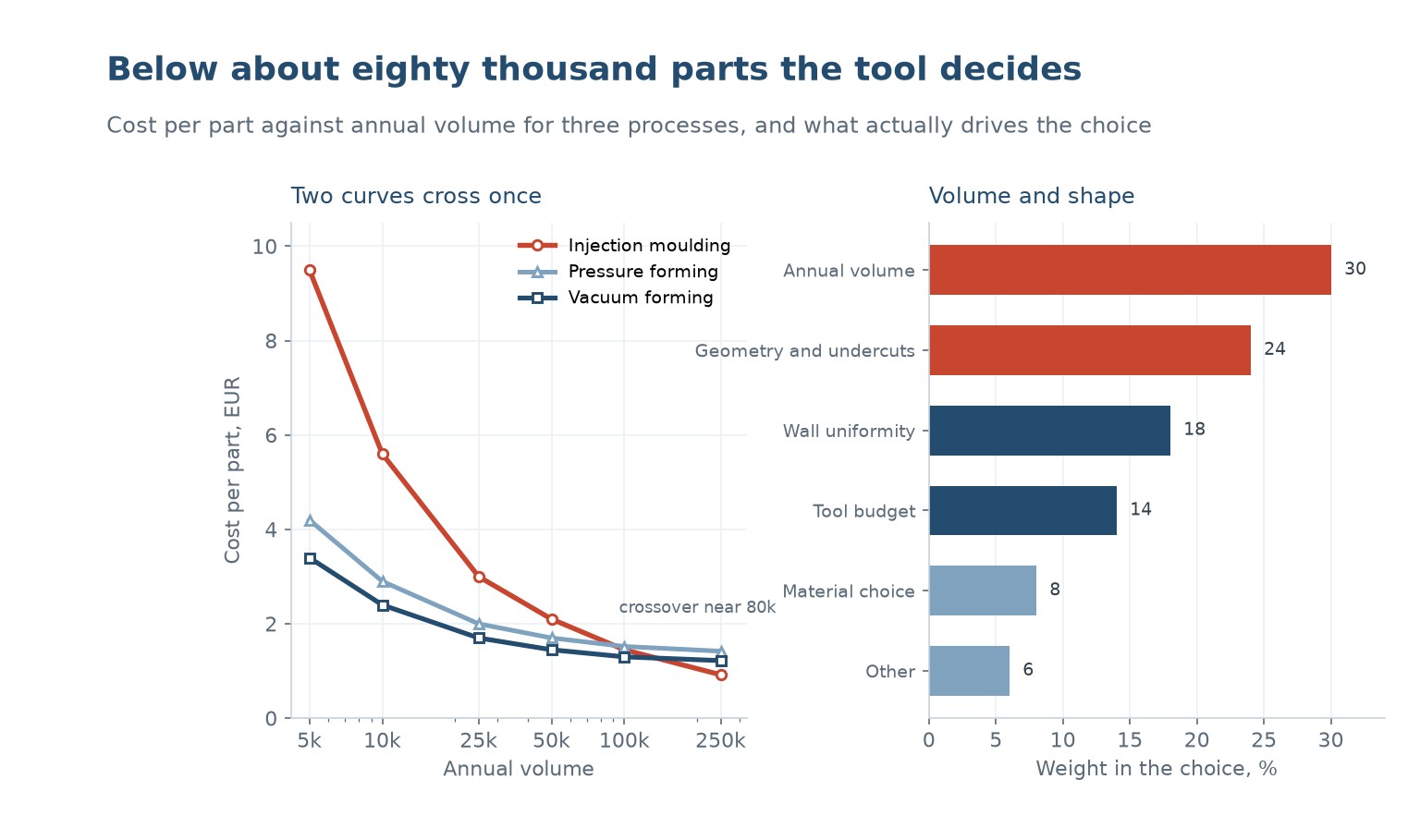
The crossover is at about eighty thousand parts a year for a part of moderate complexity. Below that, thermoforming is cheaper; above it, injection moulding is. The exact number moves with part size, wall thickness and tool cost, but it is rarely below fifty thousand or above a hundred and fifty thousand.
The reason the crossover is where it is, is that the two curves have different shapes. Thermoforming has a high material cost and a low tool cost, so its curve starts low and falls slowly. Injection moulding has a low material cost and a high tool cost, so its curve starts high and falls steeply.
That means the decision is stable at the ends and sensitive in the middle. A part at twenty thousand a year is a thermoforming part by a wide margin; a part at two hundred thousand is an injection part by a wide margin. A part at eighty thousand depends on the details, and that is where a proper cost model earns its keep.
Geometry and what each can make
Thermoforming cannot make an undercut that faces the draw direction, because the part has to come off the tool. It can be made with a slide in the tool or a secondary operation, but both add cost and both are a compromise. A part with several undercuts is usually an injection part on geometry alone.
Thermoforming cannot make a closed hollow, because the sheet is formed over a male tool or into a female one and there is no way to close the other side. Twin sheet forming can make a hollow by joining two sheets, and it is a real process, but it is a different cost structure and a different design.
Thermoforming cannot easily make a thick-to-thin transition, because the wall thickness follows the draw. A part that needs a thick boss and a thin panel is difficult; a part that needs a uniform wall is ideal. Injection moulding has the opposite property: it can put material exactly where it is needed, which is why ribs and bosses are natural.
Thermoforming is very good at large, shallow, double curved shapes. A panel of a metre square with a gentle curve and a flange is a thermoforming part, and it would need a tool that no injection machine could hold. Size is the one dimension where thermoforming wins outright.
Wall thickness and stiffness
A thermoformed wall is the sheet thickness minus the thinning, and the thinning is uneven. A part with a 2 mm sheet may have a 1.8 mm panel and a 0.9 mm corner, and the corner is where it fails. The design has to account for that, either by starting thicker or by avoiding sharp draws.
An injection moulded wall is what the tool says it is, to within a tolerance. That uniformity is worth a lot in a part that has to be strong, and it is why a structural part is usually moulded. The moulded part can also have ribs, which put material where it does the most good without thickening the panel.
The consequence for stiffness is significant. A moulded part with ribs can be three times stiffer than a formed part of the same weight, because the ribs are on the neutral axis. A formed part has to get its stiffness from the panel thickness and from formed-in ribs, which are shallower and thinner at the base.
That is why the crossover moves with the part. A part that needs stiffness at low weight is a moulding even at moderate volume, because the thermoformed alternative would have to be thicker and therefore heavier and more expensive in material.
Tooling cost and lead time
A thermoforming tool is an aluminium or epoxy shape with vacuum holes and a cooling circuit. It costs a few thousand euro and takes two to four weeks. An injection tool is a hardened steel pair of halves with a runner, an ejection system and often a hot runner. It costs tens of thousands and takes eight to sixteen weeks.
That difference in lead time is often more important than the cost. A product launch that needs parts in six weeks is a thermoforming launch, whatever the volume, because the injection tool will not be ready. A bridge tool in aluminium can be made in three weeks and used for the first production run while the steel tool is being built.
The tool life follows the same pattern. A thermoforming tool for a simple part makes tens of thousands of parts before it needs attention; an injection tool makes hundreds of thousands to a million. A part with a total volume of twenty thousand is a part where the injection tool outlives the product.
The maintenance profile is different too. A forming tool is refurbished by polishing and re-drilling vacuum holes, which is cheap. An injection tool is refurbished by welding, re-machining and re-polishing, which is not. For a long-lived product the injection tool is still cheaper per part, but the maintenance has to be in the model.
| Czynnik | Termoformowanie | Injection moulding |
|---|---|---|
| Tool cost | 2 000 to 15 000 EUR | 20 000 to 150 000 EUR |
| Tool lead time | 2 to 5 weeks | 8 to 16 weeks |
| Tool life | 10 000 to 100 000 parts | 300 000 to 1 000 000 parts |
| Material cost per kilo | Sheet, 20 to 40 percent more | Pellet |
| Wall uniformity | Poor at corners | Good, set by the tool |
| Podcięcia | Difficult, needs slides | Standard with slides |
| Duże części | Up to several square metres | Limited by tonnage |
Table 1 — The two processes side by side
A decision that holds
The chart on the right shows what actually drives the choice. Annual volume accounts for 30 percent, geometry and undercuts 24, wall uniformity 18, tool budget 14, material choice 8 and everything else 6. The first two are 54 percent, and both are known before a cost model is built.
A decision that holds starts with geometry. If the part has undercuts facing the draw, or a closed hollow, or a thick boss next to a thin panel, it is a moulding and the volume question is secondary. If it is large, shallow and uniform, it is a forming and the volume question decides the tool.
The second step is volume against the crossover. A part below fifty thousand a year is very likely a forming; above a hundred and fifty thousand it is very likely a moulding. In between, the cost model decides, and the model has to include the tool amortisation and the sheet yield.
The third step is the bridge. A product that starts at low volume and grows is often best served by a thermoformed bridge and an injection tool ordered in parallel. The bridge pays for itself in the first months, and the injection tool arrives when the volume justifies it. That is a plan rather than a choice, and it is usually the right answer for a new product.
| Situation | Proces | Dlaczego |
|---|---|---|
| Under 20 000 a year, simple shape | Formowanie próżniowe | Tool cost dominates |
| 20 000 to 80 000, cosmetic | Pressure forming | Better detail, still cheap tool |
| Above 150 000, any shape | Injection moulding | Material and cycle dominate |
| Undercuts or closed hollow | Injection moulding | Geometry, not volume |
| Very large and shallow | Termoformowanie | No machine can hold the tool |
| New product, volume unknown | Forming bridge, then mould | Launch now, tool later |
Table 2 — Six situations and the answer each one points to
At what volume is injection moulding cheaper than thermoforming?
About eighty thousand parts a year for a part of moderate complexity. Below fifty thousand thermoforming is usually cheaper; above a hundred and fifty thousand injection moulding usually is.
Why is thermoforming cheaper at low volume?
Because the tool costs a few thousand euro instead of tens of thousands. The material is more expensive per part, but at low volume the tool dominates the total.
Can thermoforming make undercuts?
Only with a slide in the tool or a secondary operation, and both add cost. A part with several undercuts facing the draw is usually an injection moulding part on geometry alone.
Which process gives a more uniform wall?
Injection moulding, by a wide margin. A thermoformed wall follows the draw and thins at corners, sometimes to half the starting thickness.
How long does each tool take to make?
Two to five weeks for a thermoforming tool and eight to sixteen for an injection tool. That difference often decides a product launch more than the cost does.
Can I start with thermoforming and switch later?
Yes, and it is often the right plan for a new product. A thermoformed bridge tool pays for itself in the first months while the injection tool is being built.
Not sure which process the part should use?
Send the drawing and the annual volume. We will tell you where the crossover sits for this part and whether a bridge tool makes sense.
Continue reading
- Thermoforming Cost Model: Sheet, Cycle, Tooling and Labour
- Vacuum Forming Versus Pressure Forming: Detail and Cost
- Thermoforming Mould Cost: What an Aluminium Tool Really Costs
- Injection Mould Cost Breakdown: Where the Money in a Tool Goes
- Thermoforming Undercuts: Slides, Inserts and the Cost of Each




 PL
 EN
 ES
 FR
 DE
 PT
 AR
 RU
 JA
 KO
 IT
 NL
 TR
 ID
