

A tool is a machining job
The intuitive model of a mould price is material plus a margin. That model is wrong by a wide margin. A tool of 500 kg of steel contains perhaps 1 500 euro of material and sells for thirty to eighty thousand, and the difference is hours: hours of programming, hours of milling, hours of spark erosion, hours of polishing and hours of a toolmaker standing at a bench fitting two halves together.
That is why two suppliers can quote for the same drawing and differ by a factor of two without either of them being dishonest. They are not pricing the same steel, they are pricing different numbers of hours, and the hours depend on how much of the work is done by a machine and how much by a person.
The practical consequence is that a tool price is negotiable in a way that a material price is not. You cannot argue with the price of steel, but you can argue about whether a cavity needs to be polished by hand for six hours or by a machine for two, and whether a slide is needed at all.
It also means that the cheapest quote is rarely the cheapest tool. A price that is twenty percent lower usually means fewer hours somewhere, and the place those hours were removed shows up in the first year of production as flash, wear or a cavity that needs polishing every month.
The seven lines in a tool price
The chart on the left breaks a typical tool price into its parts. Cavity and core machining is 28 percent, the mould base 18, slides and ejection 16, design and project management 12, steel and components 10, heat treatment and surface finish 9, and trial and correction 7.
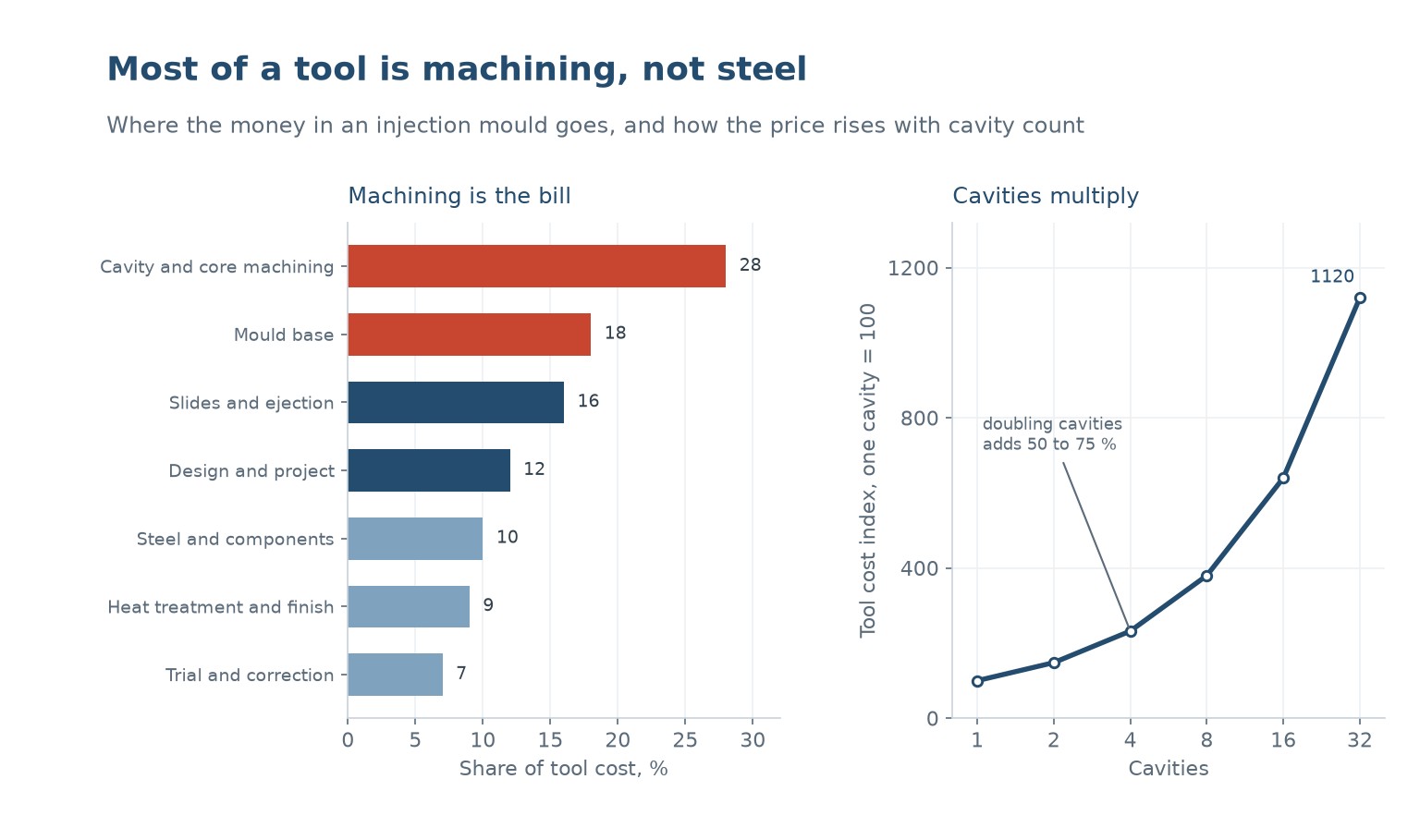
Two of those lines are worth arguing about and five are not. Cavity and core machining is the biggest and it scales with complexity, so it is where a design simplification pays. The mould base is a catalogue item and its price is what it is, unless the tool can be built on a smaller base.
Slides and ejection at 16 percent is the line that appears and disappears with the part design. Every undercut that needs a slide adds a mechanism, a wear surface, a maintenance item and a set of hours. A part that can be redesigned to avoid two slides is a cheaper part and a cheaper tool, and the redesign is usually free at the drawing stage.
Design and project management at 12 percent is the line that customers try to remove and should not. A tool built without a proper design review is a tool built on assumptions, and the assumptions get tested at the trial, where changes cost ten times what they cost on paper.
| Line | Share | What drives it |
|---|---|---|
| Cavity and core machining | 28 percent | Number of cavities, surface finish, tolerance |
| Mould base | 18 percent | Standard or custom, size, plate thickness |
| Slides and ejection | 16 percent | Undercuts, ejector layout, lifter count |
| Design and project | 12 percent | Part complexity, customer documentation |
| Steel and components | 10 percent | Grade, hardness, hot runner, sensors |
| Heat treatment and finish | 9 percent | Hardening, nitriding, texture, polish |
| Trial and correction | 7 percent | Material, machine time, number of rounds |
Table 1 — Where a tool price comes from
Cavity count is the biggest lever
The chart on the right plots tool cost against cavity count, indexed to a single cavity tool at 100. Two cavities cost 148, four cost 232, eight 380, sixteen 640 and thirty two 1 120. Each doubling adds between fifty and seventy five percent, which is less than doubling but much more than nothing.
The reason it is less than doubling is that the base, the ejection system and the design are shared. The reason it is far from free is that every cavity is another set of machining hours, another polishing job and another dimension to hold, and the tolerance on cavity-to-cavity variation gets tighter as the count rises.
That is why the economic cavity count is not the largest one that fits. The right number is set by the annual volume divided by the number of shots the tool will make in its life, and the tool life in shots is a property of the steel and the material. A thirty two cavity tool that runs ten thousand shots a year is a tool that will never pay back its extra machining.
There is also a quality argument. A sixteen cavity tool with a hot runner has sixteen gate temperatures and sixteen cooling circuits, and keeping them balanced is a job in itself. Beyond about sixteen cavities the variation between cavities becomes the dominant source of rejects, and the tool needs cavity-specific process control to stay in specification.
Steel, base and the parts you cannot see
The steel is only ten percent of the price, and it is the line most often downgraded to save money. That is usually a mistake. The steel sets the tool life, the polishability and the wear rate, and a tool made in a softer grade will need polishing, welding and eventually replacement long before a tool made in a harder one.
The mould base is the second invisible cost. A standard base from a catalogue is cheap and takes weeks to arrive; a custom base is expensive and takes longer. Designing the part so that it fits a standard base is one of the cheapest decisions available, and it is made at the drawing stage or not at all.
Heat treatment and surface finish is nine percent and it covers three different things: hardening of the cavity inserts, nitriding or coating of the wear surfaces, and the texture or polish of the cavity face. The last of those is the one customers notice, and a texture that needs a hand-applied pattern is a different price from one that comes off a standard plate.
Trial and correction at seven percent is the line that is always underestimated. A tool that needs six rounds of correction instead of three can double that line, and the extra rounds are usually caused by decisions made earlier in the project rather than by the trial itself.
Where quotes differ for the same tool
Two quotes for the same drawing usually differ in four places. The first is cavity count, which may be read differently if the drawing does not state it. The second is the runner system: a cold runner is cheaper to build and more expensive to run, and a hot runner is the reverse.
The third is the ejection system. A simple ejector pin layout is cheap; a stripper plate, a lifter or a collapsible core is not. If the drawing has an undercut, one supplier may quote a slide and another may quote a lifter, and both are valid answers with different costs and different maintenance profiles.
The fourth is the standard of finish. A tool quoted for a visible cosmetic part needs a polish that a tool quoted for a hidden part does not, and the difference is hours. A quote that does not state the surface standard is a quote that cannot be compared.
The way to compare is to ask for a breakdown rather than a total. A supplier who can give the seven lines has thought about the tool; a supplier who gives a single number has either quoted from experience or from a template, and the two are not the same thing.
Reading a tool price
The first check is the ratio of tool price to part price. A tool should cost roughly the value of the parts it will make in its first year at reasonable volume, and a tool that costs ten times that is either over-engineered or for a very low volume part where the tool is the product.
The second check is the cavity count against the volume. Divide the annual volume by the number of shots per year the machine can make, and see whether the cavity count is close. A tool with four times the cavities it needs is paying for machining it will never use.
The third check is the maintenance plan. A tool with slides needs a maintenance interval, and the interval is shorter than a tool without. If the quote does not include a maintenance schedule, the cost of the slides is being paid later rather than now.
The fourth check is the trial. A quote that includes a trial and a first article inspection is a quote from a supplier who expects to prove the tool. A quote that ends at delivery is a quote that hands you the risk.
| Pytanie | What a good answer looks like | Red flag |
|---|---|---|
| Cavity count | Justified by volume and tool life | Maximum that fits the base |
| Runner | Hot or cold, with a reason | Not mentioned |
| Ejection | Named mechanism for each undercut | Generic ejector pins |
| Surface | Written polish or texture standard | Cosmetic only |
| Trial | Included, with first article | Delivery is the end |
| Konserwacja | Interval and wear parts listed | Not discussed |
Table 2 — Six questions that separate two quotes
Why is an injection mould so expensive?
Because it is mostly machining hours rather than material. A 500 kg tool contains about 1 500 euro of steel and thirty to eighty thousand euro of programming, milling, spark erosion, polishing and fitting.
How much does each extra cavity add?
Roughly fifty to seventy five percent of the previous price per doubling. Two cavities cost 1.48 times one, four cost 2.32, eight 3.80, sixteen 6.40 and thirty two 11.2.
Should I choose a hot runner or a cold runner?
A hot runner costs more to build and less to run, and it pays back at volume with a material that is expensive or has a long cycle. A cold runner is cheaper to build and produces scrap that has to be reground.
Why do two quotes for the same tool differ so much?
Usually cavity count, runner type, ejection method or surface standard. A quote that does not state those four cannot be compared with another.
Does a cheaper tool cost more in the end?
Often. The hours removed to lower the price come out of polishing, fitting or heat treatment, and they show up as flash, wear or a cavity that needs re-polishing every month.
How long does an injection mould last?
Between a hundred thousand and a million shots depending on steel, material and maintenance. A glass filled material at the top of that range will wear a soft tool out in a fraction of the life.
A tool quote you cannot compare with another?
Send the drawing and the two quotations. We will tell you where they differ, which line is doing the work and which one is missing.
Continue reading
- Mould Tryout Debugging: The Order in Which to Fix Things
- Draft Angle in Injection Moulding: Degrees That Earn Their Keep
- Thermoforming Mould Cost: What an Aluminium Tool Really Costs
- Silicone Tooling Cost: Cavities, Steel and the Price of a Press Tool
- Injection Moulding Machine Selection: Tonnage, Shot and Tie Bars




 PL
 EN
 ES
 FR
 DE
 PT
 AR
 RU
 JA
 KO
 IT
 NL
 TR
 ID
