

What silicone actually releases
Outgassing is the release of volatile molecules from a material over time, driven by heat and by vacuum. In silicone rubber the volatiles are mostly low molecular weight siloxanes that were never bound into the network.
Curing links most of the polymer into a cross linked network, but a fraction stays as free chains and cyclic species. Cyclic siloxanes, especially D4, D5 and D6, are the classic offenders because they are volatile and chemically inert.
There is also water and, in condensation cure systems, the small molecule released by the cure reaction itself. Peroxide cure leaves decomposition products behind unless a post cure drives them off.
None of these make the rubber defective. A fully cured silicone gasket can still emit enough to haze a lens, and that is the surprise that catches design engineers.
Where outgassing bites
Sealed enclosures are the worst case. Volatiles have nowhere to go, so they accumulate until they condense on the coolest surface, which is usually the window or the lens.
Optical assemblies see it as haze or a film that appears over weeks. Electronics see it as contact contamination and, in high humidity, as leakage across a surface.
Automotive sensors see it as drift, because a film on the sensing element changes its response. Space and vacuum applications see it as mass loss and as condensate on cold optics, which is why ASTM E595 exists.
Medical devices see it as extractables. A volatile that is harmless in air becomes a leachable when the part is in contact with fluid, and the test moves from outgassing to extraction.
How it is measured
ASTM E595 heats a sample to 125 degrees Celsius under vacuum for 24 hours and measures two numbers: total mass loss, TML, and collected volatile condensable materials, CVCM, which is what actually deposits on a cold surface.
CVCM is the number that matters for optics and sensors. A material can lose a lot of mass as water and still have a low CVCM, because water does not condense on a warm window.
For general industrial work, thermogravimetric analysis or a simple mass loss test at the service temperature is enough. It will not give a space grade number but it ranks materials correctly.
Gas chromatography tells you what the volatiles are. That matters when the failure is specific, for example when a customer's adhesive is attacked by a particular siloxane rather than by silicone in general.
Post-cure is the main lever
Post-curing drives off the volatiles before the part goes into service. Hold the part above its service temperature for a few hours and most of what would have outgassed in the field leaves in the oven instead.
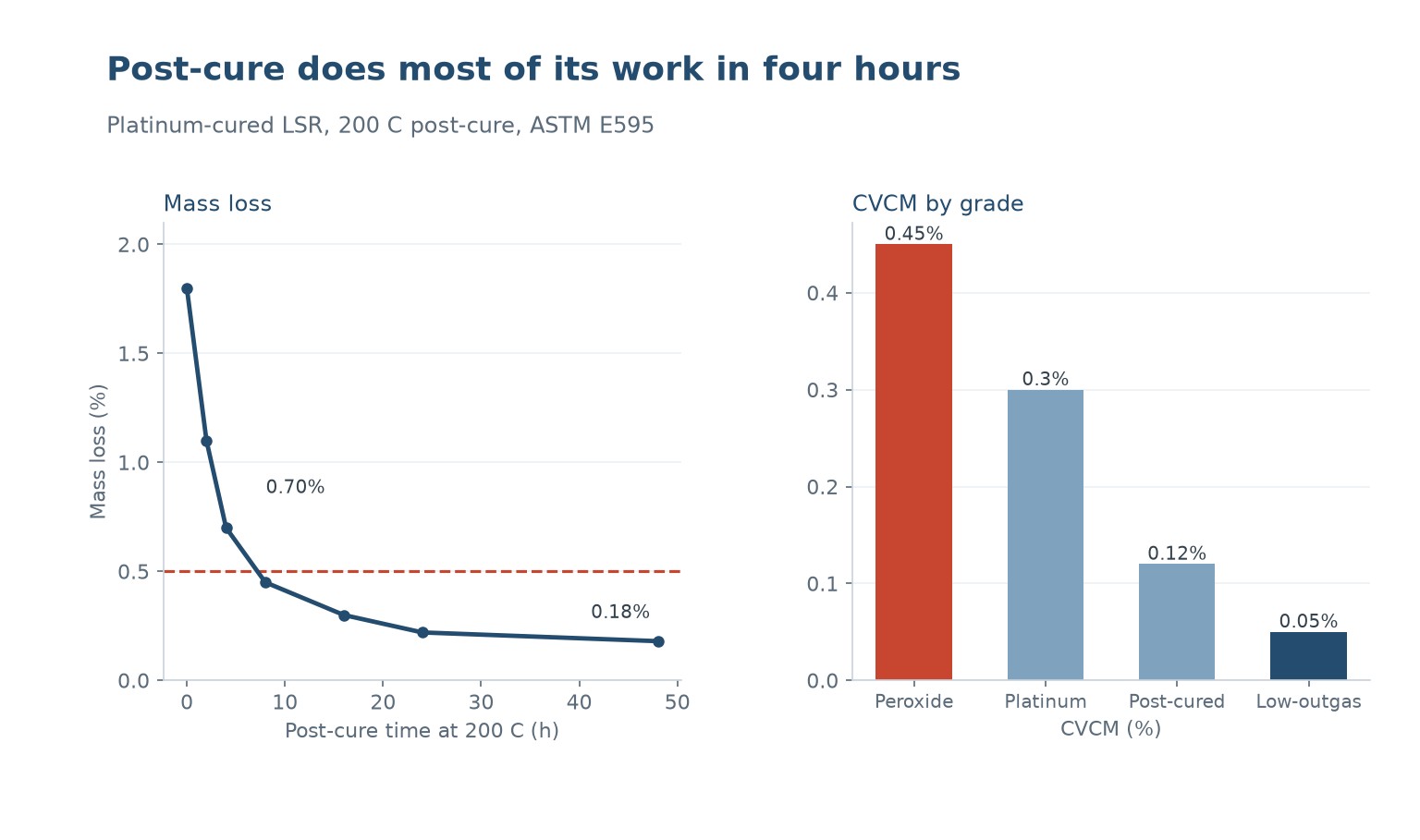
The left chart is mass loss against post-cure time at 200 degrees for a platinum cured liquid silicone. Four hours takes it from 1.8 percent to 0.45; sixteen hours takes it to 0.3.
The curve flattens. Doubling from sixteen to forty-eight hours buys only a little more, which is why most specifications settle on a practical post-cure rather than an indefinite one.
Temperature matters more than time. A post cure at 200 degrees removes in four hours what a post cure at 150 degrees needs all day to achieve, because diffusion through the rubber is strongly temperature dependent.
Grades and cure chemistry
The right hand panel compares CVCM by grade. Peroxide cured rubber is the highest at 0.45 percent because the cure itself leaves fragments behind; standard platinum is lower at 0.30.
A post-cured platinum part reaches 0.12, and a purpose-made low outgassing grade reaches 0.05. The last step is a formulation choice, usually a stripped polymer with the light ends removed before compounding.
So there are three levers, in order of cost: post-cure, which costs oven time; cure chemistry, which costs a different compound; and a low outgassing grade, which costs more per kilogram.
Most applications are solved by the first lever alone. Reaching for an exotic grade before post-curing properly is paying for a problem you did not have.
Specifying for a sealed assembly
State the service temperature and whether the enclosure is sealed. Those two facts decide whether outgassing matters at all, and they are the two most often left off a drawing.
If it matters, specify CVCM rather than TML, and specify the test. A limit of 0.1 percent CVCM to ASTM E595 is meaningful; 'low outgassing' is not.
Ask for the post-cure to be recorded. A supplier who post-cures to schedule will show it on the certificate, and a supplier who does not will show nothing, which is the answer.
And design an escape route. A vent, a desiccant or a breathable membrane turns a sealed box into a managed one, and often costs less than qualifying a new compound.
| Volatile | Źródło | Effect |
|---|---|---|
| D4 / D5 / D6 | Free cyclic siloxanes | Fogs optics, contact films |
| Water | Absorbed moisture | Low CVCM, high TML |
| Cure byproduct | Condensation cure | Odour, extractables |
| Peroxide fragments | Peroxide cure | Highest CVCM |
Table 1 — What silicone releases and what each volatile does.
| Zastosowanie | CVCM target | Typical route |
|---|---|---|
| General sealing | not specified | Standard platinum |
| Electronics enclosure | 0.15% | Post-cured platinum |
| Optics and sensors | 0.10% | Post-cured, low volatiles |
| Space / vacuum | 0.05% | Low outgassing grade |
Table 2 — CVCM targets by application.
What does silicone outgassing release?
Mostly low molecular weight cyclic siloxanes such as D4, D5 and D6, plus water and, for condensation cure systems, the cure byproduct.
Does platinum cured silicone outgas?
Yes, though less than peroxide cure. Platinum cure leaves no reaction byproduct but still contains free cyclic siloxanes that evaporate over time.
What is CVCM?
Collected volatile condensable materials, from ASTM E595. It measures what deposits on a cold surface, which is the number that matters for optics and sensors.
How do I reduce silicone outgassing?
Post-cure above the service temperature. Four hours at 200 C cuts mass loss from 1.8 to 0.45 percent; longer times give diminishing returns.
Why does my enclosure window fog up?
Volatiles from the silicone gasket have nowhere to escape in a sealed box, so they condense on the coolest surface, usually the window.
What CVCM should I specify?
0.10 percent for optics and sensors, 0.05 for vacuum and space. Specify the test method as well, because 'low outgassing' on its own means nothing.
Fogging or drifting in a sealed unit?
Send the assembly and the service temperature. We will tell you whether it needs a post-cure, a different cure chemistry or a low outgassing grade.





 PL
 EN
 ES
 FR
 DE
 PT
 AR
 RU
 JA
 KO
 IT
 NL
 TR
 ID
