Fogging is condensation, not a sheet defect
A tray that turns white in the chilled cabinet is usually not hazy sheet. Haze is a lasting property of the material or its surface; fogging is a layer of microscopic water droplets that appears when the lid surface falls below the dew point of the air around it, and clears again as the pack warms. The two are confused in complaints because both hide the product, and the distinction decides who has to fix what.
What an anti-fog treatment changes is the contact angle. On an untreated PET surface, condensed water beads into separate droplets whose curved interfaces scatter light in every direction. A surface active treatment lowers that angle so the same quantity of water spreads into a continuous film, which is close to invisible. The water is still there; only its geometry has changed.
That means the cabinet drives the problem as much as the tray does. A chilled case opened repeatedly for restocking, a pack moved from a cold store onto a humid sales floor, or a display with poor air circulation can all push the local dew point above the lid temperature. The same production lot can read perfectly clear in one store and mist over in another with no change in the sheet at all.
Product respiration matters more than most specifications allow. Fresh produce, salads and prepared meat release water vapour into a sealed pack from the moment it is closed, so the inner face of a lid can reach saturation while the outer face still looks dry. A test run on an empty tray in ambient air does not reproduce that condition, and will pass a tray that fails on shelf.
The practical consequence is that anti-fog is not a material property you can tick off on a resin datasheet. It is a performance statement about an assembled pack under a defined temperature and humidity cycle, after a defined period of storage. Written any other way, it is unenforceable when the complaint arrives.
Why a treated tray still mists over
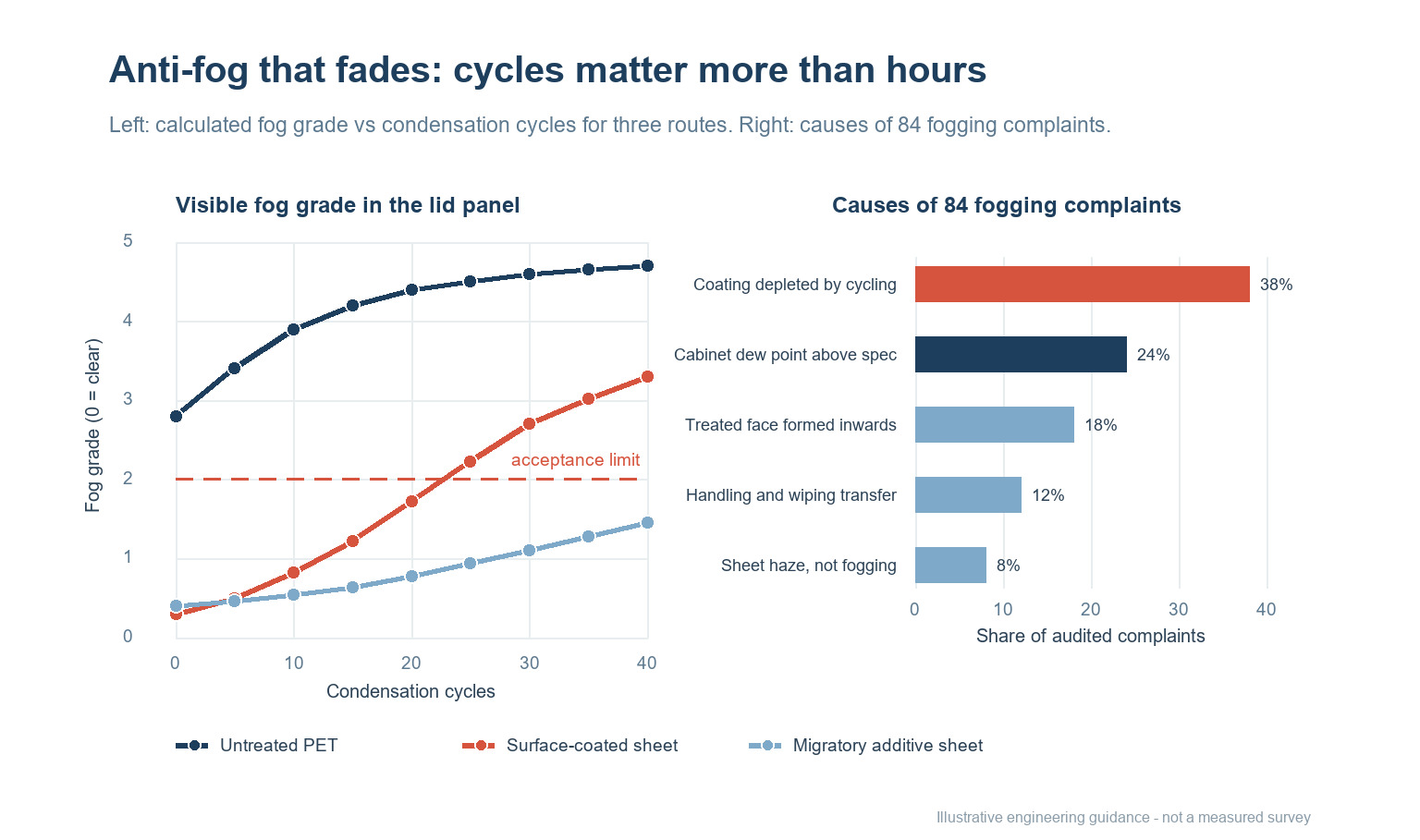
Most anti-fog systems work by holding a surface active ingredient at the interface, and an interface is a place that gets worn away. A migratory additive in the sheet continually replenishes the surface from the bulk of the polymer. A coating applied to the sheet or to the formed part starts with a finite layer. Both decline, but for different reasons and on different timescales.
Condensed water is the main removal mechanism. Each fogging cycle dissolves a little of the surfactant and leaves it in the droplets that run to the edge or evaporate. A tray seeing two condensation cycles a day in a retail cabinet loses treatment much faster than the same tray held at a steady temperature, even when the total hours in the cold are identical.
Contact removes it as well. Stacking, denesting on the filling line, wiping, dust removal, contact with the product, and the lidding film itself all transfer material off the surface. A treatment that passes on a flat sample can be largely gone from the formed part at the one point the customer looks through, namely the clear lid panel.
Face orientation is a quiet source of failure. Sheet is frequently treated on one side only. If the tooling, the loading direction, or a later lamination step puts that face away from the humid headspace, the pack behaves exactly like an untreated tray. Confirm the treated face on the formed part, not on the roll, and record which way it was loaded.
Time in store completes the picture. Surface treatments keep redistributing, and some lose effectiveness before a tray is ever filled. The same question is already familiar from antistatic coatings on stored trays: qualify the property at the end of the intended storage life, not only at goods-in.
Anti-fog options and what each one costs you
There is no universal best route. Each one puts the active chemistry in a different place, which changes how long it lasts, what it does to the converting line, and which documents have to accompany the pack. The decision belongs in the RFQ, not in a late change to the sheet order.
| Route | How it works | Trade-off | Where it fails first |
|---|---|---|---|
| Migratory additive in the sheet | Additive diffuses to the surface and is replenished from the bulk | Slower onset, formulation dependent, affects the whole sheet | Cold start, or when the reservoir is used up |
| Coating on the sheet | A thin surfactant layer applied before forming | Immediate performance, one extra converting step | Deep draw areas and mould contact |
| Coating on the formed part | Applied after forming, on the face that needs it | Best face control, added handling and cure or dry time | Throughput, overspray on the seal band |
| Surface activation or primer | Raises surface energy so water spreads without a free surfactant layer | Cleaner surface, needs tight process control | Decays with storage and handling |
| Pack design instead of chemistry | Venting, headspace control or an anti-fog lidding film | Moves the problem to a component you can change | Barrier, shelf life and sealing requirements |
Table 1 - Anti-fog routes, what each one costs, and where it tends to fail first.
Keep food-contact documentation in the same decision. A coating is part of the finished article, so the compliance file has to cover the treatment as well as the base sheet, including any change of coating supplier or formulation. Ask for the supporting declaration and migration assessment from the supplier and check that the document names the actual construction you are buying; do not accept a generic sheet certificate as evidence for a coated part.
Recyclability belongs in the conversation too. Additives and surface layers can affect how a PET tray is handled in a recycling stream, and a recycled-content declaration may need to state the calculation basis. If the pack carries a recycled-content or design-for-recycling claim, agree the evidence for it before the treatment route is fixed.
Where the forming line quietly removes it
Sheet heating is the first place a treatment can be lost. Surfactant layers sit within a narrow thermal window: too little heat and the sheet will not form cleanly, too much and the surface chemistry can degrade or migrate away from the face you need. Log the actual sheet temperature rather than the heater setting, and treat any change to the heating profile as a change to the anti-fog performance.
Stretching dilutes a surface layer. Where the draw ratio is highest, the same amount of active material is spread over a larger area, so a lid corner or a deep well can fog while a flat flange stays clear. If the failures follow the forming geometry rather than the batch, that is a distribution problem, not a coating supply problem.
Mould contact and release agents are the next suspects. A hot tool, a plug, or a release aid can transfer material away from the treated face, and a release agent left on the surface can raise the contact angle again. Check the plug temperature and the release routine alongside the fog result, in the same way chill marks on PET trays are traced back to plug condition.
Downstream steps finish the damage. Trimming dust, stacking and denesting friction, wiping, printing, and heat sealing near the lid all touch the treated face. A sealing band contaminated with surfactant can also show up as a seal complaint, which is why the anti-fog requirement and the lidding-seal requirement should be reviewed together.
The cheapest diagnostic is a stage-by-stage measurement. Test the sheet as received, a formed part straight off the tool, a part 24 hours later, and a part after its intended storage life. The step where the result moves tells you whether to change the treatment, the forming conditions or the handling, and it avoids a long argument about the sheet supplier.
Writing an anti-fog requirement into the tray specification
Write the requirement as a performance statement: the formed pack, filled or with a defined headspace simulant, stays legible after a stated number of condensation cycles at a stated temperature and humidity, with a defined inspection method and a defined storage age. Then name the supporting tests and their acceptance values. The words "anti-fog" alone on a drawing are not a specification.
| Metoda | What it measures | What it does not tell you |
|---|---|---|
| Contact angle on the formed part | Whether water will spread into a film | How long the effect survives cycling |
| Haze and light transmission | Optical clarity of the dry part | Wet behaviour under a dew point cycle |
| Cold fog visual grading | What a customer actually sees in the cabinet | Which mechanism caused the failure |
| Cabinet simulation with product | Behaviour with real humidity and temperature cycling | Performance after months in store |
| Stored-part retest | Whether the treatment survives the supply chain | Which process step removed it |
Table 2 - Anti-fog test methods and the question each one answers.
Fix the test conditions with the number. State the sample age at test, the number and length of condensation cycles, the temperature and humidity at each step, the viewing angle and lighting, and whether the pack is filled, empty or conditioned with a simulant. A grading result without those details cannot be compared between two suppliers or between two batches.
Agree a visual reference with the number. Photographs of an acceptable and a rejected lid, taken under the same lighting and angle, remove most of the subjectivity from a visual grade. Keep them in the approval file and issue a new set whenever the pack artwork, sheet gauge or lid geometry changes.
Put the requirement into the drawing, the RFQ and the first-article approval, and add a change-control line: any change of sheet supplier, coating formulation, coating applicator, tool or release agent requires re-approval of the anti-fog result. That single line prevents most of the surprises that arrive as a seasonal complaint.
Incoming inspection and the evidence pack
Sample by batch and by position, not just by pallet. A stack that has been sitting under load can behave differently at the bottom from the top, and a treatment that has partly transferred onto the tray above it will not show up in a single sample taken from the outside of a carton. Record the sheet roll, the coating batch, the forming date and the carton position with each result.
Set two inspection gates: on arrival, and at the end of the agreed storage window. The second gate is the one that catches a decaying treatment, and it needs retained samples from the same lot to be meaningful. If a 90 day retest is written into the specification, the sampling plan and the retention conditions have to be written in at the same time.
Keep an evidence pack that can answer a complaint without a new investigation: the declaration and migration documentation covering the coated construction, the sheet and coating batch traceability, the forming and storage dates, the test conditions and raw photographs from both gates, and the retained samples. This is the same discipline used for migration reports and declarations of compliance on thermoformed trays.
When a complaint arrives, diagnose in a fixed order. If the fogging clears on warming and returns on the next cold cycle, look at dew point and treatment condition first. If the whole lot fails dry optical checks, look at sheet haze and the forming step. If only older stock fails, look at storage decay. If only certain stores fail, measure the cabinet conditions before rejecting the supplier.
Finally, agree how a failure will be closed out. A corrective action that changes only the coating concentration may fix the first article and fail the next seasonal peak. Require the retest at the end of storage life on production parts from the production tool, with the change recorded against a new revision of the specification.
Is fogging the same as haze in PET sheet?
No. Haze is a lasting optical property of the sheet or its surface and is visible when the part is dry. Fogging is condensation of microscopic droplets on a cold surface, and it clears as the pack warms. A tray can have excellent dry clarity and still fog badly in a humid cabinet.
Why do some stores complain about fogging and others do not with the same batch?
Fogging starts when the lid surface falls below the dew point of the surrounding air. Cabinet temperature, humidity, door openings and air circulation vary between stores, and a pack of fresh produce raises its own internal humidity. Store conditions are usually the first thing to measure, before questioning the batch.
Does an anti-fog treatment change the food-contact documentation?
It can. The treatment is part of the finished article, so ask the supplier for documentation that covers the actual coated construction, including the coating formulation and any migration assessment. A certificate for the base sheet alone does not describe the part you are buying. Confirm the scope of the documents against your own market before approval.
How long should an anti-fog treatment last?
There is no universal figure. Durability depends on the route, the number of condensation cycles, handling and storage conditions. Specify it as a performance requirement at a stated storage age and after a stated number of cycles, then confirm it on production parts rather than on a flat sample.
Can ventilation holes replace an anti-fog treatment?
Sometimes, but it is a different trade. Venting equalises humidity with the cabinet and can reduce condensation, while also changing barrier performance, shelf life and how the pack handles on the filling line. Where modified atmosphere or leak tightness is required, it is rarely a free substitution.
What belongs in a first-article approval for an anti-fog tray?
Production parts from the production tool, at the agreed storage age and after the agreed condensation cycles, with the test conditions and photographs, the sheet and coating batch records, the compliance documentation for the coated construction, and retained samples for the later retest. A sample cut from sheet is not an approval sample.
A lid that turns white two days into shelf life?
Send the tray drawing, the sheet and coating specification, the cabinet temperature and humidity range, and when the fogging first appears. We will help you separate a treatment depletion problem from a forming problem or a display-condition problem.
Continue reading
- Thermoformed Food Trays: Material, Barrier and the Filling Line
- Antistat Coating That Fades in Store: Qualifying Surface Resistivity After 90 Days
- PET Sheet Crystallinity: Why APET Sags and CPET Does Not
- Clamshell Packaging: Hinge Design, Seal and the Opening Nobody Can Manage
- Food Contact Compliance for Thermoformed Packaging: FDA and EU 10/2011







 PL
 EN
 ES
 FR
 DE
 PT
 AR
 RU
 JA
 KO
 IT
 NL
 TR
 ID