

Tolerance is a cost, not a detail
Sheet is bought by weight and formed by thickness. Those two facts are the origin of the whole problem. A supplier who is paid by weight has no incentive to hold thickness tightly, and a former who needs a minimum wall has every reason to want it tight. The tolerance is where those two interests meet.
A loose tolerance does not cost the same at both ends. Sheet that is over nominal is material that is bought, shipped, heated and trimmed for nothing. Sheet that is under nominal produces parts that are too thin to meet the drawing, and those parts are scrap. One end is a slow leak and the other is a step loss.
The reason it gets ignored is that the cost is spread across purchasing, forming and quality, and nobody owns the total. Purchasing sees a cheaper sheet, forming sees a heavier sheet, quality sees a reject rate, and the three numbers are never added together.
Adding them together is the exercise in this article. On a thousand parts the difference between a twelve percent tolerance and a five percent tolerance is a five figure number, and it is larger than the price difference that made the loose tolerance look attractive.
What the tolerance actually controls
The sheet thickness sets the wall thickness of the formed part, minus whatever the forming process takes away. In a vacuum form the draw thins the wall, and the thinning is not uniform: a corner can be half the starting thickness and a flat panel almost all of it. The starting thickness is therefore the only number the former controls directly.
That is why the drawing usually calls out a minimum wall rather than a nominal one. If the minimum is 1.2 mm and the draw thins the worst point to 60 percent, the sheet has to be at least 2.0 mm. If the sheet is allowed to arrive at 1.8 mm, the part cannot be made to drawing at all, whatever the process does.
The tolerance also controls the process window. A thick sheet needs more heat and a longer cycle; a thin sheet needs less of both. A batch that varies by twelve percent across its width cannot be run at one setting, so the setter either runs to the thin end and wastes material on the thick end, or adjusts per sheet and loses the time.
There is a third effect that is rarely counted: the clamp frame. A sheet that is over thick does not sit in the frame the same way, and the seal is made on a different part of the edge. On a machine with a fixed frame depth, a twelve percent variation is enough to change the seal quality from sheet to sheet.
The cost of buying loose
The chart on the left plots material cost per thousand parts against the tolerance purchased. At plus or minus twelve percent the cost is 1 860 euro; at eight percent 1 760; at five percent 1 690; at three percent 1 670. The difference between the loosest and the tightest is 190 euro per thousand parts, and it is almost all resin that never ships.
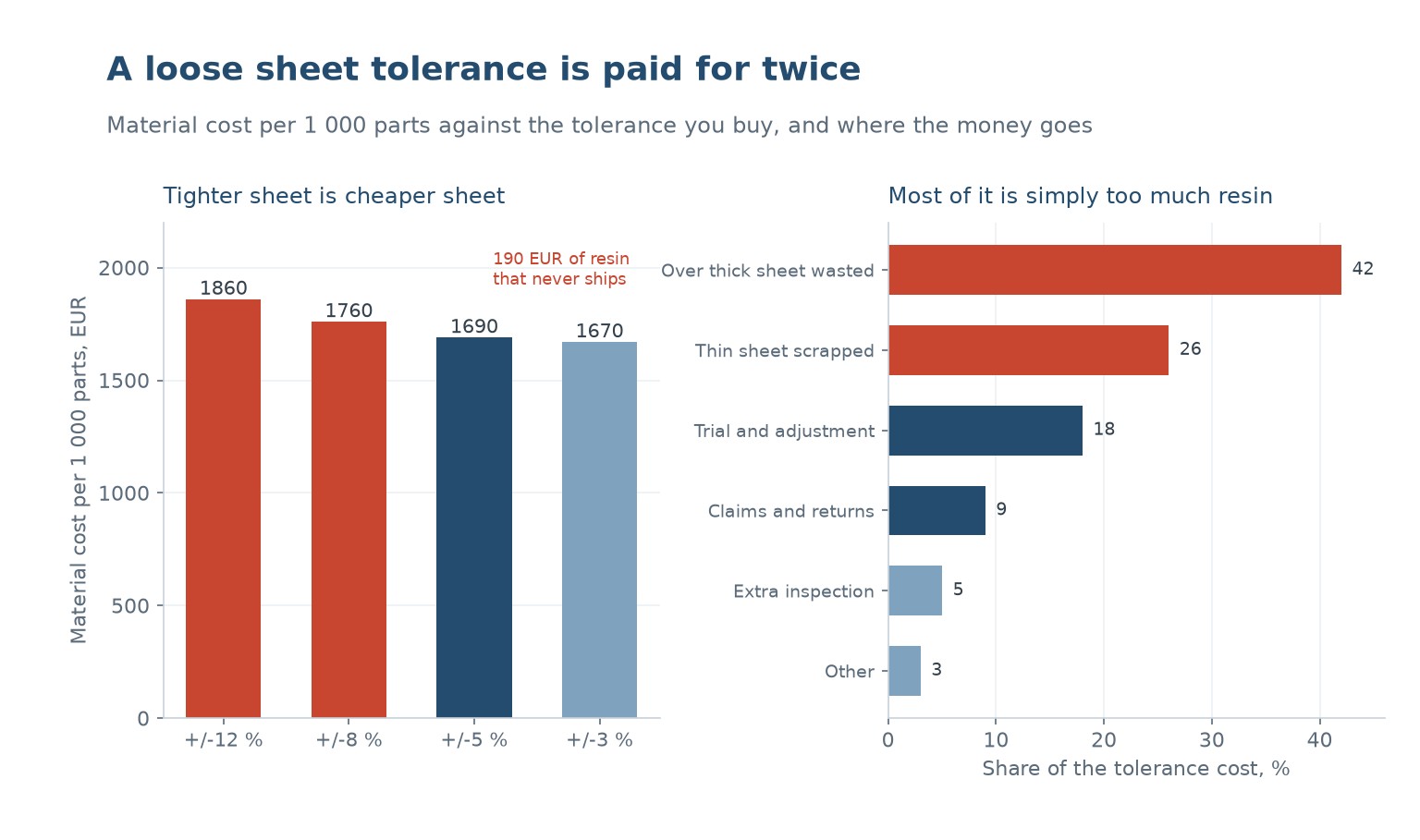
The shape of the bars explains where the money is. The step from twelve to eight percent saves 100 euro; from eight to five saves another 70; from five to three saves 20. The first two steps are worth taking and the third is marginal, which is why five percent is the usual specification for a demanding part.
The chart on the right allocates the cost. Over thick sheet wasted is 42 percent, thin sheet scrapped 26, trial and adjustment 18, claims and returns 9, extra inspection 5, and everything else 3. Sixty eight percent is material, which is why the saving is real rather than an accounting entry.
The numbers are per thousand parts and they scale linearly. At a hundred thousand parts a year the difference between twelve and five percent is 17 000 euro, and that is before the scrap and the claims are counted. A supplier who charges three percent more for a tighter sheet is usually cheaper in total.
Where the tolerance goes wrong
The tolerance on a sheet is not a single number, it is a distribution across the sheet and along the roll. A sheet that measures 2.0 mm at the centre and 1.85 at the edge is within a twelve percent band and is not a uniform material. Forming it produces parts that are thick in the middle and thin at the edge, and the drawing is met only where the measurement happened to be taken.
Roll stock has a different problem. The thickness varies along the length as well as across the width, and the variation has a period set by the die and the cooling. A roll that is good at the start can be out at the end, and the only way to know is to measure at intervals rather than at the start.
The third source is the caliper itself. A handheld micrometer reads the high point on a sheet and a dial gauge on a stand reads an average; the two disagree by more than the tolerance being argued about. Specifying how the sheet is measured is as important as specifying the tolerance.
The fourth is temperature. Sheet measured cold in a store room and sheet measured warm on the line are different thicknesses, because the thermal expansion of a polymer is ten times that of steel. A 2 mm sheet at 20 degrees is 2.02 mm at 40, which is one percent and enough to matter at a three percent tolerance.
| Tolerance | Typical use | What it buys |
|---|---|---|
| Plus or minus 12 percent | Undemanding parts, thick sections | Cheapest sheet, highest material cost |
| Plus or minus 8 percent | General packaging | A workable compromise |
| Plus or minus 5 percent | Technical parts with a minimum wall | The usual specification |
| Plus or minus 3 percent | Medical and optical | Premium sheet, tighter process |
| Plus or minus 2 percent | Special order only | Costs more than it saves in most cases |
Table 1 — Tolerances and what each one is for
Specifying it
A thickness specification has four lines: the nominal, the tolerance, the measurement method and the sampling plan. The nominal is set by the drawing. The tolerance is set by what the process can absorb. The method defines the instrument and the contact pressure. The sampling plan defines how many points and where.
The tolerance should be derived from the drawing rather than chosen from a table. Take the minimum wall, divide by the thinning factor at the worst point, and that is the minimum sheet. Take the maximum wall the part can tolerate and divide by the thinning at the thinnest point, and that is the maximum sheet. The difference is the tolerance the design can accept.
The measurement method should be the one the supplier uses, or the two of you will argue forever. A micrometer with a flat anvil and a defined closing force, measured at five points across the width and three along the length, is a reasonable standard and it is quick enough to do on every pallet.
The sampling plan should include the edges. Thickness variation is usually worst at the edge of a sheet and at the start of a roll, and a plan that samples only the centre will report a tolerance that the material does not hold. Five points across the width, including both edges, is the minimum.
Checking incoming sheet
Incoming inspection takes five minutes per pallet and it pays for itself in the first month. Measure at five points, record the minimum and the maximum, and compare the spread with the tolerance on the purchase order. A pallet that is out is a supplier conversation, not a forming problem.
Record the batch with the measurement. When a run of thin parts appears three weeks later, the record is what lets you say whether the sheet or the process changed. Without it, the investigation starts from zero and usually ends with the process being adjusted to compensate for the material.
Check the width as well as the thickness. A sheet that is 10 mm narrow does not clamp, and the clamp is where the seal is made. Width is cheap to check and expensive to discover at the machine.
The last check is the one that is never done: measure a formed part and compare its wall with the sheet it came from. That single comparison tells you the thinning factor for your process, and once you know it the tolerance calculation stops being a guess and becomes arithmetic.
| Where the cost lands | Share | How to reduce it |
|---|---|---|
| Over thick sheet wasted | 42 percent | Tighter tolerance, buy by thickness not weight |
| Thin sheet scrapped | 26 percent | Minimum wall check, reject at goods in |
| Trial and adjustment | 18 percent | One setting per batch, record the window |
| Claims and returns | 9 percent | Wall measurement on the finished part |
| Extra inspection | 5 percent | Sample by batch rather than by part |
Table 2 — Where the tolerance cost goes and what reduces it
What tolerance should I specify for thermoforming sheet?
Plus or minus five percent for a technical part with a minimum wall. Twelve percent is fine for undemanding packaging, and three percent is only worth buying for medical or optical work.
Why does a loose tolerance cost more?
Because over thick sheet is resin that is bought, heated and trimmed for nothing, and thin sheet produces parts below the minimum wall. On a thousand parts the difference between twelve and five percent is about 170 euro.
How is sheet thickness measured?
With a flat anvil micrometer at a defined closing force, at five points across the width and three along the length. The instrument and the pressure have to be agreed with the supplier or the numbers will not match.
Does thickness vary across a sheet?
Yes, and that is often the bigger problem. A sheet within tolerance at the centre and at the edge can still be 0.15 mm thinner at one edge, which produces parts that are thin on one side only.
Can I compensate for thin sheet with the process?
Only slightly. A longer heat cycle and more vacuum help at the margin, but if the starting sheet is below the minimum the part cannot be made to drawing at any setting.
Should I buy sheet by weight or by thickness?
By thickness, with the weight as a check. Buying by weight gives the supplier an incentive to be at the top of the tolerance, which is exactly the end that costs you material.
Parts that are thin on one side of the sheet?
Send the drawing, the sheet specification and a few measurements from the incoming pallet. We will tell you whether the tolerance or the forming is responsible.
Continue reading
- Thermoforming Sheet Yield: Where the Material Actually Goes
- Sheet Storage and Handling: Moisture, Static and Hidden Damage
- Thermoforming Thinning: Predicting Wall Thickness Before the Trial
- Thermoforming Sheet Sag Control: Keeping the Sheet Flat
- Thermoforming Cooling Cycle: Time, Temperature and Distortion




 PL
 EN
 ES
 FR
 DE
 PT
 AR
 RU
 JA
 KO
 IT
 NL
 TR
 ID
