

Four routes, and only one of them is free
A threaded feature in a moulded part can be made four ways: moulded directly in the tool, moulded over a metal insert, inserted after moulding by heat or ultrasonics, or cut after moulding with a tap. Each has a different cost structure and a different failure mode.
A moulded thread costs nothing per part beyond the cycle time and the tool work. It is also the weakest option, because the thread is made of the same plastic as the wall and it has to be stripped or unscrewed from the tool, which limits the thread form and the number of turns.
A moulded-in insert costs the price of the insert plus the handling to place it in the tool before every shot. It gives a metal thread in a plastic wall, and it is strong, but the placement step is manual on most tools and it is a cycle time and quality risk.
A post-moulded insert, installed by heat or ultrasonic energy, avoids the in-mould placement but adds a second operation and a second machine. It is usually the cheapest way to get a metal thread at moderate volume.
Tapping after moulding is the fallback. It is slow, it produces chips, and it is only worth it for low volume or for thread forms that cannot be moulded, such as a very fine pitch or a thread that has to be repaired.
The numbers, for an M6 in glass-filled PA66
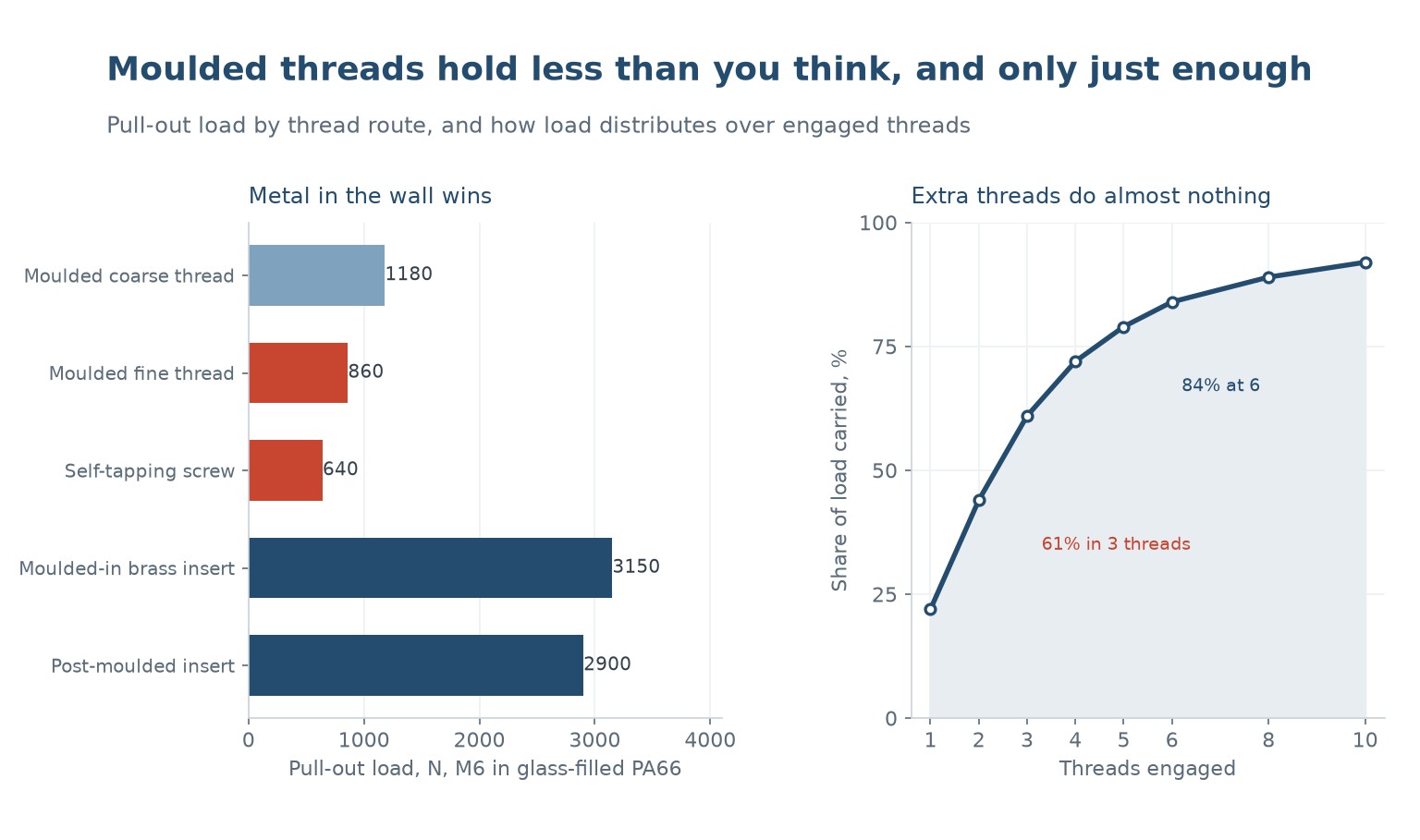
Pull-out load on an M6 thread in 30 percent glass-filled PA66, measured on the same boss geometry: a moulded coarse thread holds about 1,180 N, a moulded fine thread about 860 N, a self-tapping screw in a plain hole about 640 N, a moulded-in brass insert about 3,150 N, and a post-moulded insert about 2,900 N.
The gap between 1,180 and 3,150 is not a small percentage. A moulded thread carries roughly a third of what an insert carries, and the difference is not the thread form; it is that the insert spreads the load into the wall through its knurl or its through-hole, while a moulded thread loads the wall directly at the root.
The fine thread is weaker than the coarse one, which surprises people who assume finer means more precise. A fine thread has a shallower depth, so there is less material engaged, and in a glass-filled material the notch at the root of a shallow thread is a better crack starter. Coarse threads are the right choice for moulded plastic.
These numbers are for a single pull-out. A joint that will be assembled and disassembled twenty times needs a different calculation, and a moulded thread in an unfilled material may not survive five cycles before the crests wear round.
The design rules for a moulded thread
The first rule is thread form. Use a coarse, rounded thread, not a sharp V. The root radius is what decides whether the thread strips or the boss cracks, and a sharp root in a glass-filled material will crack before it strips.
The second rule is engagement length. One diameter of engagement carries most of the load; one and a half diameters is the practical maximum for a moulded thread, because the last turns carry almost nothing and they are the ones that need the most draft to release.
The third rule is release. A moulded internal thread has to be unscrewed from the core, which means either a rotating core, a collapsing core, or a thread that is stripped off a flexible core. Stripping works for shallow threads in flexible materials and destroys the thread in rigid ones. For rigid materials, plan for a rotating or collapsing core and budget for it in the tool.
The fourth rule is the wall around the thread. The boss wall has to be thick enough to carry the thread and thin enough not to sink on the outside face. A common starting point is a wall of one third of the nominal diameter, with a transition radius at the base that is at least a quarter of the boss diameter.
The fifth rule is anti-rotation. A moulded thread that is over-torqued will not strip the thread; it will rotate the whole boss in the wall. A boss that stands on a ribbed web, or that has a flat on one side, resists that.
Inserts: what actually goes wrong
The failure mode of a moulded-in insert is not usually pull-out. It is the wall cracking around the insert, because the insert was placed cold in a hot tool and the plastic shrinks onto it under tension. A preheated insert, or one with a compliant knurl, avoids most of this.
The second failure is flash. Plastic gets between the insert and the tool and forms a thin film that has to be removed, or worse, blocks the thread. A insert with a proper flange and a shut-off face prevents it; a plain cylindrical insert does not.
The third is placement error. An insert that is 0.3 mm off centre gives a thread that is 0.3 mm off centre, and on a part that bolts to something else that is enough to strip the screw or to leave a gap. In-mould placement needs a jig or a robot, not a pair of tweezers.
For post-moulded inserts the failure is different: the hole was moulded too small, so the insert either will not go in or it splits the boss. The hole diameter for a heat-set insert is specified by the insert maker and it is not a tolerance you can guess. Measure the first ten.
Choosing between them
The decision usually comes down to three questions. How many assembly cycles will the joint see? What load does it carry? And what is the annual volume?
A joint assembled once, carrying a light load, at high volume, is a moulded thread. A joint assembled many times, or carrying a structural load, is an insert regardless of volume. A joint at low volume with a structural load is a post-moulded insert, because the tooling for an in-mould insert cannot be justified.
The volume thresholds are rough but useful. In-mould inserts usually need more than 20,000 parts a year to justify the tool complexity. Post-moulded inserts are economic from a few thousand. Moulded threads are economic at any volume, which is exactly why they get used in places they should not be.
| Route | Typical pull-out, M6 | Best volume | Main risk |
|---|---|---|---|
| Moulded coarse thread | 1,180 N | Any | Strips at low torque, wears with cycles |
| Moulded fine thread | 860 N | Any | Weaker than coarse, notch sensitive |
| Self-tapping screw | 640 N | Laag tot gemiddeld | Cracks the boss, one assembly only |
| Moulded-in insert | 3,150 N | Above 20,000 a year | Wall cracking, placement error |
| Post-moulded insert | 2,900 N | Above 3,000 a year | Boss splitting if the hole is small |
| Tapped after moulding | Similar to moulded | Low volume | Chips, slow, thread repair only |
Table 1 — Thread routes against strength and volume
How to put it on the drawing
A moulded thread is not a machined thread and should not be specified like one. Write the thread form and the engagement length, and add a note that the thread is moulded and that the crest may be rounded. If the drawing calls out a standard thread with a sharp root, the toolmaker will either ignore it or make a tool that cracks parts.
Give the boss diameter, the wall thickness at the thread, and the base radius. Those three numbers decide whether the part cracks in service, and none of them are implied by a thread callout.
For an insert, specify the insert by part number and by the hole diameter that the insert maker requires, with a tolerance. Do not let the toolmaker derive the hole from the insert's outside diameter; the interference is specified and it is not zero.
| Functie | What to specify | Waarom |
|---|---|---|
| Thread form | Coarse, rounded root | Sharp roots crack in glass-filled material |
| Engagement | 1.0 to 1.5 diameters | Beyond 1.5 adds nothing and hurts release |
| Boss wall | About one third of nominal diameter | Thick enough to carry, thin enough not to sink |
| Base radius | At least a quarter of the boss diameter | Removes the stress riser at the root |
| Anti-rotation | Rib web or a flat on the boss | Over-torque rotates the boss, not the thread |
| Insert hole | Insert maker's diameter with a tolerance | Guessing splits the boss |
Table 2 — What a moulded thread drawing has to contain
Can I mould an M6 thread directly in the tool?
Yes, with a coarse rounded thread and a core that either rotates or collapses. A moulded M6 in glass-filled PA66 holds about 1,180 N in pull-out, roughly a third of what a brass insert holds.
Why is a fine thread weaker than a coarse one when moulded?
A fine thread is shallower, so less material is engaged, and the notch at the root is a better crack starter in a glass-filled material. Coarse threads are the right choice for moulded plastic.
How many threads should engage?
One diameter carries most of the load and one and a half diameters is the practical maximum. Beyond that the extra turns carry almost nothing and they make release from the core harder.
Should I use an in-mould insert or a post-moulded one?
In-mould above roughly 20,000 parts a year, where the placement can be automated. Below that, a post-moulded insert avoids the tool complexity and the cycle time risk.
Why did my boss crack around the insert?
Usually because the insert was placed cold and the plastic shrank onto it under tension, or because the moulded hole was undersized for a post-moulded insert. Pre-heat in-mould inserts and measure the first ten holes.
Can a moulded thread be assembled more than once?
It can, but the crests wear. In an unfilled material, five to ten cycles is realistic before the thread starts to feel loose. If the joint will be serviced repeatedly, use an insert.
Threaded feature that keeps failing?
Send the drawing with the thread callout, the load and the assembly count. We will tell you whether to mould it, insert it or tap it, and what the boss has to look like.




 NL
 EN
 ES
 FR
 DE
 PT
 AR
 RU
 JA
 KO
 IT
 TR
 PL
 ID
