
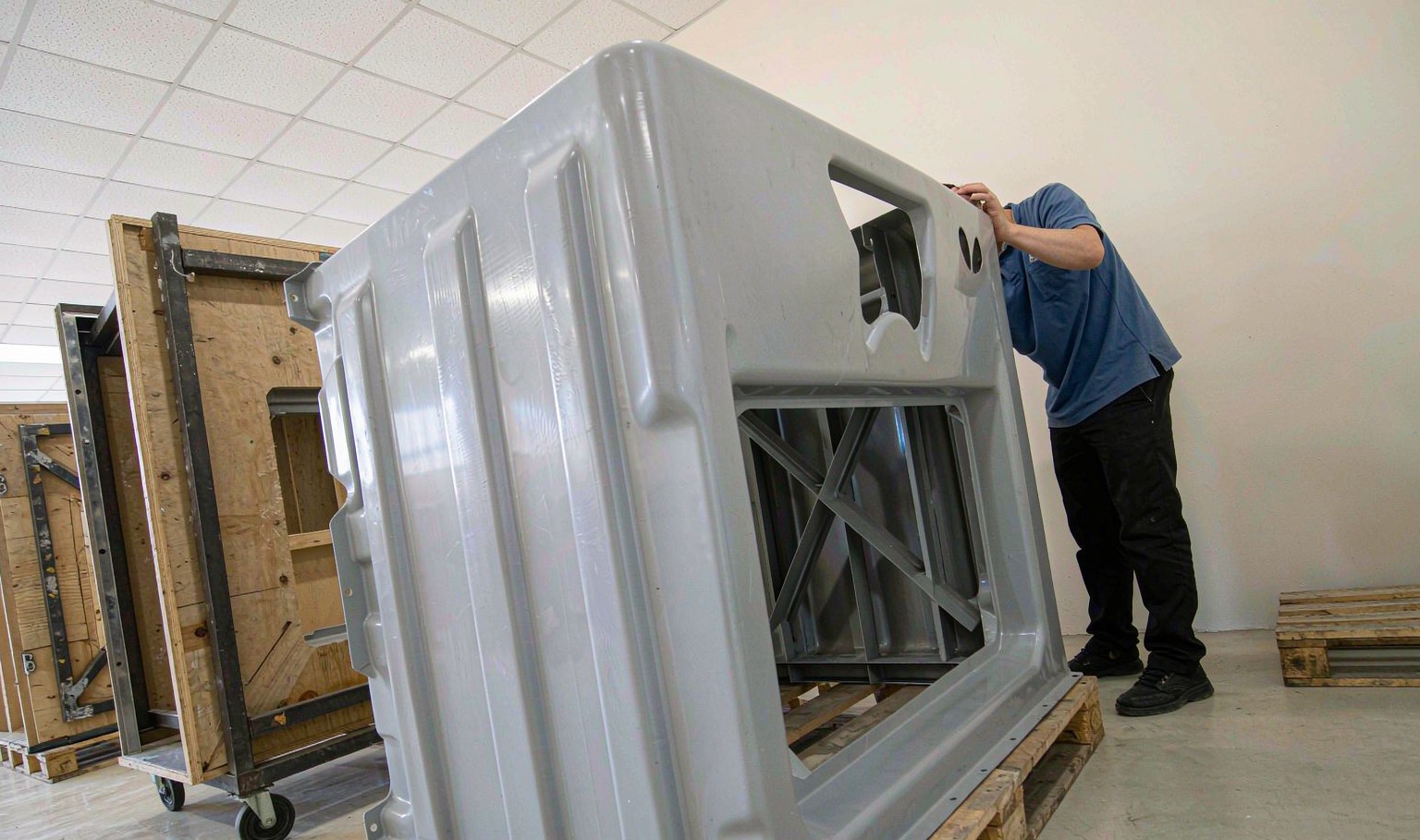
The problem is the ratio, not the part
A machine housing is a large, shallow, cosmetic part with a few functional features: a display cut-out, a fan grille, a cable exit, a mounting flange. Thermoforming is the right process for it, because injection moulding a 1,200 mm cover needs a tool that costs more than the machine it covers.
The difficulty is that the same part is often needed in tens rather than thousands. A machine builder making 40 units a year needs 40 housings a year, and a tool that costs 30,000 units of currency amortised over 40 parts is 750 per part before any plastic is formed.
So the whole design of a small-volume housing is a tooling decision, and the part geometry follows from it. A housing designed for an aluminium tool has features that a housing designed for an epoxy tool cannot have, and the difference shows up as a cost per part that is three times higher than it needs to be.
The other constraint is size. A 1,500 mm housing needs a 1,500 mm oven and a 1,500 mm former, and there are not many of those. The machine available often decides the part layout before the designer does.
Epoxy or aluminium, and where the crossover is
An epoxy tool is a glass-filled resin shell cast over a pattern, backed with a steel or wooden frame. It costs a fraction of an aluminium tool, it takes 2 to 3 weeks instead of 6 to 8, and it holds a vacuum well. It also has a short life, a lower thermal conductivity and a surface that degrades with every cycle.
The cost per part tells the story. At 10 off, an aluminium tool gives 980 units per part and an epoxy tool 560. At 50 off it is 320 against 190. At 200 off it is 168 against 132. At 1,000 it is 112 against 118. At 5,000 it is 96 against 112.
The crossover is at about 250 parts. Below that the epoxy tool is cheaper per part; above it the aluminium tool wins and keeps winning, because the tool cost is amortised and the aluminium tool has a longer life and a faster cycle.
The crossover moves with the part. A housing with a deep draw or a fine texture pushes it towards aluminium, because an epoxy tool cannot hold a deep draw at temperature for long and its surface texture wears out. A housing with a simple shape and a matte finish pushes it towards epoxy.

Warpage scales with length, and it is not a tool problem
A formed housing comes off the tool hot and it shrinks as it cools. The shrinkage is not uniform: the walls shrink in the plane of the sheet, the base shrinks in the plane of the sheet, and the difference between them is what makes the part bow.
The amount of bow scales with the square of the length. A 300 mm housing warps 1.1 mm. A 600 mm housing warps 2.4, a 900 mm housing 4.3, a 1,200 mm housing 6.9, and a 1,500 mm housing 10.4. Doubling the length quadruples the bow, which is why a 600 mm cover is easy and a 1,500 mm cover is a project.
A 3 mm flatness limit on a 1,500 mm housing is not achievable by forming alone. It is achieved by forming, then cooling in a fixture that holds the part in its correct shape until it is below 40 C, then trimming. The fixture is not a nicety on a large housing; it is the process.
The other lever is the sheet. A sheet with balanced orientation shrinks evenly in both directions and bows less. A sheet that was extruded with a strong machine direction orientation shrinks more along the machine and the part curls. Specifying a balanced sheet costs a little more and saves a fixture redesign.
Designing for the process you can afford
An epoxy tool cannot hold a sharp internal corner, because the resin shrinks away from the pattern and the corner rounds. It cannot hold a fine texture, because the texture is in the pattern and the pattern wears. It cannot hold a deep draw at 80 C for 500 cycles, because the resin softens.
So a housing designed for epoxy has generous radii, a matte or no texture, a draw ratio under 0.35, and features that are cut after forming rather than formed. Those are not compromises on quality; they are the geometry that suits the tool, and a part designed that way looks intentional.
A housing designed for aluminium can have a 0.4 draw ratio, a fine texture, a sharp flange and formed screw bosses. It also costs three times as much to tool, and if the volume is 40 a year it will never pay back.
The features that are always cut rather than formed are the display window, the connector cut-outs and the mounting holes. A formed hole is a hole with a thinned rim and a witness mark, and on a cosmetic cover it looks like a mistake.
| Functie | Epoxy tool | Aluminium tool |
|---|---|---|
| Draw ratio | Up to 0.35 | Up to 0.5 |
| Internal corner | 6 mm minimum | 2 mm minimum |
| Texture | Matte or none | Fine grain possible |
| Tool life | 200 to 500 parts | 50,000 parts |
| Lead time | 2 to 3 weeks | 6 to 8 weeks |
| Cost per part at 100 | 160 | 130 |
Table 1 — What each tool route can and cannot do
What a housing actually costs
The tool is the visible cost and it is rarely the largest one. On a 40-a-year housing the sheet is 20 to 30 percent of the cost, the forming is 25 to 35 percent, the trimming and the fixtures are 15 percent, and the tool amortisation is the rest.
The hidden cost is the fixture. A large housing needs a cooling fixture and a trim fixture, and both of them are part-specific. On a small volume they can cost as much as the forming tool, and a quotation that covers only the tool is a quotation that will be revised.
The other hidden cost is packing. A 1,200 mm cosmetic housing that gets a scratch in transit is a housing that has to be remade, and at 40 a year a 5 percent transit damage rate is two remakes. A foam-lined returnable crate costs less than the remakes.
The comparison that matters is not thermoforming against injection moulding. It is thermoforming against sheet metal, which is the other way to make a housing at this volume. Sheet metal needs a press brake, a weld fixture and a paint line, and it gives a metal housing with a different look. Thermoforming gives a plastic housing with formed ribs and no secondary assembly, and at 40 a year it usually wins on both cost and appearance.
| Cost element | Share of part cost | What drives it |
|---|---|---|
| Sheet | 20 to 30% | Gauge, colour, UV grade |
| Het vormen van | 25 to 35% | Cycle time, oven, labour |
| Trimmen | 10 to 15% | Cut-outs, fixtures |
| Cooling fixture | 5 to 10% | Size, flatness requirement |
| Tool amortisation | 15 to 30% | Tool cost over quantity |
| Packing | 3 to 6% | Cosmetic protection in transit |
Table 2 — Where the money goes on a small-volume housing
What to send for a quotation
A housing quotation needs five things: the drawing with the critical dimensions, the annual quantity and the batch size, the material and colour, the surface finish, and the environment the housing has to survive.
The batch size matters as much as the annual quantity. Forty a year in one batch of forty is a different job from forty a year in batches of five, because the setup cost per batch is real and it is 30 to 60 minutes on a large former.
The environment decides the material. An indoor machine housing in ABS is fine. An outdoor one needs a UV-stabilised grade or a cap layer. One that sees solvent or oil needs a chemical-resistant grade, and one that has to meet a fire rating needs a flame-retardant sheet that forms differently.
Is an epoxy tool good enough for a machine housing?
Up to about 250 parts and a draw ratio of 0.35, yes. It is cheaper, faster to make and holds a vacuum well. Above that, or for a deep draw or a fine texture, aluminium is the better route.
Where is the crossover between epoxy and aluminium?
About 250 parts. At 10 off the epoxy tool gives 560 units per part against 980 for aluminium; at 1,000 off it is 118 against 112.
Why does a large housing warp so much?
Because bow scales with the square of the length. A 300 mm housing warps 1.1 mm and a 1,500 mm housing 10.4 mm, which is why a large housing needs a cooling fixture.
Can a formed housing hold a 3 mm flatness?
Not by forming alone at 1,500 mm. It needs a cooling fixture that holds the part until it is below 40 C, and a balanced sheet that shrinks evenly.
Should holes be formed or cut?
Cut. A formed hole has a thinned rim and a witness mark, which looks like a defect on a cosmetic cover. The same applies to display windows and connector cut-outs.
How long does a tool take?
Two to three weeks for epoxy and six to eight for aluminium, and the aluminium route also needs a trial and a first-article inspection.
Forty housings a year, and a tool quote that does not add up?
Send the drawing, the annual quantity and the environment. We will tell you whether epoxy or aluminium is the cheaper route, and what the fixtures will cost.




 NL
 EN
 ES
 FR
 DE
 PT
 AR
 RU
 JA
 KO
 IT
 TR
 PL
 ID
