
What PPR is, and why it is not PP
PPR is polypropylene random copolymer. A small fraction of ethylene is inserted randomly along the chain, which disrupts the crystallinity enough to make the polymer transparent-ish and, more importantly, to make it tough at low temperature and resistant to slow crack growth under pressure.
Homopolymer PP is stiffer and cheaper and would be a better pipe on paper. It is not used because it becomes brittle below about 5 °C, and a buried water pipe sees that temperature every winter. The random copolymer keeps impact strength down to −10 °C, which is the whole reason PPR exists as a pipe material.
PPR is joined by fusion welding, not by solvent cement or mechanical fittings. A heated tool brings both pipe end and fitting bore to melting point, they are pushed together, and the material fuses into one piece. A correct joint is stronger than the pipe; an incorrect one is the point where the system will fail.
| Grade | Design stress at 20 °C | Typical use | Note |
|---|---|---|---|
| PPR 80 | 6.3 MPa | Cold water, low pressure | Legacy grade, still common |
| PPR 100 | 8.0 MPa | Hot and cold water | The current default |
| PPR 125 | 10.0 MPa | High pressure, industrial | Higher cost, better creep |
Table 1 — PPR grades and design stress. The number is not a pressure; the pressure follows from SDR and temperature.
The derating curve is the specification
Every PPR pipe is rated at 20 °C, because that is the temperature at which the 50-year hydrostatic extrapolation is done. Almost no PPR pipe operates at 20 °C. Hot water service is 60 to 70 °C, and heating systems run at 70 to 80 °C.
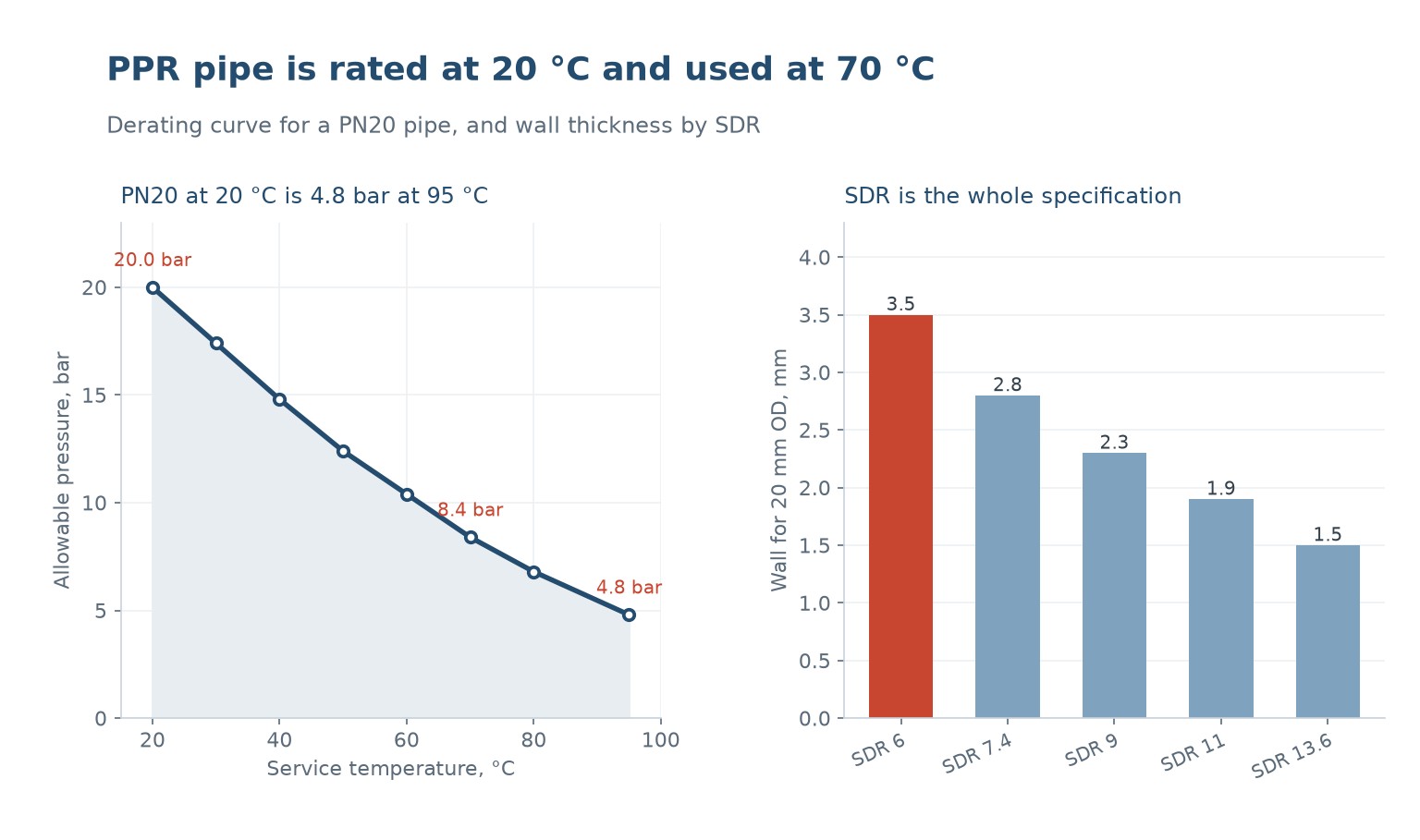
The derating is severe. At 60 °C a PN20 pipe is good for about 10.4 bar; at 70 °C, 8.4 bar; at 80 °C, 6.8 bar; at 95 °C, 4.8 bar. A system designed for 10 bar working pressure and installed in 70 °C service is running at 119 percent of its allowable stress, and it will fail by slow crack growth in five to fifteen years rather than fifty.
This is the single most common engineering error in PPR systems, and it is invisible at installation because the pipe is not overloaded at commissioning. It fails later, usually at a fusion joint, and usually in a wall.
| Temperatuur | Factor | PN20 allowable | PN16 allowable |
|---|---|---|---|
| 20 °C | 1.00 | 20.0 bar | 16.0 bar |
| 30 °C | 0.87 | 17.4 bar | 13.9 bar |
| 40 °C | 0.74 | 14.8 bar | 11.8 bar |
| 50 °C | 0.62 | 12.4 bar | 9.9 bar |
| 60 °C | 0.52 | 10.4 bar | 8.3 bar |
| 70 °C | 0.42 | 8.4 bar | 6.7 bar |
| 80 °C | 0.34 | 6.8 bar | 5.4 bar |
| 95 °C | 0.24 | 4.8 bar | 3.8 bar |
Table 2 — Temperature derating for PPR 100. Use the 70 °C column for domestic hot water, not the 20 °C number on the pipe.
Extrusion: slow cooling and a long tank
PPR is a semi-crystalline polymer with a melting point around 145 °C and a wide processing band from 200 to 240 °C. It extrudes easily and it cools slowly, which is the defining constraint on the line.
The crystallisation that gives PPR its strength also releases heat, and that heat has to be removed through an already-solid layer. A 32 mm SDR 6 pipe with a 3.5 mm wall needs about 4 m of cooling at 2 m/min; a 63 mm SDR 6 pipe with a 7 mm wall needs 8 m at the same speed. Undersized tanks produce pipe that is oval and has high residual stress, and the stress shows up as a pipe that curls when cut.
Melt temperature should be kept at the lower end of the range. PPR at 240 °C oxidises faster and the surface takes on a yellow tint that is the first sign of degradation. 210 to 225 °C is the working band for most lines.
Sizing is by vacuum sleeve for small diameters and vacuum tank for large. PPR is stiffer than HDPE at the same temperature, so sag is less of a problem, but the shrinkage is higher — 1.5 to 2.5 percent — and the sizing sleeve must be cut to compensate.
Dimensions: SDR is the whole specification
PPR pipe is specified by outside diameter and SDR, exactly as HDPE is. The wall follows as OD / SDR, and the pressure rating follows from the wall. A 20 mm SDR 6 pipe has a 3.5 mm wall and is rated PN20; the same diameter at SDR 11 has a 1.9 mm wall and is rated PN12.5.
The dimension that gets ignored is ovality. PPR pipe is coiled or straight-length, and a coil that has been wound too tight will be oval at the point where it was bent. An oval pipe end does not enter a fusion fitting squarely, and the joint that results is the one that fails.
Fusion jointing: the part that decides the system
A PPR system has no weak link except its joints, and the joints are made on site by whoever is available. The process is simple and the tolerance for error is not.
Heating tool temperature must be 260 ± 5 °C. Below 250 the material does not reach fusion temperature and the joint is a cold weld that holds at commissioning and fails in service. Above 280 the material degrades and the joint is weak from the start.
Heating time depends on wall thickness: roughly 5 seconds per millimetre of wall for the pipe, plus 5 seconds for the fitting. A 3.5 mm wall pipe into a fitting needs about 22 seconds of heating. Pushing too fast gives a joint with a thick internal bead and a thin fusion zone; pushing too slowly gives a joint with no bead at all.
Cooling time before handling is at least 6 times the heating time. A joint that is moved while still hot will be misaligned and the fusion zone will be stressed. On a site where the installer is being paid by the metre, this is the step that gets skipped.
| Pipe OD | Wall (SDR 6) | Opwarmtijd | Cooling before handling |
|---|---|---|---|
| 20 mm | 3.5 mm | 22 s | 2 min |
| 25 mm | 4.2 mm | 26 s | 3 min |
| 32 mm | 5.4 mm | 32 s | 3 min |
| 50 mm | 8.3 mm | 47 s | 5 min |
| 63 mm | 10.5 mm | 58 s | 6 min |
Table 3 — Fusion parameters at 260 °C tool temperature. Times are for the pipe side; add 5 seconds for the fitting socket.
What to test and when
A completed PPR system is pressure tested before it is covered, at 1.5 times working pressure for one hour, with the test pressure held and recorded. That catches installation errors and defective joints. It does not catch the derating error described earlier, because the test is done cold.
The test that catches design errors is a review of the specification: working temperature, working pressure, SDR, and the allowable pressure at that temperature. If the allowable is not at least 1.5 times the working pressure, the pipe is undersized and no amount of careful installation will fix it.
What does PN20 mean on a PPR pipe?
It is the nominal pressure at 20 °C for a 50-year service life. It is not the allowable pressure at operating temperature. At 70 °C a PN20 pipe is good for about 8.4 bar.
Can PPR be used for cold water only?
It can, and it is often specified for both because using one material simplifies the installation. If the system is cold only, a lower SDR can be used and the cost falls.
Why do PPR joints leak after a few years?
Almost always a cold joint. The heating tool was below 250 °C or the heating time was short, so the fusion zone never formed. The joint passes a cold pressure test and fails under thermal cycling.
Is PPR suitable for underfloor heating?
Yes, and it is widely used for it. The temperature is typically 40 to 50 °C, where the derating is mild, and the fusion joints are buried and must be right the first time.
What is the difference between PPR and PEX?
PPR is rigid and joined by fusion; PEX is flexible and joined by mechanical fittings. PPR is cheaper for large diameters and straight runs; PEX is easier to route through existing structures.
How much does PPR pipe shrink after extrusion?
1.5 to 2.5 percent over 24 hours, depending on wall and cooling. Sizing sleeves are cut oversize, and the factor must be measured on the line rather than taken from a datasheet.
Extruding PPR pipe and chasing ovality?
Give us the diameter, the SDR and the line speed. We will tell you the cooling length and the sizing allowance, and where the residual stress will show first.




 NL
 EN
 ES
 FR
 DE
 PT
 AR
 RU
 JA
 KO
 IT
 TR
 PL
 ID
