
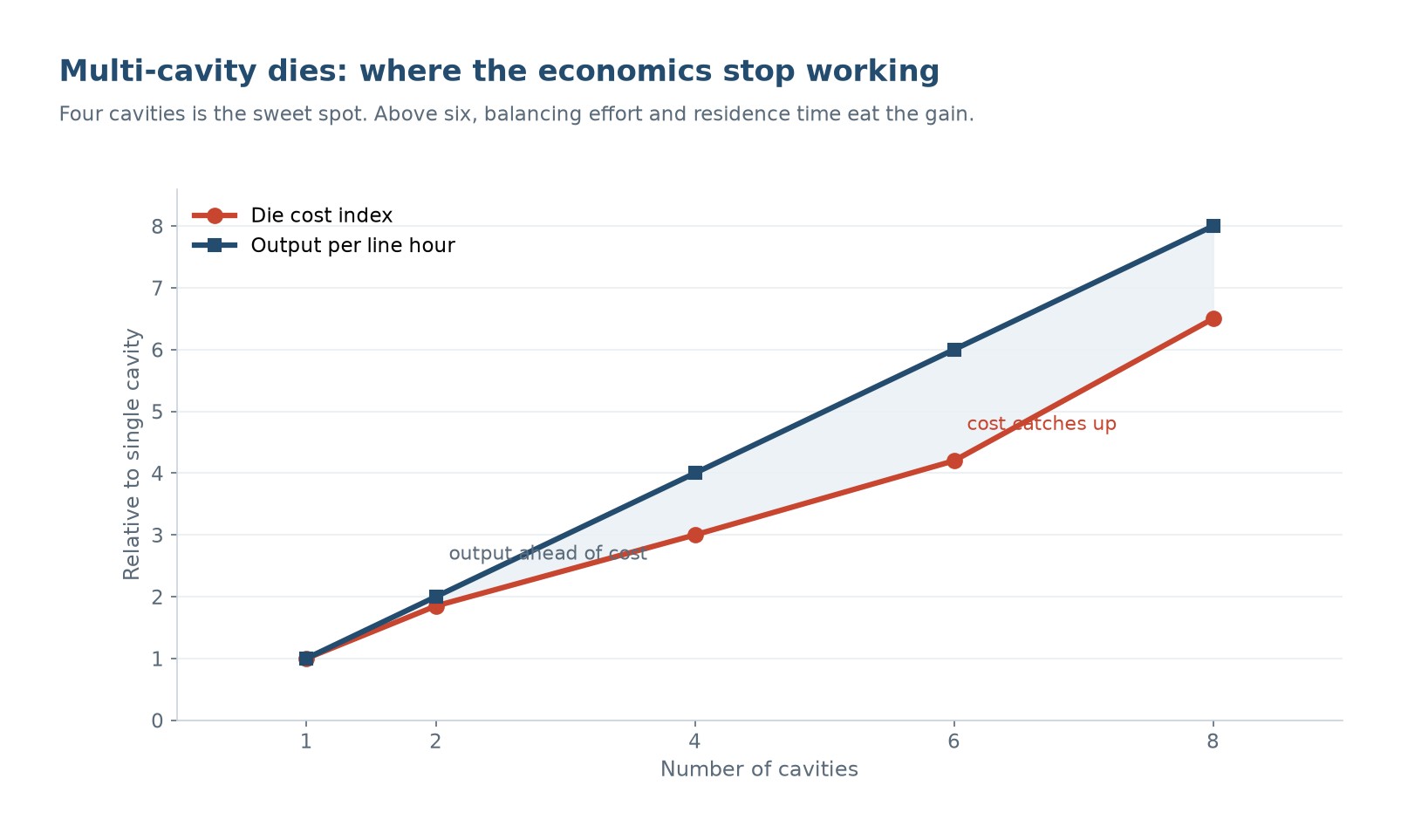
Why multi-cavity is a volume decision
Running two or four profiles through one die is the standard way to raise output without buying a bigger extruder. The arithmetic is attractive: a 75 mm extruder producing 250 kg/h can feed four cavities of a small profile at 62 kg/h each, or one cavity at 250 kg/h — but the single cavity would need a line speed four times higher, and most cooling sections cannot support that.
So multi-cavity is often not about output at all. It is about line speed. Four cavities let you run at a comfortable 3–4 m/min instead of 12–16 m/min, which the cooling tank can actually handle.
The trade: a four-cavity die costs roughly 2.5–3.5 times a single-cavity die, but it produces four times the output per hour of line time. Below about 30,000 m/year of profile, the die cost does not amortise. Above it, multi-cavity is usually the cheapest way to add capacity.
The manifold: where balance is won or lost
A multi-cavity die takes one melt stream and splits it. The splitting geometry is the manifold, and its job is to deliver identical pressure and identical thermal history to every cavity.
| Manifold type | How it splits | Balance quality | Complexiteit |
|---|---|---|---|
| H (coat-hanger) manifold | Symmetric Y-splits, equal path lengths | Goed | Matig |
| T (T-manifold) | Straight run with branches | Poor; pressure drops along the run | Laag |
| Spiral mandrel | Melt spirals around a mandrel and spreads | Good, used for tube and blown film | Hoog |
| Fishtail | Gradual widening from inlet to full width | Moderate; needs land adjustment | Laag |
| Balanced bridge | Runner lengths equalised by geometry | Very good | Hoog |
Table 1 — Manifold types for multi-cavity dies. The T-manifold is cheap and produces cavities that run at different pressures, which is exactly the problem multi-cavity is trying to avoid.
The balanced bridge is the reference design: the runner path from the inlet to each cavity is made exactly the same length, so each cavity sees the same pressure drop. It costs more to machine and it takes up more space in the die body, but it removes the single largest source of cavity-to-cavity variation.
Land length: the fine adjustment
Manifold balance gets you close. Land length gets you exact. The land is the final parallel section of the flow channel just before the die exit, and its length controls the pressure drop for that cavity.
| Land adjustment | Effect on that cavity | Practical range |
|---|---|---|
| Longer land | Higher pressure drop, lower output from that cavity | +20% of nominal |
| Shorter land | Lower pressure drop, higher output | −20% of nominal |
| Land with a restriction insert | Adjustable without re-machining | Replaceable |
| Die lip adjustment | Changes the gap, not the pressure drop | Small corrections only |
Table 2 — Land length as the balancing tool. A die designed with 20% extra land on each cavity can be tuned by machining, which is much cheaper than re-making the manifold.
This is why a well-designed multi-cavity die is machined with the land deliberately long, then shortened cavity by cavity during commissioning until the outputs match. Once material is removed it cannot be put back, so the die starts rich and is tuned lean.
Some dies use replaceable restriction inserts in each land. They cost more upfront and they make the die serviceable — a worn or damaged cavity can be re-balanced without re-machining the body.
Thermal balance: the invisible asymmetry
Flow balance is visible in the drawing. Thermal balance is not, and it causes as many problems.
| Thermal issue | Effect | Fix |
|---|---|---|
| Uneven heater placement | Cavities at different melt temperatures | Zone the die body; one thermocouple per zone |
| Heat loss to the die body edges | Outer cavities run cooler | Extra heaters at the edges, or insulation |
| Long residence in the manifold | Material degradation in dead zones | Streamlined manifold, no sharp corners |
| Uneven cooling of the die face | Different die swell per cavity | Cooling channels in the die face |
| Different land surface finish | Different slip, different output | Polish all lands identically |
Table 3 — Thermal sources of cavity imbalance. The outer-cavity problem is the most common: cavities near the die edge lose heat to the surroundings and run cooler.
A 5 °C difference in melt temperature between cavities changes the viscosity by roughly 3–5%, which changes the output by a comparable amount. On a profile with a ±0.2 mm tolerance that is enough to put one cavity out of spec while the others are fine.
Downstream: four profiles, one haul-off
Multi-cavity dies create a downstream problem that is often underestimated. Four profiles leave the die at slightly different speeds because the melt velocity differs across the die face, and they must all be pulled by the same haul-off.
| Issue | Oorzaak | Oplossing |
|---|---|---|
| Different cavity speeds | Manifold imbalance | Balance the die; then adjust land |
| One profile sagging | That cavity runs hotter | Thermal zoning of the die |
| Uneven pull tension | Cavity spacing vs puller position | Guide rollers; centre the puller |
| Different cut lengths | Speed difference frozen into the product | Balance; then accept a small length spread |
| One cavity's calibrator wearing faster | That cavity carrying more load | Re-balance; check calibrator alignment |
Table 4 — Downstream problems in multi-cavity lines. The cut length spread is the one that shows up in the customer's inspection, because it is measurable on every piece.
Cut length is where imbalance becomes commercially visible. If one cavity produces profile at 3.0 m/min and another at 3.05 m/min, and the saw cuts on a length signal from the puller, the two cavities produce pieces that differ in length by 1.7%. On a 3 m length that is 50 mm — far outside most tolerances.
The standard solution is to cut on a signal from the fastest cavity, or to use a saw that cuts each cavity separately. Neither is free. The better solution is to balance the die well enough that the spread is under 0.3%.
Cost and when to choose multi-cavity
| Cavities | Die cost index | Output per line hour | Balance difficulty |
|---|---|---|---|
| 1 | 1.0 | 1× | None |
| 2 | 1.7 – 2.0 | 2× | Laag |
| 4 | 2.5 – 3.5 | 4× | Matig |
| 6 | 3.5 – 5.0 | 6× | Hoog |
| 8+ | 5.0 – 8.0 | 8× | Very high; rarely worth it |
Table 5 — Die cost against cavity count. The cost rises faster than linearly because the manifold, the thermal zoning and the balancing effort all scale up.
Above six cavities the balancing problem starts to dominate. The manifold becomes long, residence time increases, and the thermal zoning needs more zones than most controllers provide. Most profile extrusion stays at two or four cavities, with six used only for small, simple sections.
Commissioning a multi-cavity die
| Stap | What to do | What to measure |
|---|---|---|
| 1. Thermal check | Run with no material, stabilise all zones | Die face temperature at each cavity position |
| 2. Initial run | Run at design output, let it stabilise 20 min | Output from each cavity (weigh 1 min of product) |
| 3. Balance | Shorten the land on the slowest cavity | Re-weigh; iterate |
| 4. Dimensional check | Measure all cavities against drawing | Critical dimensions per cavity |
| 5. Cut length check | Run 30 pieces, measure each | Length spread between cavities |
| 6. Stability run | Run 4 h, sample hourly | Drift in output and dimensions |
Table 6 — Commissioning sequence. The thermal check before any material runs is the step most often skipped, and it is the one that explains most of the initial imbalance.
The 4-hour stability run matters because a die that balances in the first 20 minutes can drift as the manifold heats unevenly. Sampling hourly for four hours catches the drift while the die is still on the bench and the die maker is still available.
Is a multi-cavity die worth it?
Above roughly 30,000 m of profile per year, usually yes. A four-cavity die costs 2.5–3.5 times a single but produces four times the output per hour of line time, and it lets you run at a line speed the cooling tank can support. Below that volume the die cost does not amortise.
How do I balance cavities in a profile die?
Start with a balanced manifold, then tune with land length. Machine all lands deliberately long, run the die, weigh the output from each cavity, and shorten the land on the slowest cavity until the outputs match. Remove material in small steps — you cannot put it back.
Why does one cavity produce a different size?
Either flow imbalance or thermal imbalance. Flow imbalance means that cavity sees a different pressure; thermal imbalance means it sees a different melt viscosity. Check die face temperature at each cavity position first, because it is easier to fix than re-machining the manifold.
How many cavities can a profile die have?
Two to six is practical. Above six the manifold becomes long, residence time increases and the thermal zoning gets difficult. Eight-cavity dies exist for small simple sections but they are the exception.
Do all cavities need their own calibrator?
Yes. Each cavity has its own sizing sleeve or calibrator, and they must be aligned individually. A shared calibrator only works for very closely spaced, identical cavities.
How much cut length variation is normal between cavities?
Under 0.3% on a well-balanced die. Above 0.5% you have a problem, and above 1% the customer will find it. The variation comes from cavity speed differences frozen into the product.
Can I convert a single-cavity die to multi-cavity?
Rarely. The manifold, the die body size and the thermal zoning all have to change. It is usually cheaper to make a new die than to convert, unless the original body was designed with space for additional cavities.
Does multi-cavity affect regrind or start-up?
Yes, both get worse. Start-up produces four times the scrap per stabilisation, and any imbalance means one cavity's product is rejected while the others pass. That is an argument for balancing carefully rather than accepting a small imbalance.
Need more output without a second line?
Send us the profile drawing, the resin, the current line speed and the annual volume. We will tell you whether a two or four cavity die pays back, and what balance we can guarantee between cavities.




 NL
 EN
 ES
 FR
 DE
 PT
 AR
 RU
 JA
 KO
 IT
 TR
 PL
 ID
