

The four numbers, in order
Clamp force is the first. It has to hold the mould closed against the pressure of the melt pushing the two halves apart, and that force is the projected area of the cavities and runner multiplied by the cavity pressure. Get it wrong on the low side and the part flashes; get it wrong on the high side and you pay for tonnage you never use.
Shot capacity is the second. The machine has to deliver the mass of the part, the runner and a cushion, in one shot, at a pressure it can sustain. Shot capacity is quoted in grams of polystyrene, and it has to be corrected for the density and the compressibility of the actual material.
The platen and tie bar dimensions are the third. The mould has to fit between the tie bars and on the platens, with room for the clamping and the ejector. A mould that does not fit cannot be run, whatever the tonnage says.
The dry cycle is the fourth, and it is the one most often ignored. It sets the floor on cycle time: a machine that takes four seconds to open, close and eject cannot run a six second cycle. On a thin wall part, the dry cycle is the difference between a competitive machine and an uncompetitive one.
Clamp force from projected area
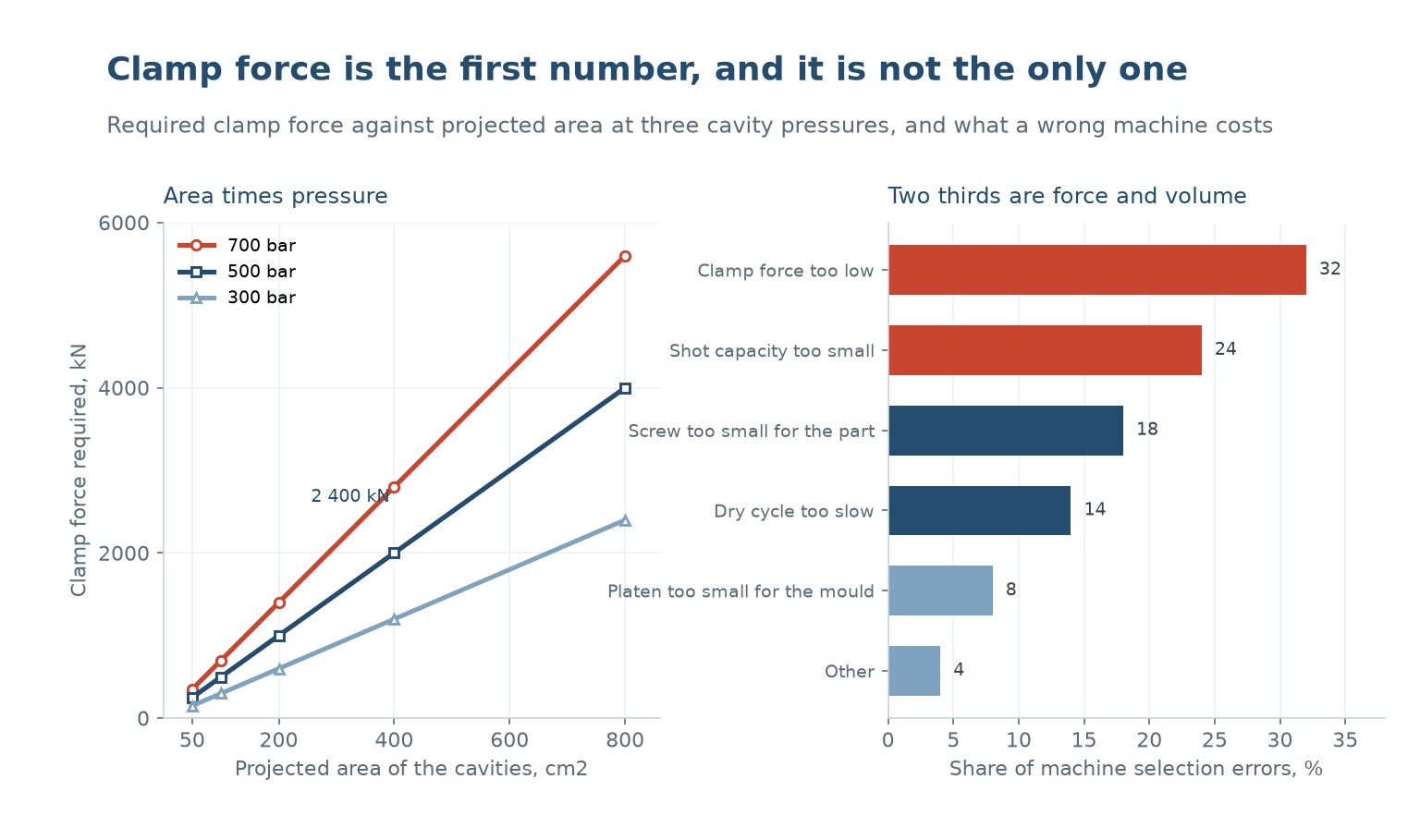
The chart on the left plots required clamp force against projected area for three cavity pressures. A 200 cm2 part at 500 bar needs 1,000 kN; the same part at 700 bar needs 1,400. A 400 cm2 part at 500 bar needs 2,000 kN.
The cavity pressure is the number that has to be chosen with judgement. It depends on the material, the wall thickness and the flow length: a thin wall with a long flow needs 700 to 1,000 bar, a thick wall with a short flow may need only 300. Using a single number for everything is how machines end up oversized.
The calculation is a starting point, not an answer. It assumes the pressure is uniform across the projected area, which it is not; it is highest near the gate and lowest at the end of flow. A more accurate estimate uses the average pressure, which is typically 40 to 60 percent of the peak, and that is why the simple calculation is conservative.
The practical rule is to add 20 percent to the calculated force for safety, and then check that the machine's rated force is available at the platen, not just at the cylinder. Some machines lose 10 percent of their rating through the toggle or the tie bar stretch, and the rating plate does not say so.
Shot capacity and screw size
Shot capacity has to cover the part, the runner and a cushion of 10 to 20 percent of the shot. A machine running at 90 percent of its shot capacity has no room for the cushion, and the cushion is what makes the process stable.
The screw diameter matters as much as the capacity. A large screw on a small shot gives a long residence time and degrades the material; a small screw on a large shot needs a long stroke and gives poor mixing. The rule is that the shot should be 25 to 75 percent of the barrel capacity, and 40 to 60 is the comfortable middle.
The material changes the numbers. A glass filled material needs a larger screw and a wear resistant barrel; a PVC needs a shorter, cooler screw; a high temperature material needs a barrel that can reach its processing temperature without degrading the resin at the edges of the heater bands.
The injection unit also has to deliver the pressure. A machine with adequate tonnage but a small injection unit will not fill a long flow path, and the symptom is a short shot that no amount of temperature will fix.
Platens, tie bars and daylight
The mould has to fit between the tie bars with clearance for the mould base, the clamping plates and any hoses. The tie bar distance is a hard limit: a mould that is 20 mm too wide does not fit, and no amount of tonnage helps.
The platen size sets the clamping area. A mould that is larger than the platen will bend, and a bent platen produces uneven clamping and flash at one end. The rule is that the mould footprint should be within the platen and centred, with the clamping force applied over the mould base rather than over its edges.
Daylight, the maximum distance between the platens, has to accommodate the mould height plus the opening stroke needed to eject the part. A deep part needs a long stroke, and a machine that is adequate on tonnage can still be unable to open far enough.
| Number | Rule of thumb | Symptom if wrong |
|---|---|---|
| Clamp force | Projected area times cavity pressure plus 20 % | Flash or unused tonnage |
| Shot capacity | Part plus runner plus 20 % cushion | Short shots, unstable cushion |
| Screw diameter | Shot 25 to 75 % of barrel capacity | Degradation or poor mixing |
| Tie bar distance | Mould width plus 20 mm | The mould does not fit |
| Daylight | Mould height plus opening stroke | Cannot eject a deep part |
| Dry cycle | Below the target cycle time | Cycle time is capped by the machine |
Table 1 — The four numbers and how to check them
The numbers that do not appear on the plate
Energy consumption per kilogram is not on the rating plate and varies by a factor of two between machines of the same tonnage. A servo hydraulic machine uses 40 to 60 percent less energy than a fixed displacement one on the same part, and on a machine running three shifts that is a large number.
Repeatability is the second. Two machines with the same specification can differ in how well they hold a shot weight, and the difference shows up as scrap rate rather than as a specification. A trial on the actual mould is the only way to know.
Maintenance access is the third. A machine that needs the injection unit removed to change a heater band costs more in downtime than it saved in purchase price, and that is invisible until the first failure.
The purchase decision should weigh all of these against the four hard numbers. The four numbers decide whether the machine can make the part; the others decide whether it can make it profitably.
The common mistakes
Sizing to the part rather than to the mould is the first. The mould base is larger than the part, the runner adds area, and the clamp force is calculated on the projected area of the cavities plus the runner, not on the part alone.
Ignoring the cushion is the second. A machine that is exactly big enough for the shot has no cushion, and without a cushion the process has no stability margin. The chart on the right puts clamp force at 32 percent of selection errors and shot capacity at 24, which together are more than half.
Buying for the biggest job is the third. A machine sized for the largest mould runs every other job at 20 percent of its capacity, with poor energy efficiency and long residence times. Two smaller machines are often better than one large one.
| Mistake | Consequence | How to avoid it |
|---|---|---|
| Sizing to the part | Flash on the first run | Use projected area including the runner |
| No cushion | Unstable shot weight | Shot at 40 to 60 % of barrel capacity |
| Buying for the largest job | Poor efficiency on everything else | Size for the volume, not the extreme |
| Ignoring dry cycle | Cycle time capped | Compare dry cycle with the target cycle |
| Ignoring energy | Higher running cost for years | Ask for kWh per kilogram on a trial |
Table 2 — Five mistakes and how to avoid them
The last one is the most expensive in the long run, because it is invisible at the purchase decision and permanent afterwards. Asking for the specific energy on a trial part costs nothing and separates two machines that look identical on paper.
How do I calculate the clamp force I need?
Projected area of the cavities plus runner, in square centimetres, multiplied by the cavity pressure in bar, divided by 100 to give kilonewtons. Add 20 percent for safety and check the machine's force at the platen, not at the cylinder.
What shot size should I run?
Between 25 and 75 percent of the barrel capacity, with 40 to 60 being comfortable. Below 25 the residence time is long and the material degrades; above 75 there is no room for a cushion and the process becomes unstable.
Does the machine's tonnage rating mean what it says?
Usually, but check it at the platen. Some machines lose 10 percent of their rating through the toggle or the tie bar stretch, and the rating plate is a theoretical figure rather than a measured one.
Why does the dry cycle matter?
It sets the floor on cycle time. A machine that takes four seconds to open, close and eject cannot run a six second cycle, and on thin wall parts that is the difference between competitive and not.
Is a bigger machine always better?
No. A machine sized for the largest mould runs every other job at low utilisation, with poor energy efficiency and long residence times. Sizing for the volume rather than the extreme is usually the better decision.
What else should I compare between two machines?
Specific energy in kWh per kilogram on a trial part, shot weight repeatability, and maintenance access. Those three decide the running cost, and none of them appear on the rating plate.
Buying a machine or moving a mould?
Send the part drawing, the mould dimensions and the material. We will size the clamp force, the shot and the platens, and tell you what the machine has to be able to do.




 NL
 EN
 ES
 FR
 DE
 PT
 AR
 RU
 JA
 KO
 IT
 TR
 PL
 ID
