

What the land actually does
The land is the straight, parallel section of the flow channel immediately before the die exit. It has two jobs: to let the polymer relax the elastic deformation it picked up in the converging section, and to generate enough back pressure to distribute melt evenly across the die.
Both jobs depend on length. A short land lets the melt exit while it is still elastically stretched, so it swells and the surface is rough. A long land gives the melt time to relax and evens out the velocity profile, so the extrudate is closer to the die dimensions and the surface is smooth.
The cost of length is pressure. Every additional millimetre of land adds resistance, and that resistance is paid for by the extruder in output or in melt temperature. A die with an over-long land runs hot and slow, and eventually the surface degrades for the opposite reason.
That is the whole design problem in one sentence: enough land to relax the melt, not so much that the extra pressure damages it. The optimum sits in a band, not at a point.
Swell falls fast, then flattens
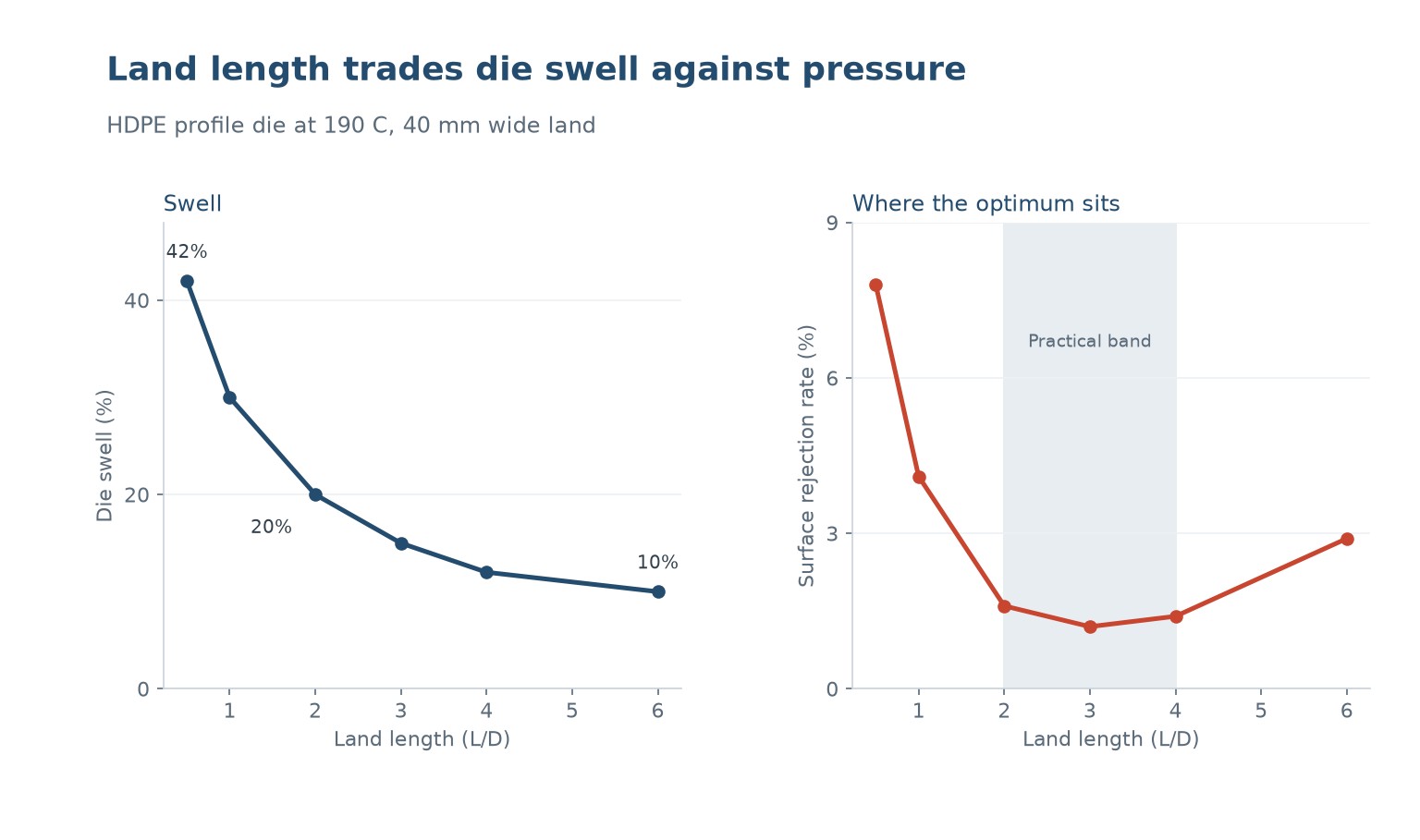
Die swell is the ratio of the extrudate dimension to the die dimension, and it falls steeply as land length increases. In the HDPE profile series in the chart, a land of half a diameter gives 42 percent swell, one diameter gives 30, two gives 20, three gives 15, four gives 12 and six gives 10.
The shape of that curve is the important part. Going from L/D 0.5 to 2 removes more than half the swell. Going from 2 to 6 removes another ten points and costs four times the pressure. Almost all the benefit is available in the first two diameters.
This is why land length is such a cheap variable to get wrong. A die made with L/D 1 because the toolmaker had a short blank will swell 30 percent, and the calibration or sizing downstream then has to absorb that swell, which it can only do by pulling harder, which introduces orientation and residual stress.
The right hand panel shows the consequence in rejection rate. At L/D 0.5 the surface rejection rate is 7.8 percent, at 2 it is 1.6, at 3 it is 1.2, at 4 it is 1.4 and at 6 it is 2.9. The minimum is broad and flat between 2 and 4, which is where most well-made profile dies sit.
Too long is also a defect
An over-long land does not just cost pressure. It produces melt fracture at higher output, because the shear stress at the wall exceeds the critical value before the output target is reached. The surface then shows the characteristic sharkskin pattern, and the operator responds by raising temperature, which lowers viscosity but also lowers the melt strength the calibration needs.
It also increases die drool. A long land holds a larger volume of melt at the wall for longer, and low molecular weight fractions migrate to the surface and accumulate at the exit lip. The result is periodic contamination marks on the profile.
And it makes the die harder to clean. A long, narrow land is difficult to purge, so colour changes take longer and degraded material hides in the land between runs.
The practical upper limit is usually around L/D 6 to 8 for a profile die, and much lower for a die that has to run at high output. Beyond that you are buying pressure, not quality.
| Land L/D | Die deining | Surface rejection | Pressure cost | Verdict |
|---|---|---|---|---|
| 0.5 | 42% | 7.8% | Very low | Too short |
| 1.0 | 30% | 4.1% | Laag | Marginal |
| 2.0 | 20% | 1.6% | Matig | Goed |
| 3.0 | 15% | 1.2% | Matig | Best |
| 4.0 | 12% | 1.4% | Hoog | Goed |
| 6.0 | 10% | 2.9% | Very high | Too long |
Table 1 — The trade-off measured on one HDPE profile die.
Land length by polymer
The correct land length depends on how much elasticity the polymer carries at the die exit, which is a function of its molecular weight distribution and its relaxation time. Polymers with broad distributions and high molecular weight need more land to relax.
Rigid PVC needs a short land because it is shear sensitive and degrades if it dwells. A typical PVC profile land is L/D 1.5 to 3, and the die is designed so the land can be shortened if the compound demands it.
Polyolefins are more forgiving and are usually run at L/D 3 to 6. Polyamide and PET need care because their low melt strength means a long land at high temperature can let the extrudate sag before it reaches the calibrator, so land length and die-to-calibrator distance have to be designed together.
The general rule for a new die is to start at the middle of the range for the polymer and leave enough metal that the land can be shortened by machining. Lengthening is much harder than shortening.
| Polymer | Typical land L/D | Note |
|---|---|---|
| Rigid PVC | 1.5 to 3 | Keep short, shear sensitive |
| HDPE | 3 to 6 | Tolerates long land |
| PP | 3 to 5 | Watch sag after the die |
| ABS | 2.5 to 4 | Balance with gloss requirement |
| PA | 2 to 4 | Low melt strength, pair with calibration |
| PC | 3 to 5 | High viscosity, pressure limited |
| PMMA | 2.5 to 4 | Surface finish sensitive |
Table 2 — Starting land lengths by polymer, before tuning.
Balancing a multi-leg die
A profile die rarely has one flow path. A window profile has walls, a hollow section has an outer and an inner leg, and a co-extruded seal has two materials meeting at a common exit. Each path has its own resistance, and the melt takes the easiest route unless the die is balanced.
Balance is achieved by adjusting land length, not by adjusting the feed. Shortening the land on a starved leg reduces its resistance and increases its share of flow. This is why profile dies are built with removable or machinable land blocks: the die is balanced empirically on the bench and then in the press.
The diagnostic is simple: run the die at production temperature with a coloured compound, cut the extrudate, and look at the cross section. Legs that are short of material are starved; legs that are heavy are over-fed. The land on the starved leg comes down, or the land on the heavy leg goes up.
Do this before the die goes to the customer, not at the customer. A die that arrives unbalanced costs a week of commissioning and a great deal of trust.
Changing a land without a new die
Because the land is the last section before the exit, it can be modified without disturbing the rest of the flow channel. Shortening is straightforward: the die face is machined back, or a land insert is replaced with a thinner one.
Lengthening is harder but still possible if the die was designed with a replaceable land plate. Dies built with a separate land insert are more expensive initially and much cheaper to tune, which is why they are standard on any profile that is expected to run for years.
For a die without a replaceable land, the practical options are to machine the face back and accept the shorter land, or to fit a shim at the exit. A shim is a compromise: it adds length but it also adds a seam, and the seam becomes a die line.
The lesson for the next die is to specify a replaceable land from the start. It costs a few hundred dollars on a die that costs tens of thousands, and it converts a three-week rebuild into a two-hour change.
What is die land length?
The straight parallel section of the flow channel immediately before the die exit. It lets the melt relax and generates back pressure to distribute flow across the die.
How does land length affect die swell?
Longer land reduces swell. In HDPE, going from L/D 0.5 to 2 removes more than half the swell, but going from 2 to 6 removes only another ten points.
Can land length be too long?
Yes. An over-long land raises pressure, promotes melt fracture at high output, increases die drool and makes purging difficult. The practical ceiling is around L/D 6 to 8.
What land length should a PVC profile die have?
Typically L/D 1.5 to 3. Rigid PVC is shear sensitive, so a long land risks degradation, and the die is usually designed so the land can be shortened.
How do I balance a multi-leg profile die?
Adjust the land length per leg. Shortening a starved leg reduces its resistance and increases its share of flow. Check with a coloured compound and a cut cross section.
Can I change land length without making a new die?
Usually yes, by machining the die face back or replacing a land insert. Lengthening is only practical if the die was built with a replaceable land plate.
Chasing die lines or dimensional drift?
Send the profile drawing and the polymer. We will review the land geometry and tell you whether the die can be reworked or needs replacing.





 NL
 EN
 ES
 FR
 DE
 PT
 AR
 RU
 JA
 KO
 IT
 TR
 PL
 ID
