The problem
Symptom. A buyer rejects a PC/ABS housing whose notched Izod impact reads 18 kJ/m2 against a 30 kJ/m2 limit, while the moulder's delivery note quietly admits 50 % regrind instead of the quoted 25 %.
What it costs. Because regrind percentage is not capped on the order, a cost-saving blend turns into a disputed batch, an assembly-line impact failure and a requalification before the launch can resume.
This article links chain scission to impact and melt-flow drift, gives the 0/25/50 % retention figures, and sets a maximum regrind percentage plus a test-coupon limit in the purchase order.
- 1. What a regrind percentage dispute looks like
- 2. Separate chain scission from a drying or contamination fault
- 3. Retention figures that belong on the drawing
- 4. Heat history and blend choices that move strength
- 5. Write a regrind cap and coupon test into the order
- 6. Recovery actions ranked by requalification cost
What a regrind percentage dispute looks like
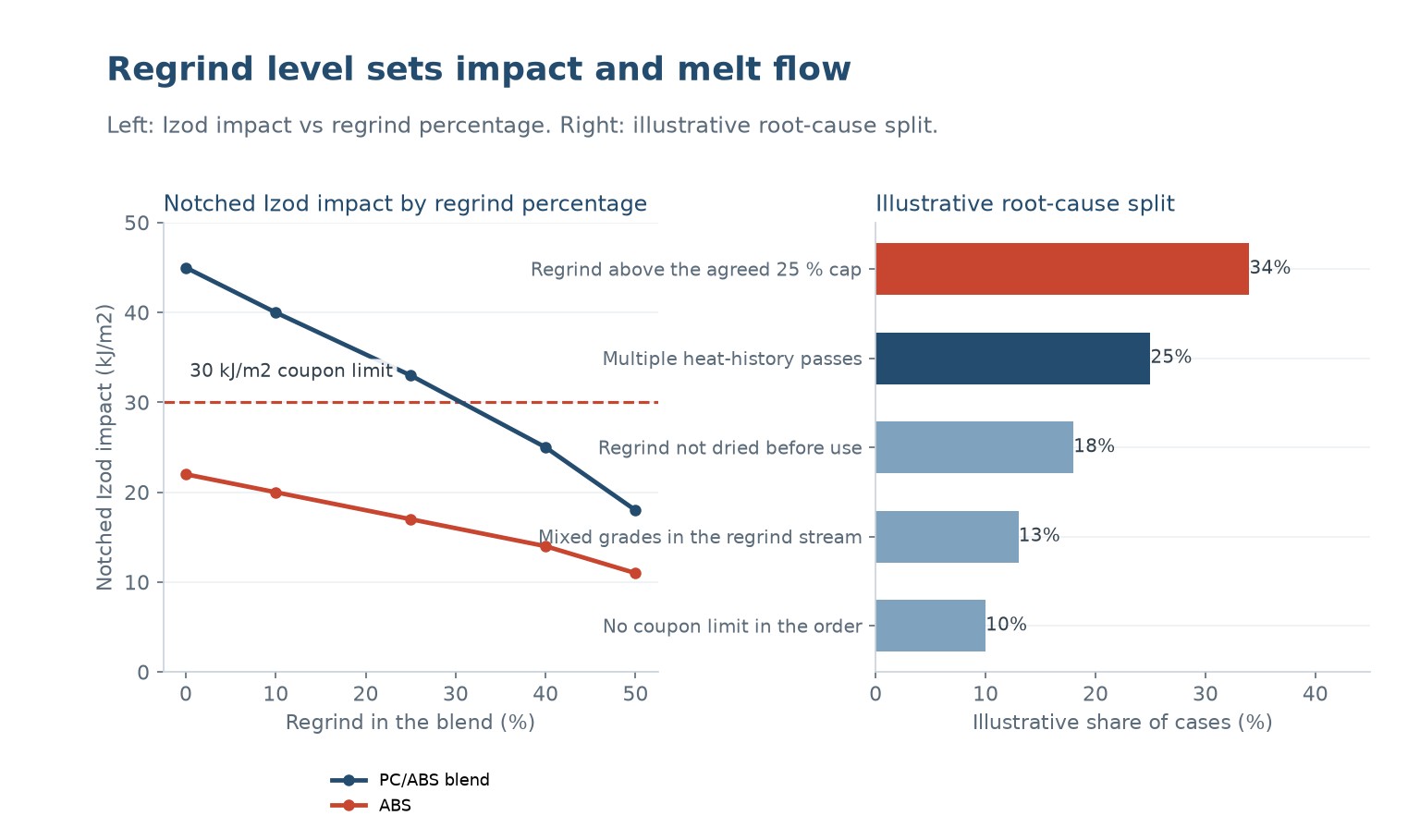
Regrind is not a free filler. Each moulding pass shortens PC/ABS chains, so notched Izod impact falls from 45 kJ/m2 at 0 % regrind to 33 at 25 % and 18 at 50 %, while melt-flow rate climbs from 12 to 22 g/10 min.
| Observed result | Most likely cause | First check on the order |
|---|---|---|
| Izod impact reads 18 kJ/m2, below 30 | Regrind raised to 50 % | Compare the quoted cap with the delivery note |
| MFR rises from 12 to 22 g/10 min | Chain scission from extra heat passes | Check the number of regrind passes |
| One lot weak, MFR normal | Wet or contaminated regrind | Re-dry and re-test a control coupon |
| Strength steps after a lot change | Regrind fraction changed | Log regrind percentage per lot |
Table 1 - Reading a regrind dispute before re-moulding
Need a fixed price for this moulded part?
Send the 2D drawing, resin grade and annual volume. Our engineers return a DFM review, a material recommendation and a written quotation you can compare line by line.
Separate chain scission from a drying or contamination fault
Confirm the blend by moulding ISO 180 coupons at 0, 25 and 50 % regrind from one dried lot. Impact that falls with each pass is chain scission; a single weak lot with normal 12 g/10 min MFR points at moisture.
A five-step diagnostic sequence
- Pull the order, the delivery note and the lot label.
Confirm the quoted 25 % cap against the 50 % actually moulded; the 18 kJ/m2 coupon is the first evidence. - Mould coupons at 0, 25 and 50 % regrind.
A fall from 45 to 33 to 18 kJ/m2 with MFR rising 12 to 22 g/10 min confirms chain scission. - Check the number of heat-history passes.
Each extra pass shortens chains; a third pass can push a 25 % blend below the 30 kJ/m2 floor. - Verify drying and grade of the regrind stream.
Wet or mixed-grade scrap lowers impact without moving MFR, so re-test a dried control coupon. - Re-mould at the cap and re-test per lot.
Hold 25 % and one pass, then certify Izod at least 30 kJ/m2 and MFR at most 16 g/10 min.
The chart below is a typical result from that measurement step. Use it to separate a design limit from a setting that can still be recovered.
Retention figures that belong on the drawing
Put a maximum regrind percentage, the allowed heat-history passes and a coupon limit on the drawing. A 25 % cap holds PC/ABS at 33 kJ/m2 and 54 MPa tensile; 50 % drops it to 18 kJ/m2 and 48 MPa.
| Parameter | Typical target | What goes wrong outside it |
|---|---|---|
| Maximum regrind by mass | 25 %, single heat-history pass | At 50 % PC/ABS impact falls to 18 kJ/m2 |
| Notched Izod coupon, ISO 180 | At least 30 kJ/m2 per lot | An undefined coupon lets weak parts ship |
| Melt-flow rate, ISO 1133, 260 C / 5 kg | At most 16 g/10 min | 22 g/10 min signals heavy chain scission |
| Tensile strength, ISO 527 | At least 54 MPa | Drops to 48 MPa at 50 % regrind |
Table 2 - Regrind parameters for the part drawing and order
Heat history and blend choices that move strength
Virgin PC/ABS at 45 kJ/m2 is fairly tolerant, but ABS at only 22 kJ/m2 has little margin. A second or third heat-history pass, undried regrind and mixed-grade scrap all push 25 % toward the 30 kJ/m2 floor.
| Decision | Effect on impact | Trade-off |
|---|---|---|
| Cap regrind at 25 % by mass | Holds PC/ABS at 33 kJ/m2 | Less material cost saving per part |
| Limit to one heat-history pass | Stops cumulative chain scission | Needs regrind stream segregation |
| Re-mould at the 25 % cap | Clears the disputed 18 kJ/m2 batch | Scrap and a re-run of the lot |
| Re-qualify a high-regrind grade | Sets a new, lower impact limit | Full material requalification |
Table 3 - Decisions ranked by what they actually fix
Write a regrind cap and coupon test into the order
Agree acceptance before first article: a 25 % maximum regrind by mass, one heat-history pass, a notched Izod coupon at least 30 kJ/m2 to ISO 180, and an MFR within 16 g/10 min to ISO 1133 per lot.
Not sure whether the fault is in the tool or the process?
Send us the drawing, the process window and a few sample parts. We will tell you which change fixes the fault before you commit to a tool modification.
What to send us
- Part drawing with the affected dimension
- Current process settings
- Sample parts from a good and a bad batch
- Annual volume
Recovery actions ranked by requalification cost
For a batch already moulded, sort by lot and re-test coupons. Tuning cannot restore chain length, so either re-mould at the 25 % cap under concession, or re-qualify a higher-regrind grade with its own impact limit.
Before you release this injection moulding job
- A maximum regrind percentage by mass and the allowed heat-history passes are written on the part drawing
- The purchase order names the blend, the supplier and the regrind stream so a lot swap is visible
- A notched Izod coupon limit of at least 30 kJ/m2 to ISO 180 is agreed per lot
- An MFR ceiling of 16 g/10 min to ISO 1133 at 260 C / 5 kg is defined for the grade
- First-article coupons are moulded and tested at the 0, 25 and 50 % regrind levels
Attach this list to the RFQ. Most moulding faults are decided at the drawing stage.
Why did impact fall when the part looks identical?
Regrind shortens polymer chains. On PC/ABS, notched Izod drops from 45 kJ/m2 at 0 % to 33 at 25 % and 18 at 50 %, a 60 % loss, so the part looks the same but carries far less energy.
Can process settings restore the lost strength?
No. Chain length is set by heat history, not by the machine. Drying removes moisture splay, but only re-moulding at the 25 % cap restores 33 kJ/m2.
How do we tell regrind from wet resin?
Melt-flow rate separates them. Chain scission raises MFR from 12 to 22 g/10 min; wet resin lowers impact while MFR stays near 12 g/10 min.
What regrind percentage should we allow?
For a structural PC/ABS housing, 25 % by mass with a single heat-history pass holds 54 MPa tensile and 33 kJ/m2 impact. Tighter parts may need 0 %.
Who owns the dispute?
Put it in the order. State a 25 % cap, one pass, a 30 kJ/m2 coupon limit and an MFR ceiling so a weak batch is settled by a test certificate.
Is a higher-regrind grade ever acceptable?
Yes, if it is requalified with its own limit. A 50 % blend at 18 kJ/m2 can suit a non-load-bearing cover, but the drawing must name that lower figure.
Get a mouldable part and a fixed quotation
Send us the part file and the failure history. Our engineers will return a DFM review, a material recommendation and a fixed quotation with a defined first-article acceptance test.
To get an accurate quote, send:
- 3D file or 2D part drawing
- Resin grade and any regrind limit
- Annual volume and target unit price
- The failed sample or defect photos
Request a DFM review and quote
Why buyers work with Uplastech
ISO 9001, ISO 14001 and ISO 45001 certified. Founded in 2016, with injection moulding lines in Shanghai and an extrusion plant in Jiangsu. Moulding machines from 90T to 1100T and a maximum shot weight of 5100 g. Samples and a written quotation are available on request.






 NL
 EN
 ES
 FR
 DE
 PT
 AR
 RU
 JA
 KO
 IT
 TR
 PL
 ID