The filler is the formulation
Gum silicone on its own is barely a material. Unfilled polydimethylsiloxane cures into something with a tensile strength around 0.3 to 0.5 MPa and almost no tear resistance, which is why nobody sells it as a finished rubber. The properties a customer recognises as silicone come from what is put into the gum before it is cured.
That makes the filler specification the most consequential line on a compound datasheet, and the one most often left to the supplier. Two compounds can both be described as 60 Shore A VMQ and behave completely differently in a gasket that is stretched over a spigot, because one is reinforced with 32 phr of fumed silica and the other with 18 phr of fumed silica plus 25 phr of ground quartz.
There are three jobs a filler can do. It can reinforce, which means raising tensile and tear strength by bonding to the polymer chains. It can extend, which means adding bulk and reducing cost with little property contribution. And it can functionalise, which means changing thermal conductivity, electrical behaviour, colour or flame response.
Most commercial compounds use two of the three at once. The design question is not which filler, it is what balance of reinforcement and extension the application can survive, and that balance is decided by the failure mode the part has to avoid.
Fumed silica and the shape of the curve
Fumed silica is made by burning silicon tetrachloride in a hydrogen flame, which produces particles around 7 to 40 nanometres across that cluster into branched aggregates. Those aggregates form a network through the gum, and that network is what carries load. It is the most efficient reinforcing filler available for silicone and it is also the most expensive.
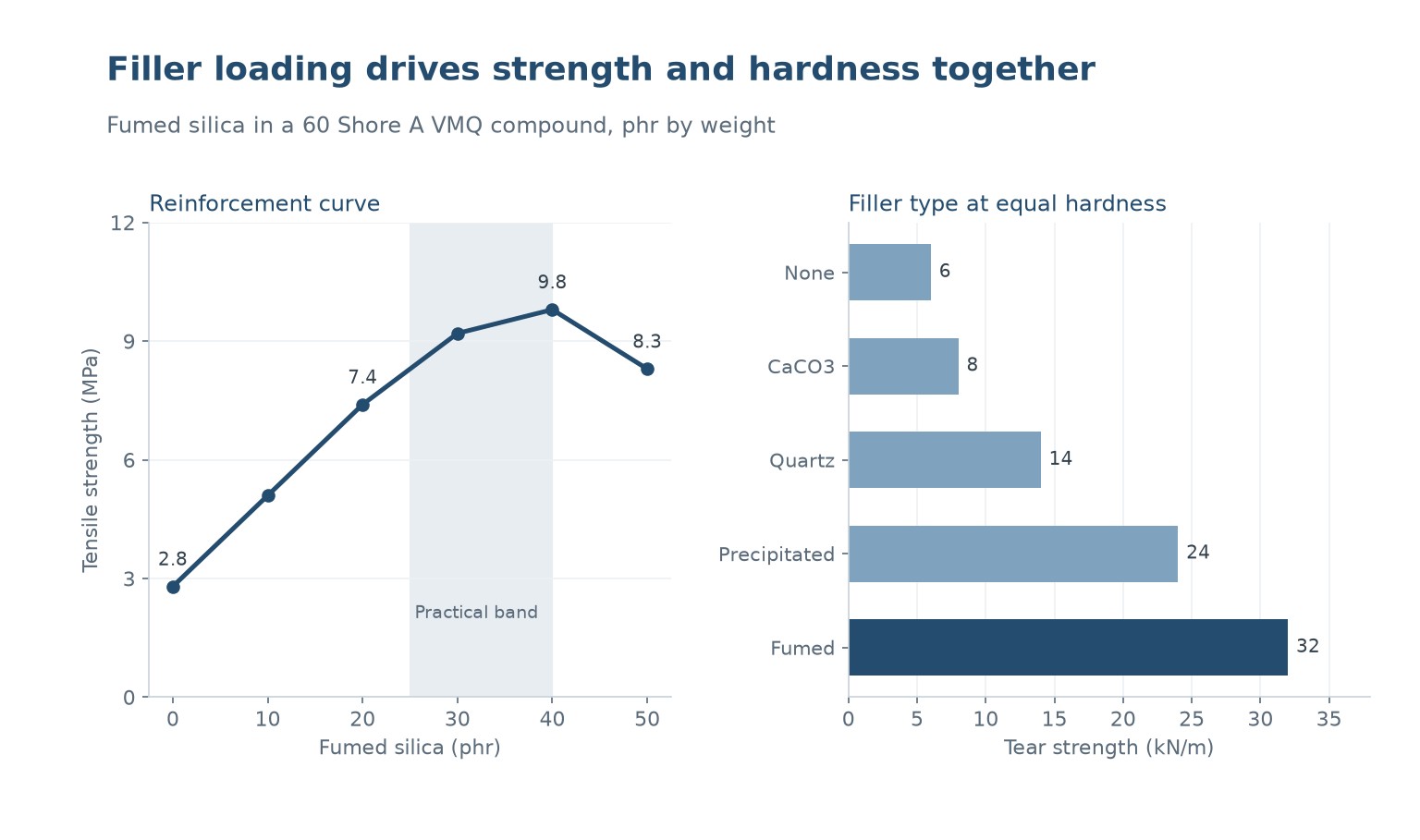
The reinforcement curve does not keep rising. In a 60 Shore A compound the tensile strength climbs steeply to about 20 phr, continues more slowly to a peak near 40 phr, and then falls away. Past the peak the filler can no longer be wetted properly, the network becomes inhomogeneous, and the extra material adds hardness without adding strength.
That fall matters commercially. A compound at 50 phr is harder than one at 40 phr and weaker in tension, so a specification that asks for hardness alone can be met by over-filling, and the part will pass a durometer check and fail in service.
The chart on the left is that curve for a single gum, and the right hand panel shows the same comparison at equal hardness across filler types. At 60 Shore A, fumed silica gives about 32 kN/m of tear strength, precipitated silica about 24, ground quartz about 14 and calcium carbonate about 8. The order is the same in every compound, and the ratio is what you are paying for.
Precipitated silica and the cost trade
Precipitated silica is made in a wet process and is cheaper per kilogram than fumed. Its particles are larger, its aggregates are less branched, and its surface carries more silanol groups and more adsorbed water. The result is a compound that reinforces well but not as well, with higher compression set and more sensitivity to moisture during mixing.
For a moulded gasket that sees static compression, the difference is often invisible. For a part that is stretched, torn or flexed in service, it shows up quickly. A bellows made with precipitated silica will tear at the convolution root at a strain where the fumed version is still intact.
The practical rule is to match the filler to the strain the part sees. Static seals, feet, pads and spacers can use precipitated silica without a problem. Diaphragms, bellows, keypads, thin-walled tubing and anything with a sharp internal corner should be specified with fumed silica, and the drawing should say so.
| Filler | Typical loading | Tensile at 60 Shore A | Tear | Relative cost |
|---|---|---|---|---|
| Fumed silica | 25 to 45 phr | 8.5 to 9.8 MPa | 32 kN/m | 1.0 |
| Precipitated silica | 30 to 55 phr | 7.0 to 8.2 MPa | 24 kN/m | 0.65 |
| Ground quartz | 40 to 120 phr | 4.0 to 6.0 MPa | 14 kN/m | 0.25 |
| Calcium carbonate | 40 to 150 phr | 3.0 to 4.5 MPa | 8 kN/m | 0.15 |
| Diatomaceous earth | 30 to 80 phr | 3.5 to 5.0 MPa | 10 kN/m | 0.20 |
Table 1 — Filler types compared at a common hardness, not a common loading.
Extending fillers and what they cost
An extending filler is there to occupy volume. Ground quartz, calcium carbonate, diatomaceous earth, talc and barytes all do this, and all of them dilute the properties that made the compound worth buying. The mistake is to think of them as neutral. They are neutral in hardness and hostile to tear.
The reason they are used anyway is cost and, sometimes, a real functional benefit. Quartz raises thermal conductivity and reduces thermal expansion, which matters in a heat-transfer roller. Barytes raises density, which matters in a part that has to feel heavy or block radiation. Calcium carbonate is close to inert and is used where the part is a spacer.
What they all do is introduce a hard particle with no bond to the polymer. Under strain the particle detaches and the void it leaves becomes a crack initiation site. That is why the tear strength falls so much faster than the tensile strength: tension loads the whole cross section, tear loads one small region at the crack tip.
If a part has to be cheap and has to survive being pulled off a spigot, the compromise is a blend: enough fumed silica to build a network, enough extender to hit the price. A 50/50 split on a 60 Shore A compound typically lands at 6 to 7 MPa tensile and 18 to 20 kN/m tear, which is a workable seal and a bad diaphragm.
| Filler | Funzione | What it buys | What it costs |
|---|---|---|---|
| Fumed silica | Reinforcement | Tensile and tear | Price, hardness control |
| Precipitated silica | Reinforcement | Price against fumed | Tear, compression set |
| Ground quartz | Extension, conductivity | Cheap bulk, heat path | Tear, tool wear |
| Calcium carbonate | Extension | Lowest cost | Tear, acid resistance |
| Talc | Extension, damping | Stiffness | Tear, mould fouling |
| Carbon black | Reinforcement, conductivity | Strength, antistatic | Colour, cleanliness |
Table 2 — What each filler class is actually for.
Surface treatment decides whether the filler bonds
A silica particle is covered in silanol groups, which are polar and love water. The silicone gum is non-polar and hates it. Left untreated, the two do not wet, and the compound behaves as if the filler were a foreign body rather than a reinforcement.
The fix is a hydrophobic treatment, usually with a silazane or a short-chain silane that caps the silanol groups with trimethylsilyl or similar groups. Treated silica disperses faster, mixes cooler, gives a lower and more stable viscosity, and produces a compound with better compression set and less creep.
You cannot see the treatment on a datasheet unless the supplier states it. What you can see is the consequence: an untreated filler needs far more mixing energy, produces a compound that creeps under load, and gives a part whose hardness drifts upward over the first weeks after cure as the filler network continues to build.
This is the mechanism behind most hardness drift complaints. The part is measured at 62 Shore A on the day it is moulded and at 67 three weeks later. Nothing changed in the cure. The filler network was still forming.
What to put on the drawing
A drawing that says only 60 Shore A VMQ leaves the filler entirely to the compounder, and the compounder will optimise for cost. That is a reasonable arrangement for a foot pad and a bad one for a bellows.
Specify the filler class where the failure mode depends on it. Fumed silica for anything that tears, flexes or is stretched over a lip. Precipitated silica is acceptable for static seals. Extending fillers should be named and capped, for example a maximum of 20 phr of non-reinforcing filler, so the compound cannot be diluted without a conversation.
Add a tear strength requirement rather than relying on tensile alone. Tensile is easy to meet with a well-dispersed but brittle compound; tear is not. A minimum of 25 kN/m at 60 Shore A is a reasonable line for a sealing part and it excludes most of the cheap formulations.
Finally, specify the conditioning before test. Hardness and tensile measured one hour after cure and measured seven days after cure are different numbers, and a supplier who tests early will always look better than one who tests late.
What is the most common filler in silicone rubber?
Fumed silica, usually between 25 and 45 phr. It gives the best balance of tensile and tear strength per unit of hardness, which is why it dominates sealing and flexing applications.
Does more filler always mean a stronger silicone?
No. Tensile strength peaks near 40 phr of fumed silica in a 60 Shore A compound and falls beyond it. Extra filler past the peak raises hardness and lowers strength.
Why is precipitated silica cheaper but worse?
Its particles are larger and less branched, so the reinforcing network is weaker. It gives lower tear strength and higher compression set than fumed silica at the same hardness.
What does surface treatment of the filler do?
It caps the polar silanol groups so the non-polar gum can wet the particle. That improves dispersion, lowers mixed viscosity and reduces creep and hardness drift.
Can I use calcium carbonate to cut cost?
Only where the part is not torn or flexed. It is close to inert and drops tear strength to about 8 kN/m at 60 Shore A, which fails most sealing applications.
How do I stop hardness drifting after moulding?
Specify treated filler and measure hardness after a defined conditioning period. Untreated filler keeps building its network for weeks after cure.
Need a compound matched to the failure mode?
Send the drawing and the service condition. We will tell you which filler class the part needs and what it will cost at volume.




 IT
 EN
 ES
 FR
 DE
 PT
 AR
 RU
 JA
 KO
 NL
 TR
 PL
 ID