
What the test actually measures
A hydrostatic pressure test holds a pipe full of water at a constant internal pressure and a constant temperature until it fails, and records the time. Repeat at several pressures and you get a curve of hoop stress against time to failure.
The pipe is free to expand lengthwise, so the wall sees a simple hoop stress and the axial stress is half of it. That is the convention the whole standard system is built on, and it is why a quoted hoop stress is not the same as a quoted internal pressure.
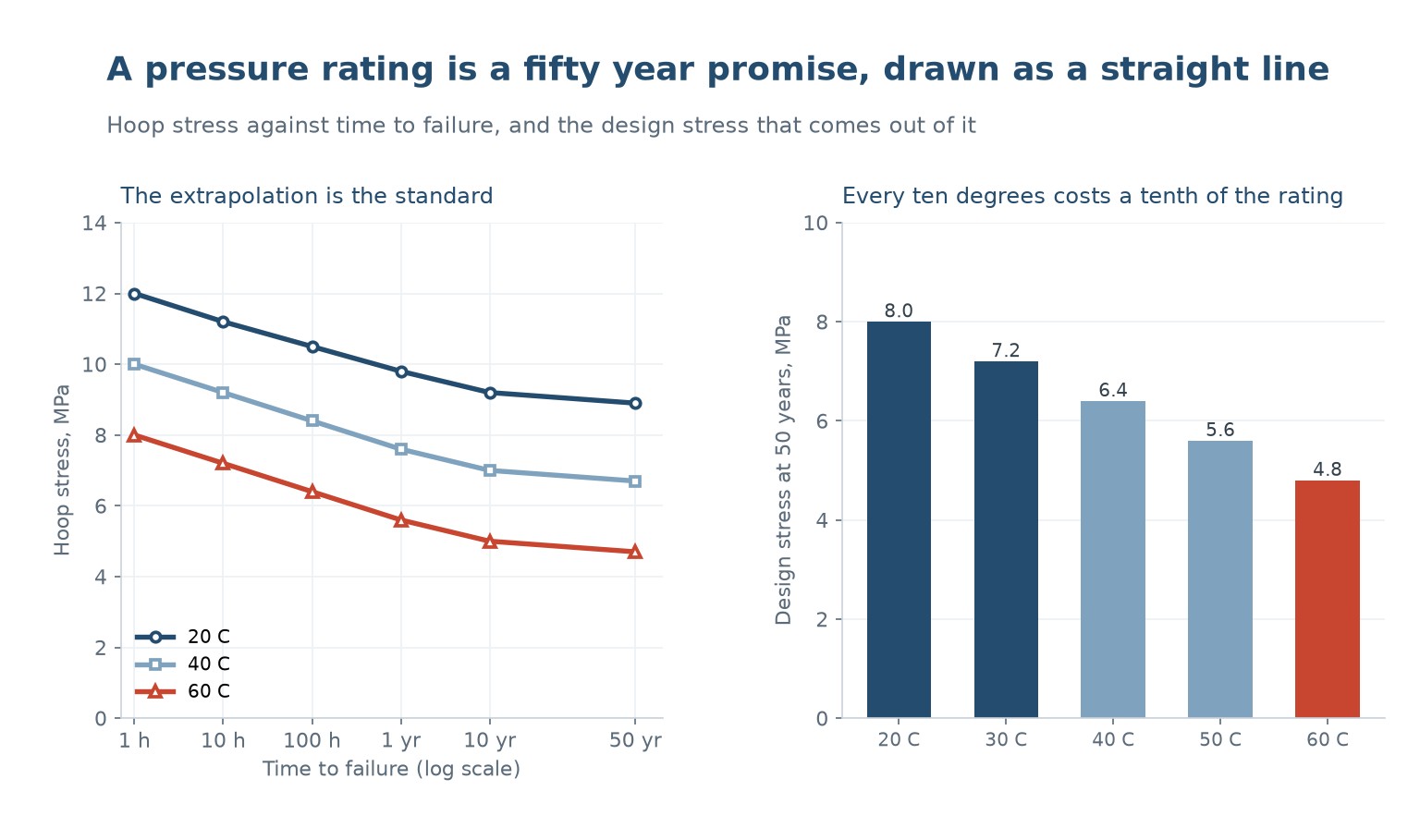
The result is plotted on log-log axes, and for most of the range it is a straight line. A straight line on log-log axes means a power law: time to failure falls as a fixed power of stress. That is what makes extrapolation possible at all.
The curve, and the knee in it
The line has a knee. At high stress the pipe fails in a ductile way, by bulging and splitting, and the slope is steep. At low stress it fails in a brittle way, by a slow crack growing from a defect, and the slope is shallower. The transition between the two is the knee.
| Time to failure | 20 C, MPa | 40 C, MPa | 60 C, MPa |
|---|---|---|---|
| 1 hour | 12.0 | 10.0 | 8.0 |
| 10 hours | 11.2 | 9.2 | 7.2 |
| 100 hours | 10.5 | 8.4 | 6.4 |
| 1 year | 9.8 | 7.6 | 5.6 |
| 10 years | 9.2 | 7.0 | 5.0 |
| 50 years | 8.9 | 6.7 | 4.7 |
Table 1 - Hoop stress against time to failure at three temperatures, for a PE 100 pipe. Only the first three rows are measured; the rest is extrapolated, and the standard defines how.
The knee is where the extrapolation gets dangerous. A line fitted through ductile data and extrapolated into the brittle region over-predicts the strength, sometimes by 30 percent. That is why the standards require data in both regions, and why a test programme runs for 10,000 hours rather than 1,000.
For PE the knee sits around 6 to 8 MPa at 20 degrees and moves down with temperature. For PVC the material is brittle throughout its service range and the curve has no ductile section at all, which is why PVC ratings are handled differently.
Extrapolating to fifty years
ISO 9080 defines how to fit the data and how far the extrapolation may go. The output is the lower confidence limit of the stress that gives 50 years of life at 20 degrees, which is the minimum required strength, the MRS.
The MRS is then rounded down to a preferred value, and the design stress is that value divided by a service coefficient. A PE 100 material has an MRS of 10 MPa, and a pipe made from it at a service coefficient of 1.25 has a design stress of 8 MPa.
| Materiale | MRS, MPa | Design stress, MPa | PN at SDR 11 |
|---|---|---|---|
| PE 80 | 8.0 | 6.3 | PN 10 |
| PE 100 | 10.0 | 8.0 | PN 16 |
| PE 100-RC | 10.0 | 8.0 | PN 16, with better crack resistance |
| PP-R | 8.0 | 6.3 at 20 C | PN 20 at 20 C, derated with temperature |
| PVC-U | 25.0 (long term) | 10.0 | PN 16 at SDR 21 |
Table 2 - From MRS to a pressure class. The service coefficient is a policy choice in each standard, and it is what turns a material property into a pipe rating.
The design stress then sets the wall thickness for a given diameter and pressure class: the wall is the pressure times the diameter divided by twice the design stress plus the pressure. A PN 16 pipe at 110 mm has a wall of about 10 mm, and the SDR is 11.
Temperature derating
The rating is quoted at 20 degrees. At any other temperature the design stress falls, and the fall is close to linear in the range that matters: 8.0 MPa at 20, 7.2 at 30, 6.4 at 40, 5.6 at 50 and 4.8 at 60.
That is a tenth of the rating for every ten degrees, which is a useful rule of thumb and a trap for anyone who specifies a PN 16 pipe for a 60 degree hot water line and expects PN 16. At 60 degrees that pipe is good for about 60 percent of its nominal pressure.
For a line that runs at more than one temperature, the standard method is Miner's rule: the fraction of life used at each condition is summed, and the sum must stay below one. A line that spends a third of its time at 60 degrees and two thirds at 20 uses more than a third of its life in the hot period.
Running the test properly
- Condition the specimens. A PE pipe that has just been extruded has a different residual stress state from one that has been stored for a month.
- Use water, not air or oil, and control the temperature to within 1 degree. A free-convection bath is not good enough at 80 degrees.
- Measure the wall thickness at several points on each specimen, and use the minimum. A pipe that is at the thin end of its tolerance fails first and the test is measuring the tolerance, not the material.
- Test at least three pressures per temperature, and enough specimens per pressure for a statistical fit. Three specimens is the usual minimum, five is better.
- Record the failure mode. A ductile bulge and a brittle slit come from different mechanisms and belong in different parts of the curve.
- Run to 10,000 hours for a full ISO 9080 evaluation. A 1,000 hour test can classify a material but cannot certify a 50 year extrapolation.
The failure modes behind the numbers
- Ductile failure: a bulge that splits along the axis. It happens at high stress, short time, and it is a strength limit.
- Brittle failure: a slit or a pinhole with no visible deformation. It starts at a scratch, a contamination particle or a void, and it is a fracture mechanics problem.
- Slow crack growth: the brittle mechanism at low stress, driven by the defect and accelerated by temperature, chlorine and pressure cycling.
- Environmental stress cracking: a surfactant or a solvent at the surface, at low stress, growing a crack that would not grow in water.
- Knee failure: the transition region where the two mechanisms overlap, and the hardest region to predict.
The practical consequence is that a pipe can pass its type test and fail in service, because the type test used a defect-free specimen and the service pipe has a scratch from installation. That is why PE 100-RC exists: it is a grade with better slow crack growth resistance, specified for installation methods that score the pipe.
Reading a pipe datasheet
A pipe datasheet has four numbers that matter and one that is usually missing.
- The material class, PE 100 or PE 80 or PVC-U, which sets the MRS.
- The SDR, the ratio of diameter to wall, which with the material sets the pressure class.
- The pressure class at 20 degrees, and the service coefficient behind it.
- The temperature derating curve, or at least the design stress at the temperatures the line will see.
- What is usually missing: the slow crack growth resistance, which is what decides whether the pipe survives installation and ground movement.
A PN 16 PE 100 pipe and a PN 16 PE 80 pipe are not the same pipe. The PE 80 one has a thicker wall to reach the same class, and the PE 100 one has better resistance to slow crack growth at the same pressure. The pressure class is the headline and the material class is the substance.
What does PN 16 mean?
A nominal pressure of 16 bar at 20 degrees, for a defined service life. It is not a burst pressure and it is not valid at other temperatures without derating.
How is a fifty year rating established?
By testing to failure at several stresses and temperatures, fitting the data under ISO 9080, and taking the lower confidence limit of the stress that gives 50 years at 20 degrees. The 50 year point is never tested.
Why does the rating fall with temperature?
The material softens and slow crack growth accelerates. For PE the design stress falls by about a tenth for every ten degrees, so a PN 16 pipe at 60 degrees behaves like a PN 10.
What is the knee in the curve?
The transition from ductile failure at high stress to brittle failure at low stress. It is where extrapolation becomes unreliable, which is why the standards require data in both regions.
What is the difference between MRS and design stress?
MRS is the material property, the stress for 50 years at 20 degrees. Design stress is MRS divided by a service coefficient, and it is what sets the wall thickness for a pressure class.
Can a hydrostatic test be done on site?
A pressure test can, and it is usually specified at 1.5 times the working pressure for one hour. It confirms the joint, not the material, and it does not predict slow crack growth.
Specifying pipe for a pressure line?
Tell us the pressure, the temperature profile and the installation method. We will tell you the material class and the SDR, and whether the line needs a crack-resistant grade rather than a thicker wall.




 IT
 EN
 ES
 FR
 DE
 PT
 AR
 RU
 JA
 KO
 NL
 TR
 PL
 ID
