
Flash is a mould problem before it is a trimming problem
Silicone flash comes from compound escaping the cavity at the parting line, at the ejector pins, or at an insert. It is thin, tough and elastic, which is exactly the combination that makes it hard to remove.
The amount is set by the mould, not by the trimmer. A parting line that closes to 0.02 mm produces a flash film of 0.02 mm; one that closes to 0.10 mm produces a film that has to be cut rather than torn. Grinding the parting line flat and keeping the platens parallel is cheaper than any trimming method.
The second cause is overfill. Silicone is often pressed to a fixed force rather than a fixed volume, so a heavy preform pushes compound into every vent and split. Reducing the preform weight by 3 percent can remove more flash than a new trimming machine.
The third is mould temperature. A hot mould cures the flash as hard as the part, so it tears instead of stretching. A cooler mould leaves flash that pulls off in a string, which is what the hand trimmer wants and what the cryogenic drum does not care about.
The three methods and what each removes
Hand trimming uses a knife, scissors or a die. It removes flash by cutting along the parting line, and it works on any geometry, any volume and any hardness. Its cost is almost entirely labour, so it scales linearly with parts.
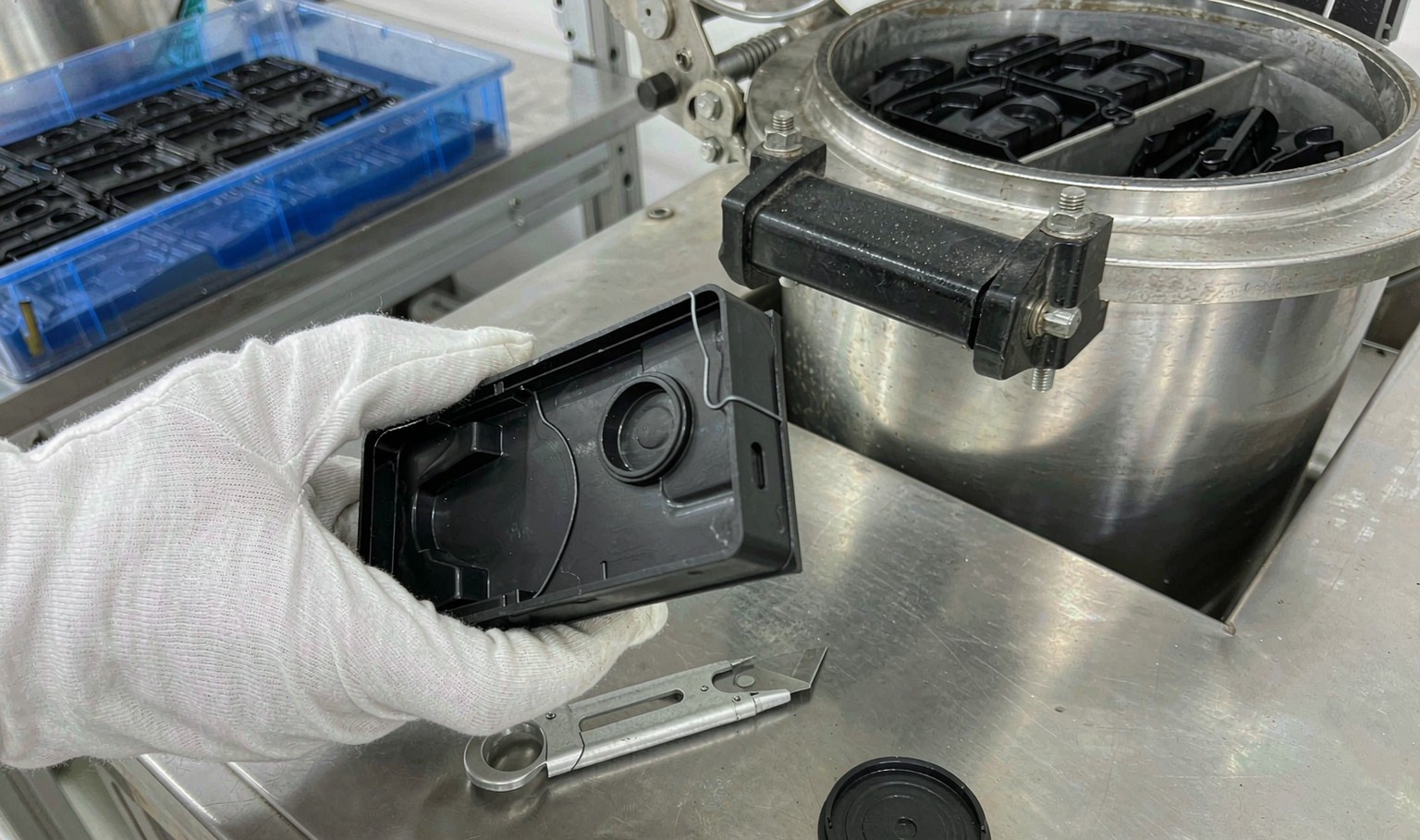
Cryogenic deflashing tumbles the parts in a drum with a media while injecting liquid nitrogen. The cold takes the silicone below its glass transition, where it becomes brittle, and the media breaks the thin flash off without damaging the thicker part. Its cost is mostly capital and nitrogen, so it scales weakly with parts.
Water jet uses a high pressure jet of water, sometimes with an abrasive, to cut the flash line. It is precise, it leaves a clean edge, and it needs a fixture for every part geometry. Its cost is capital plus fixturing, which makes it a poor fit for a part that changes every few months.
The choice is therefore a volume decision disguised as a technology decision. Below about 50,000 parts a year, hand trimming is cheaper than either machine. Above about 250,000, cryogenic is cheaper than hand. Water jet sits between and wins where the edge quality is the requirement rather than the cost.
Cost crosses over with volume
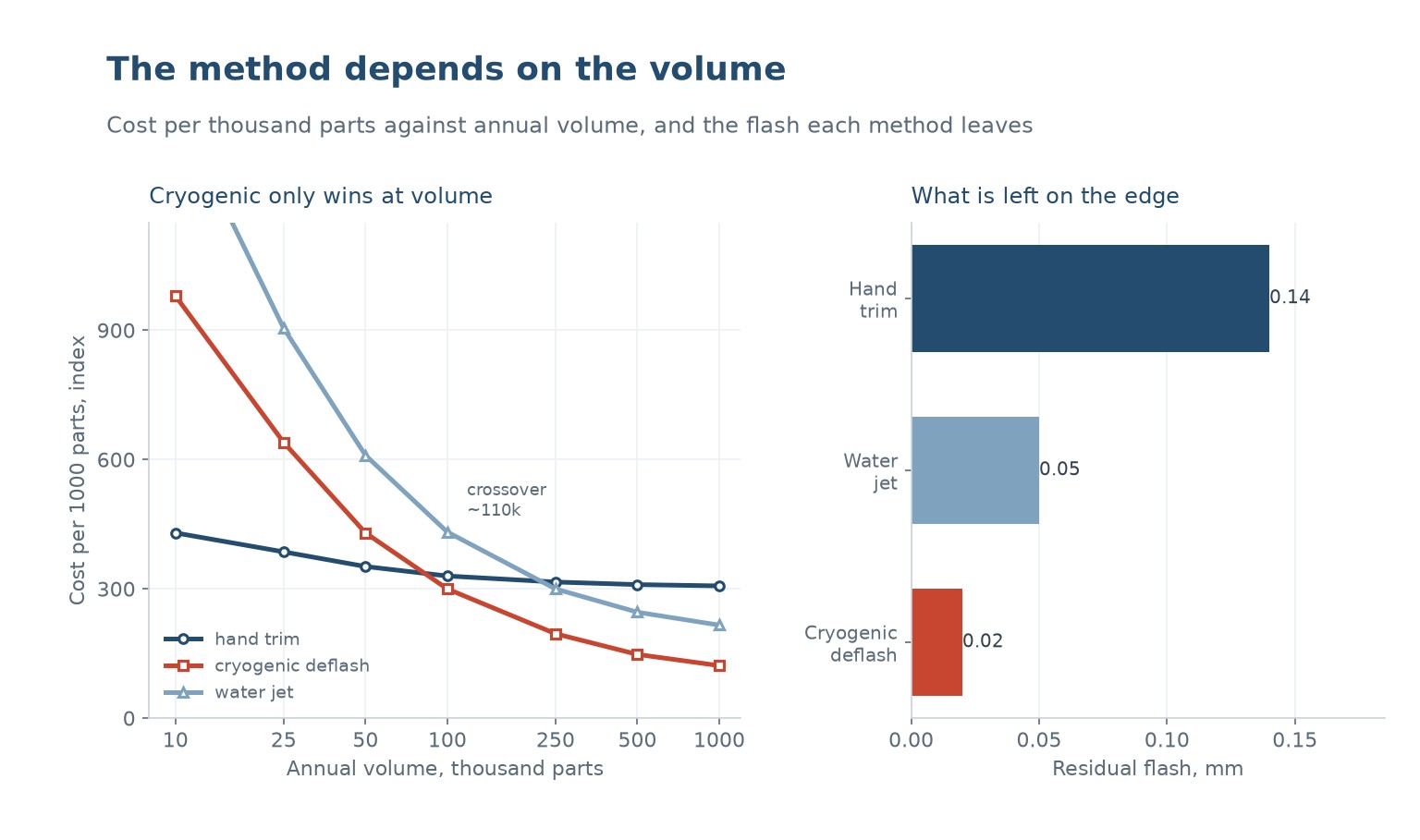
At 10,000 parts a year, hand trimming costs 430 on the index and cryogenic 980. The machine is doing 2,000 parts a year of work and sitting idle for the rest of it, while the nitrogen contract runs whether or not it runs.
At 100,000 parts, hand is 330 and cryogenic 300. The lines cross somewhere near 110,000, and at that point the two are within noise of each other, which means the decision should be made on something other than cost.
At a million parts, hand is 307 and cryogenic 122. The hand line has flattened out because the labour per part has reached its floor, and the machine has flattened out because the nitrogen and the capital are spread over ten times the parts.
Water jet starts highest at 1,420 and ends at 216, because the fixture cost is fixed and the jet time per part is short. It never beats cryogenic on cost at any volume in this comparison, which is why it is bought for edge quality or for a part that cannot be tumbled.
| Annual volume | Hand | Cryogenic | Water jet |
|---|---|---|---|
| 10,000 | 430 | 980 | 1,420 |
| 50,000 | 352 | 430 | 610 |
| 100,000 | 330 | 300 | 432 |
| 250,000 | 316 | 196 | 300 |
| 500,000 | 310 | 148 | 246 |
| 1,000,000 | 307 | 122 | 216 |
Table 1 — Cost per thousand parts, indexed, by annual volume
What the drum and the temperature actually do
Cryogenic deflashing works in a narrow window. The part has to be cold enough for the flash to be brittle and not so cold that the part itself chips. For most silicone compounds that window is minus 60 to minus 90 C, and it is set by the compound's glass transition, not by the machine.
The media matters as much as the temperature. A round media polishes; an angular media cuts. For flash on a flat parting line, a small angular media at low speed removes the film without marking the surface. For flash in a groove, a larger media is needed to reach it, and it will mark the groove.
Cycle time is typically 3 to 8 minutes including cool-down and warm-up. The parts have to be dry, because water freezes into a film that protects the flash. They also have to be free of mould release, which acts as a lubricant between the media and the flash.
The failure mode is over-processing: parts that come out with a frosted surface, or with corners rounded, or with a fine cracking along the parting line. All three mean the cycle is too long or the temperature too low, and all three are invisible until the part is flexed.
| Parametro | Typical setting | Effect of getting it wrong |
|---|---|---|
| Drum temperature | -60 to -90 C | Warm: flash smears. Cold: part chips |
| Media shape | Small angular | Round: polishes, does not cut |
| Tempo di ciclo | 3 to 8 min | Long: frosted surface, rounded corners |
| Part dryness | Dry to touch | Wet: ice film protects the flash |
| Mould release | None | Release acts as a lubricant |
Table 2 — Cryogenic deflashing settings and their failure modes
Specifying the edge, not the method
The drawing usually says trim flash. That is not a specification, because it does not say how much is acceptable, where, or by what method it will be judged. The result is a batch that passes at one supplier and fails at another, with both of them right.
What works is a residual flash allowance: a number in millimetres, a zone where it applies, and a limit on the visible witness mark. Hand trimming leaves about 0.14 mm; water jet 0.05; cryogenic 0.02. Those are the numbers to write on the drawing, because they are what the methods actually deliver.
The second thing to specify is the edge condition. A trimmed edge can be flush, slightly rounded, or feathered. On a sealing face, a feathered edge is a leak path; on a cosmetic surface, a flush edge shows a witness line. Both are legitimate and they need different methods.
The third is the inspection method. A 0.05 mm allowance cannot be checked by eye or by thumb. It needs a profile projector, a magnifier with a scale, or a limit sample that both sides have agreed. Without one of those, the allowance is a suggestion.
How to decide in an afternoon
Count the parts, count the moulds, and count the geometries. If the annual volume is under 50,000 and there are more than five part numbers, hand trimming is the answer and will stay the answer.
If the volume is over 250,000 and the geometries are similar enough to share a drum cycle, cryogenic is the answer, and the decision is really about whether the part can survive tumbling without marking.
If the edge is a sealing face or a visible cosmetic line, water jet is the answer regardless of volume, because it is the only one that can hold a 0.05 mm allowance on a complex outline.
In all three cases, spend the first money on the mould. A parting line ground to 0.02 mm turns 0.10 mm flash into a film that any method removes, and that is cheaper than moving a part from hand to machine.
At what volume does cryogenic deflashing pay?
The cost lines cross at about 110,000 parts a year. Below 50,000 hand trimming is clearly cheaper; above 250,000 cryogenic is clearly cheaper.
How much flash does each method leave?
About 0.14 mm by hand, 0.05 mm by water jet and 0.02 mm by cryogenic deflashing. Those are the numbers to put on a drawing.
Why does cryogenic deflashing mark some parts?
Because the drum is too cold or the cycle too long. The surface frosts, corners round over and the parting line can craze. It is invisible until the part is flexed.
Can water jet trim any silicone part?
It needs a fixture per geometry and a part that can be presented to the jet. It holds the tightest edge but it is the most expensive to change over.
What is the cheapest way to reduce flash?
Grind the parting line and reduce the preform weight. A parting line that closes to 0.02 mm turns heavy flash into a film that pulls off by hand.
Does mould release affect trimming?
Yes. Release agent acts as a lubricant between the blasting media and the flash, so a moulded part with release on it deflashes poorly. It also stops the flash tearing cleanly by hand.
A trimming step that costs more than the moulding?
Send the part drawing, the annual volume, the number of part numbers and the edge requirement. We will tell you which method fits and what the residual flash allowance should say.
Continue reading
- Tearing in Silicone Parts: Demoulding Force and the Undercut
- Silicone Mould Sticking: Release, Undercuts and Surface Energy
- Bubbles and Voids in Silicone: Air, Moisture and the Vacuum
- Short Fill in Silicone Moulding: Compound Flow and Cavity Pressure
- Silicone Rubber Products: Compounds, Curing and Tolerances




 IT
 EN
 ES
 FR
 DE
 PT
 AR
 RU
 JA
 KO
 NL
 TR
 PL
 ID
