
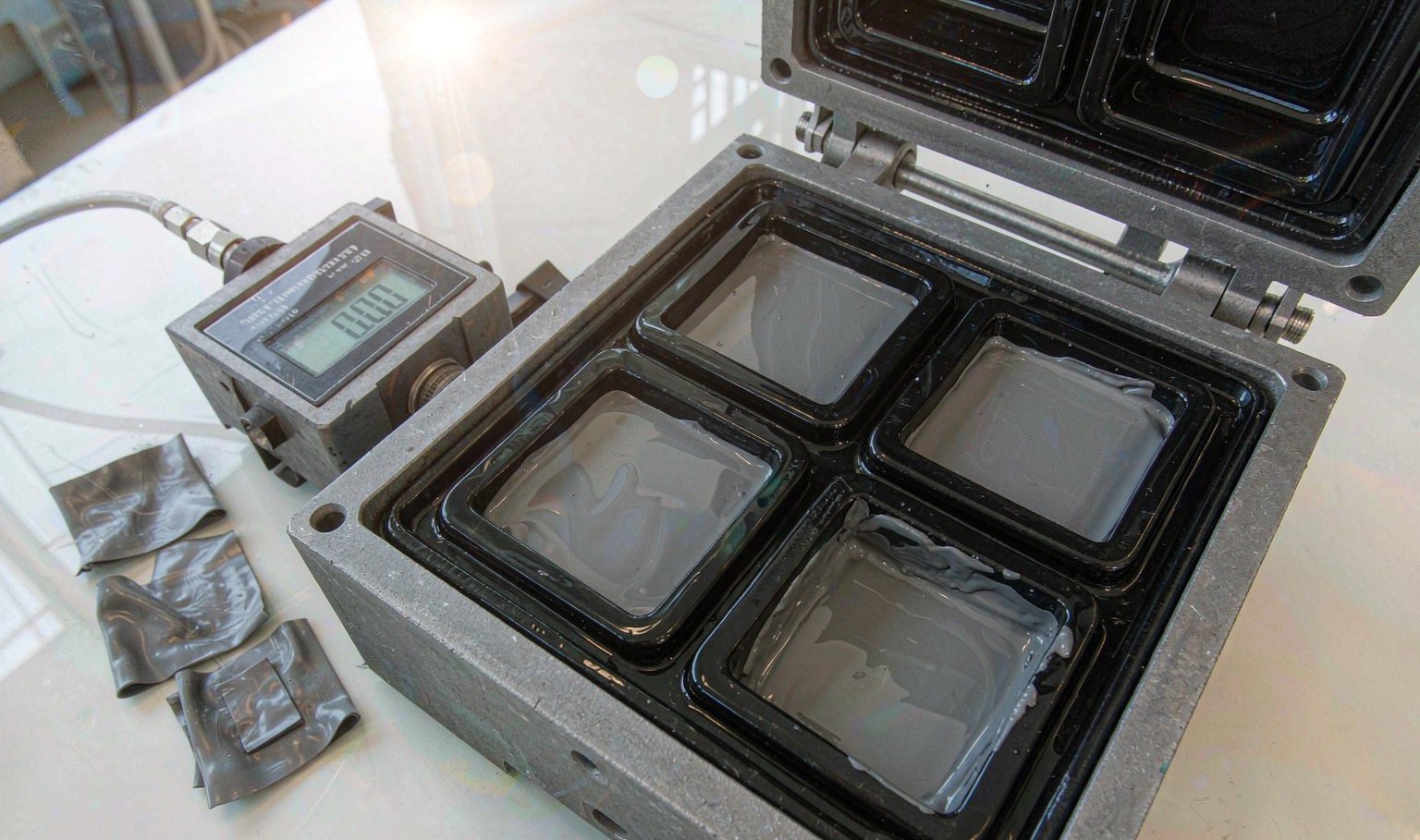
Short fill is a pressure and time problem
A short fill is a cavity that is not completely filled when the material cures. In silicone it looks different from thermoplastics, because the material is not injected into a closed cavity at high pressure; it is squeezed into shape by the closing press, and the pressure available is the press force divided by the projected area.
That changes the diagnosis. A thermoplastic short shot is almost always a pressure or speed problem at the gate. A silicone short fill is usually a flow problem: the compound is too stiff to move into the last corner before it starts to cure, or the air in that corner has nowhere to go, or the press closed too fast and trapped the compound at the edge.
The three causes look identical on the part. The difference is where the fill stops and what the edge of the unfilled area looks like. A flow stop has a rounded, smooth front. A venting stop has a ragged front with a burn or a dull patch. A trapping stop has a fold.
The order to check them is by cost. Compound viscosity is a property you can measure in ten minutes. Injection time is a setting you can change in one cycle. Venting and tooling are days.
Compound viscosity sets the floor
Silicone compound is characterised by its Mooney viscosity, measured as ML 1+4 at 100 C. A soft compound for a moulded part is 20 to 35, a general purpose one is 40 to 55, and a stiff one for a high-hardness or a highly filled part is 60 to 80.
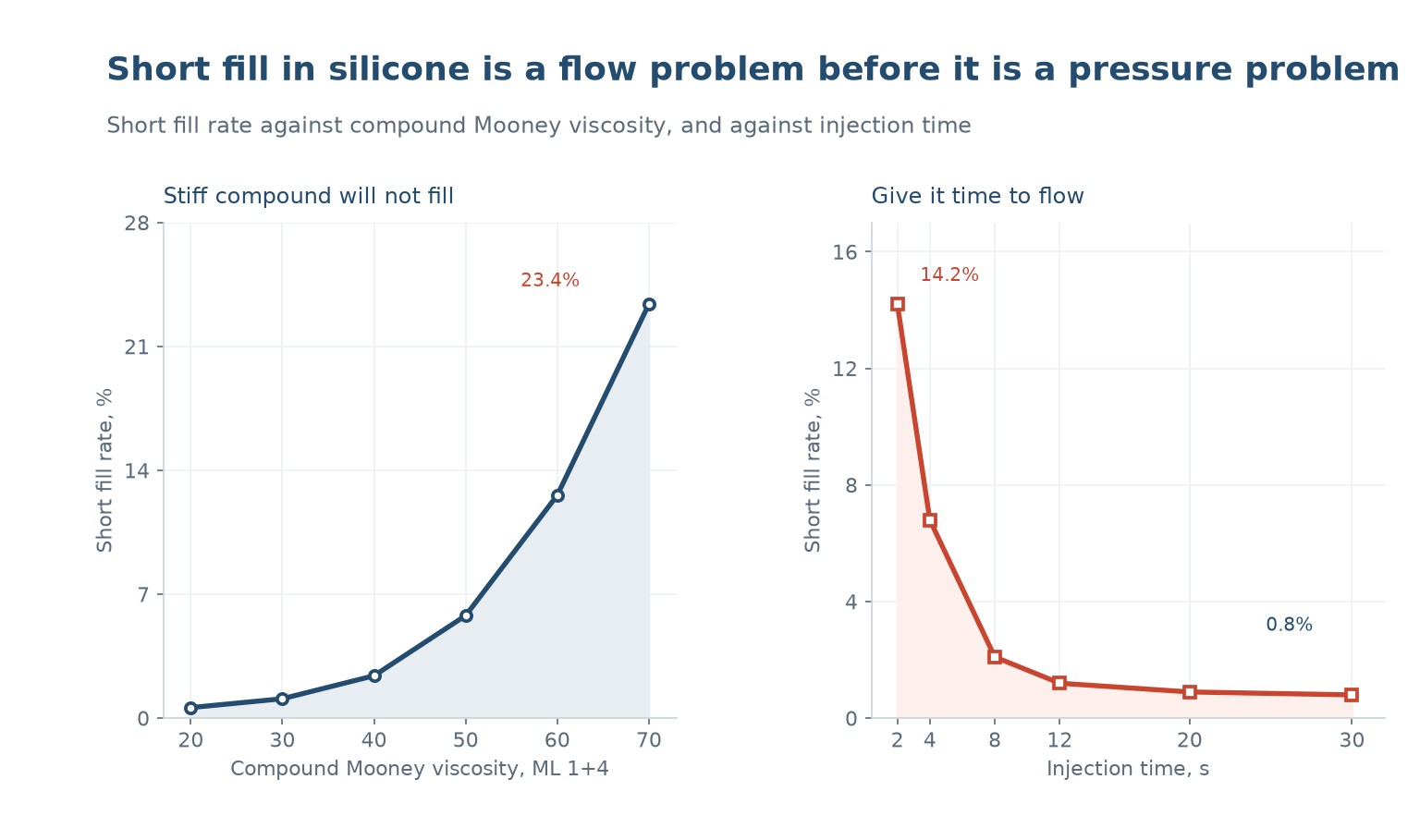
The short fill rate follows the viscosity steeply. At 20 Mooney the rate is 0.6 percent. At 30 it is 1.1, at 40 it is 2.4, at 50 it is 5.8, at 60 it is 12.6, and at 70 it is 23.4. Between 30 and 70 the rate goes up by a factor of twenty for a doubling of viscosity.
That is why a compound change is the most common cause of a sudden short fill problem. A new lot that measures 8 Mooney higher than the last one, which is within a normal lot-to-lot variation, doubles the short fill rate. The press settings did not change and the parts did.
The counter is to measure the Mooney on every lot and to adjust the injection time to suit, rather than to accept the compound as delivered. A lot at 60 Mooney needs roughly twice the injection time of a lot at 40 to reach the same fill, and that is a setting change rather than a scrap event.
Injection time is the cheap lever
In a compression or transfer press, the injection time is the time over which the press closes or the transfer plunger moves. It is the single most effective setting for a short fill, because it controls how much the compound is sheared and how long it has to flow before the cure starts.
The effect is large. At a 2 second injection the short fill rate is 14.2 percent. At 4 seconds it is 6.8, at 8 seconds 2.1, at 12 seconds 1.2, at 20 seconds 0.9 and at 30 seconds 0.8. Most of the gain is in the first 8 seconds.
There is a cost. A longer injection is a longer cycle, and on a 90 second cure a 6 second increase is 7 percent of the cycle. On a high-volume part that is real money, and the compromise is usually to run the fastest injection that holds the short fill rate under 1 percent.
The other cost is that a slow injection lets the compound start to cure before it has filled. Silicone begins to scorch at the mould temperature, and at 175 C the scorch time is 20 to 40 seconds for a typical compound. An injection that takes 30 seconds is an injection that is competing with the cure, and the symptom is a short fill that appears only on the last cavity.
Pressure, and why more of it is not always the answer
The pressure available in a compression press is the clamp force divided by the projected area of the part plus the flash land. A 100 tonne press with a 400 square centimetre projected area gives 250 bar, which is a lot. A 100 tonne press with a 2,000 square centimetre projected area gives 50 bar, which may not be enough for a stiff compound.
That is why short fill on a large part is often a press size problem rather than a compound problem. The same compound and the same tool run on a bigger press fills completely, and the fix is not a process change but a different machine.
Raising the pressure is not free. It raises the flash, it raises the wear on the tool, and it can distort the part as it ejects. A part that needs 200 bar to fill is a part that will have a heavy flash line at 200 bar, and the flash removal becomes the cost.
The other pressure to check is the cavity pressure, measured with a transducer in the cavity or calculated from the press force. A cavity that reads 40 bar while its neighbour reads 90 is a cavity with a blocked vent or a short shot of compound, and the pressure trace tells you which before you cut anything.
Venting, and the corner that always misses
Air in a silicone cavity has to leave before the compound arrives. In a compression tool the air leaves through the parting line, through ejector pin clearances and through vents cut into the parting face. A cavity with no vent in its last corner traps air, and the compound cannot fill a space that is already full of air at atmospheric pressure.
The symptom is a short fill that is always in the same place, on every part, whatever the compound and whatever the injection time. That signature is diagnostic: a flow problem moves when you change the compound, a venting problem does not.
The fix is a vent 0.02 to 0.03 mm deep running from the last corner to the outside of the block, or a vacuum applied to the tool before closing. A vent that is too deep flashes; a vent that is too shallow does not pass air. The window is narrow and it is the same 0.02 mm that governs a thermoplastic tool.
A vacuum on the tool solves the venting problem more completely and it costs a pump and a seal. On a part with a deep blind corner it is the only reliable answer, and it also reduces the voids that come from trapped air.
| Where the fill stops | Front edge | Causa | First fix |
|---|---|---|---|
| Random cavity, varies | Rounded, smooth | Compound too stiff | Longer injection, softer lot |
| Same corner every part | Ragged, dull | Trapped air | Vent or vacuum |
| Edge of the part | Folded | Press closed too fast | Slower close, more compound |
| Last cavity only | Rounded, cured skin | Scorch before fill | Shorter injection, cooler tool |
| Centre of a thick section | Dished | Insufficient pressure | Bigger press or more charge |
Table 1 — Reading a short fill by where it stops
The order to work through it
Measure the Mooney of the lot in use. If it is more than 5 above the last good lot, that is the cause and the fix is a setting change. This takes ten minutes and resolves most short fill complaints.
Change the injection time. Doubling it from 4 to 8 seconds takes the rate from 6.8 to 2.1 percent, and it costs 4 seconds of cycle. If the part fills at 8 seconds and not at 4, it was a flow problem.
Check the charge weight. A compression tool needs enough compound to fill the cavity plus the flash land, and a charge that is 5 percent light gives a short fill at the far corner that looks exactly like a flow problem.
Then check the venting. If the fill stops in the same place at every setting, it is air, and no amount of time or pressure will move it.
| Mooney ML 1+4 | Typical use | Injection time | Short fill rate |
|---|---|---|---|
| 20 to 35 | Soft parts, low hardness | 2 to 4 s | 0.6 to 1.4% |
| 40 to 55 | General moulded parts | 4 to 8 s | 2.4 to 8.0% |
| 60 to 70 | High hardness, high filler | 10 to 20 s | 12.6 to 23.4% |
| 70 to 80 | Very stiff, simple shapes | 20 to 30 s | Over 23% |
Table 2 — Compound viscosity against the injection time it needs
Why does silicone short fill instead of flashing?
Because silicone is squeezed into shape by the closing press rather than injected at high pressure. When the compound cannot reach the last corner before it cures, the cavity stays short rather than flashing.
How much does compound viscosity matter?
A lot. The short fill rate goes from 1.1 percent at 30 Mooney to 23.4 percent at 70, so an 8 point lot-to-lot variation can double the reject rate with no setting change.
What injection time should I use?
The fastest one that holds the short fill rate under 1 percent. Going from 4 to 8 seconds takes the rate from 6.8 to 2.1 percent, and most of the gain is in the first 8 seconds.
The fill always stops in the same corner. Why?
That is trapped air. A flow problem moves when you change the compound or the time; a venting problem does not. Cut a 0.02 to 0.03 mm vent from that corner, or pull a vacuum.
Can too much pressure cause problems?
Yes. It raises flash, wears the tool and can distort the part on ejection. A part that needs 200 bar to fill is a part with a heavy flash line at 200 bar.
What if only the last cavity short fills?
That is usually scorch, not flow. The compound has started to cure before it reached that cavity, so shorten the injection or cool the tool rather than adding time.
A cavity that will not fill, and the settings are already at the limit?
Send the part drawing, the compound Mooney and the press tonnage. We will tell you whether it is flow, venting or press size, and what to change first.




 IT
 EN
 ES
 FR
 DE
 PT
 AR
 RU
 JA
 KO
 NL
 TR
 PL
 ID
