
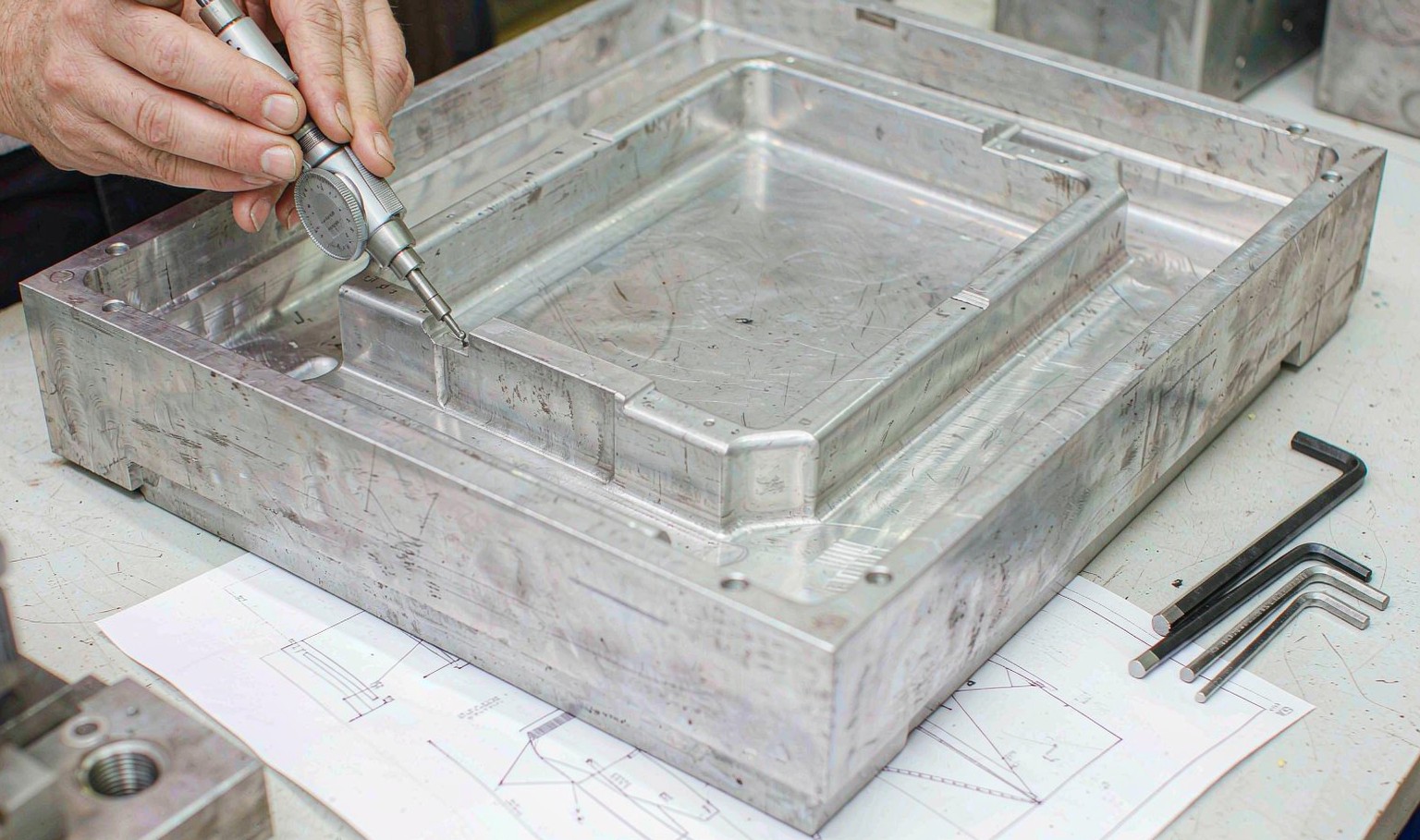
Five weeks, and only one of them is cutting metal
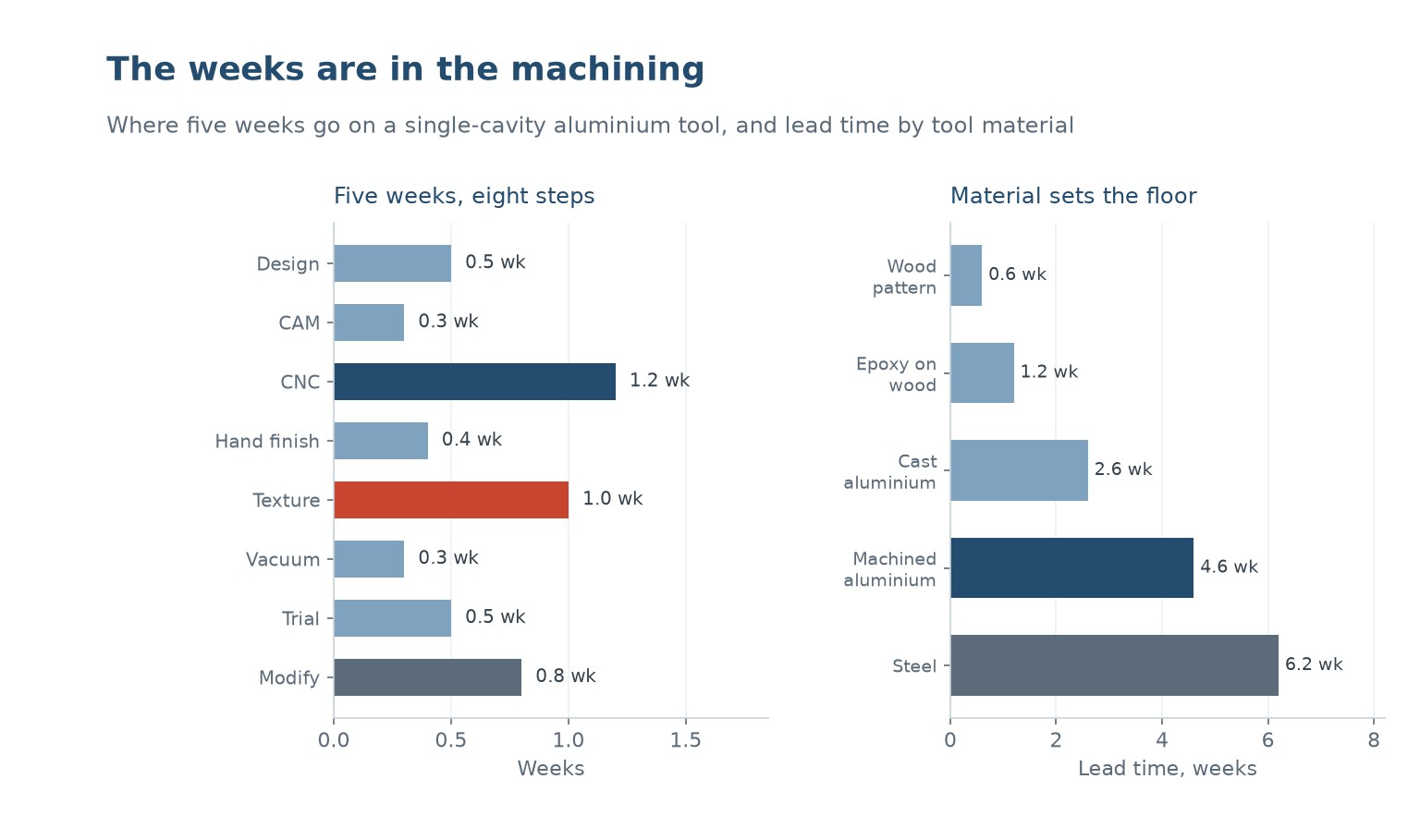
A forming tool lead time is usually quoted as a single number, four to six weeks, and it behaves like a number that nobody can explain when it slips. Broken into steps, a typical single-cavity aluminium tool is: design 0.5 week, CAM programming 0.3, CNC machining 1.2, hand finishing 0.4, texture 1.0, vacuum system 0.3, trial 0.5 and modification 0.8.
That totals five weeks, and the largest single block is CNC at 1.2 weeks. The second largest is texture at 1.0, which is a full week for an operation that many buyers assume is part of machining. The third is the modification after the trial at 0.8, which is planned-for contingency that becomes real work on most tools.
The reason this breakdown is worth knowing is that it tells you where a schedule can be recovered. Design and CAM can be compressed by working in parallel with the customer; CNC cannot, because it is machine time. Texture cannot, because it is a chemical or a cutting process with its own lead time and its own queue.
The material sets the floor
A wood pattern is 0.6 week, an epoxy tool on a wood backing 1.2, a cast aluminium tool 2.6, a machined aluminium tool 4.6 and a steel tool 6.2. Those numbers are the floor for each route, before texture and before the trial, and they are set by how much material has to be removed and how hard it is.
The jump from cast to machined aluminium is the one that catches projects. A cast tool is poured near net shape and finished; a machined tool is cut from a solid block, which is a much longer operation on a much larger machine. The two produce tools that look similar and behave differently, and the schedule difference is two weeks.
This is why the material decision should be made against the schedule as well as the volume. A project that needs parts in three weeks is a cast or epoxy project whether or not the volume justifies aluminium, and discovering that after the tool is ordered is a schedule problem that no amount of expediting fixes.
Texture is a week, and it is a separate queue
Texture on a forming tool is either cut with a small ball-nose cutter following a pattern, or applied by masking and chemical etching, or applied by spraying a coating. All three are separate operations with separate lead times, and all three happen after the cavity is finished, because a texture cannot be machined through.
The consequence is that texture is on the critical path even though it is a small fraction of the cost. A tool that is ready for texture on Monday is not a tool that produces parts on Monday; it is a tool that produces parts the following week.
The way to compress it is to decide the texture at the design stage and to send the pattern with the tool order, so that the texture shop is booked in parallel rather than after. A toolmaker who is told about the texture after the cavity is cut has to join a queue.
The modification after the trial is where projects slip
The trial itself is half a week, and it is usually the most predictable step in the build. The modification that follows is not, because it depends on what the trial found. A tool that draws correctly needs nothing; a tool that webs in a corner needs the corner radius changed, which means re-machining and re-texturing that area.
A 0.8 week allowance is realistic for one round of modification. Two rounds is 1.6 weeks and it is not unusual, particularly on a deep draw where the sheet behaviour is hard to predict. A quote that includes no modification allowance is a quote that will produce a variation order.
The single biggest thing a customer can do to protect the schedule is to send a complete package: the 3D part, the draw depth, the sheet material and thickness, the texture and the trim method. Each missing item is a question that stops the design step and pushes everything behind it.
| Langkah | Weeks | Can it be compressed? |
|---|---|---|
| Desain | 0.5 | Yes, with a complete package |
| CAM | 0.3 | Yes, in parallel with design |
| CNC | 1.2 | No, machine time |
| Hand finish | 0.4 | Terbatas |
| Texture | 1.0 | Yes, by booking early |
| Vacuum system | 0.3 | Yes, in parallel |
| Trial | 0.5 | Tidak. |
| Modification | 0.8 | Yes, by getting the design right |
Table 1 — The eight steps and which of them can actually be pulled in
What a genuinely fast route looks like
If the schedule is the constraint rather than the tool life, the fast route is a tooling board or epoxy tool formed from a CNC-machined pattern, or increasingly a printed tool. That gets parts in days rather than weeks, in the production sheet, at the production temperature.
What it does not get is a tool that holds its shape for a production run, or a texture that matches the final part, or a vacuum system that is representative. A prototype tool proves the shape and the draw; it does not prove the cycle time or the tool life.
The sensible pattern for a project with a hard deadline is two tools: a fast tool for the first parts and the design freeze, and a production tool ordered in parallel so that it arrives when the design is settled rather than when the design is first guessed.
How to manage the schedule
Ask for the breakdown, not the total. A toolmaker who can give you eight steps with weeks against each is a toolmaker who has a plan; one who gives a single number is quoting a feeling.
Ask when the texture is booked and whether it is on the critical path. Ask how many modification rounds the quote includes. Ask what the toolmaker needs from you and by when, because the design step is the one that is most often waiting on the customer rather than on the shop.
| Pertanyaan | Good answer | Warning sign |
|---|---|---|
| Breakdown | Eight steps with weeks | One total number |
| Texture | Booked, with a date | Added after machining |
| Modifications | One round included | None included |
| Inputs needed | Listed with dates | Vague |
| Trial | Date and sheet specified | After the tool arrives |
Table 2 — Five questions that predict whether the date holds
How long does a vacuum forming tool take?
Four to six weeks for a machined aluminium tool with texture, two to three for cast aluminium, and under two for epoxy or a wood pattern. The range is driven by material and texture, not by the size of the part alone.
Can the lead time be shortened after the order is placed?
Only by removing scope. Texture can be deferred, a trial can be run on a simpler tool, and the modification can be accepted as a second phase. Machining time cannot be compressed by asking.
Why does texture take a week?
Because it is a separate process with a setup and often a queue. Cut texture is machine time; etched texture needs masking, etching and cleaning; both happen after the cavity is finished.
Does a bigger part take longer?
Yes, roughly with the volume of material removed and the size of the machine. A tool that needs a 2.5 m machine may also need a machine that is busier, which adds queue time as well as cutting time.
What if I need parts next week?
A printed or tooling board tool formed in the production sheet. It will prove the shape and the draw and it will not be a production tool. Plan the production tool in parallel.
Does the tool need to be finished before the trial?
The cavity and the vacuum system do. Texture does not, and a trial on an untextured tool is often the right call because a texture change after the trial is cheaper than a texture change plus a re-texture.
A launch date that cannot move?
Send the part and the date. We will tell you which tool route meets it, what the texture does to the schedule, and where the risk actually sits.




 ID
 EN
 ES
 FR
 DE
 PT
 AR
 RU
 JA
 KO
 IT
 NL
 TR
 PL
