
Silicone runners are scrap, unlike thermoplastic runners
In thermoplastic injection moulding the runner is not waste. It is reground and fed back, and the only cost is the energy already spent on melting it. In silicone it is scrap, because a cured elastomer cannot be melted again. Every gram in the runner is a gram bought, mixed, catalysed and thrown away.
That changes the economics of the tool completely. A conventional two-plate silicone tool with a runner that is 22 percent of the shot is throwing away 22 percent of the compound on every cycle, and compound is the dominant cost in a silicone part. On a 50 gram part that is 11 grams per shot, and at a few hundred thousand shots a year it is the largest single line in the cost model.
A cold runner is the answer, and it works by a completely different mechanism from its thermoplastic namesake. There is no hot runner in silicone. There is a cold one: a temperature-controlled block that holds the compound below its cure temperature, so that the material in the runner stays uncured while the material in the cavity, which is heated by the mould, vulcanises.
What the runner actually costs
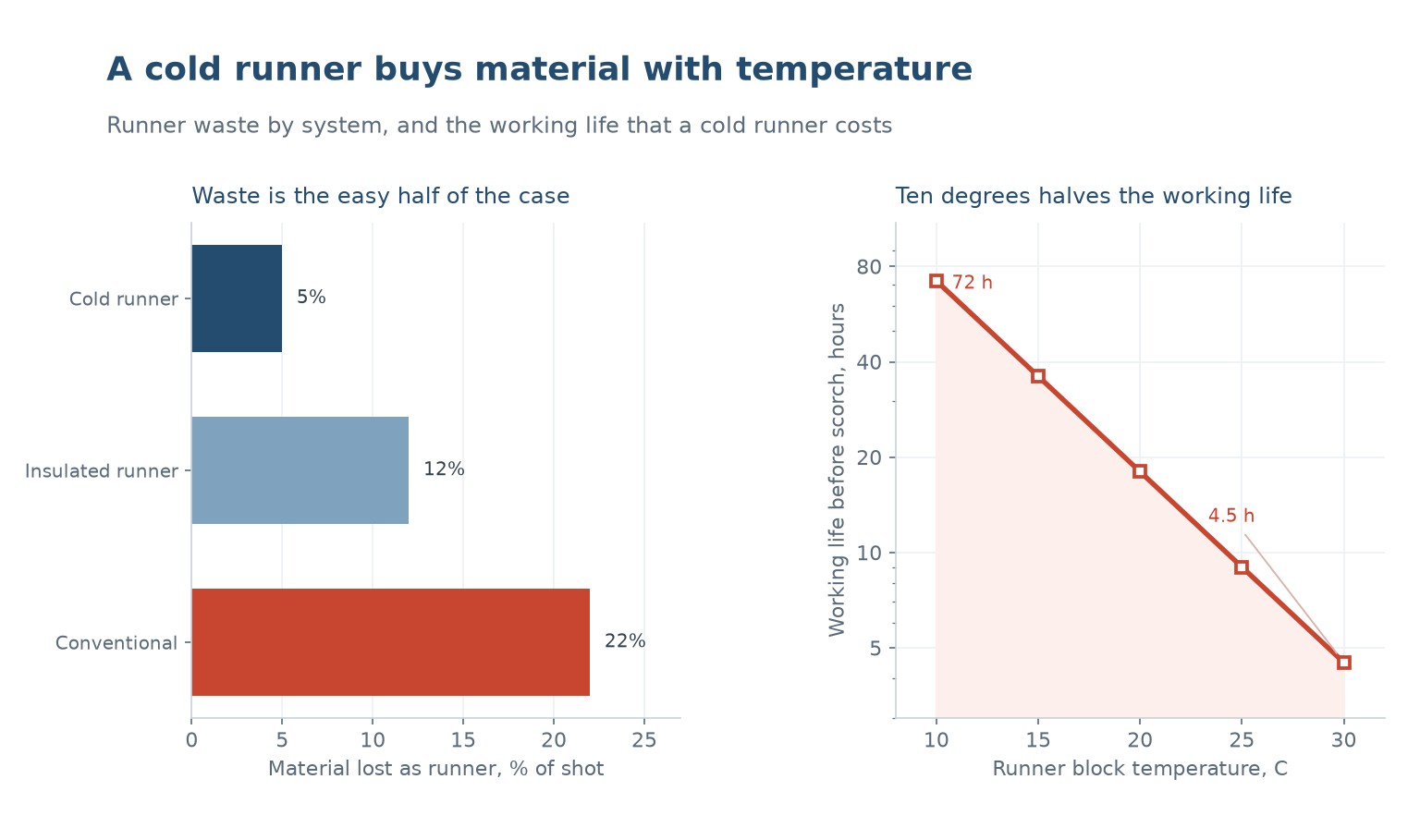
Runner waste as a share of the shot: about 22 percent for a conventional two-plate tool, 12 percent for an insulated runner, and 5 percent for a cold runner. The last number is not zero because some material is lost at start-up, at colour changes and at the end of a run.
| Runner type | Limbah | Tool cost | Where it fails |
|---|---|---|---|
| Conventional two-plate | 22 percent | Baseline | Nothing, it is simply wasteful |
| Insulated runner | 12 percent | Plus 15 percent | Heat soak over a long run |
| Cold runner | 5 percent | Plus 40 to 60 percent | Temperature control of the block |
Table 1 — Runner systems for silicone, and the trade each one makes
The saving is easy to calculate and it is usually large enough to pay for the tool in a few months. What is harder to calculate, and what decides whether the project works, is the cost of holding a block of reactive compound at a temperature where it does not cure but also does not scorch.
The window is measured in degrees
A platinum-catalysed silicone starts to cure slowly at room temperature and quickly at 120 C. A cold runner sits in the narrow band between, typically 10 to 25 C, where the cure is slow enough that the compound survives a shift but fast enough that it flows. The band is not wide.
Working life before scorch against runner block temperature: 72 hours at 10 C, 36 at 15, 18 at 20, 9 at 25 and 4.5 at 30. Ten degrees halves it, and the halving is not a rule of thumb, it is the Arrhenius behaviour of the same reaction that cures the part.
That single relationship decides the whole installation. A shop at 30 C ambient with a block cooled to 20 C has 18 hours of working life, which covers a shift and a bit. The same block on a hot afternoon, with the chiller struggling, drifts to 25 C and the working life is 9 hours, which does not cover a long shift. The failure appears as scorch marks and as parts that will not cure, and it appears suddenly.
What a cold runner tool has to do that a normal tool does not
The thermal separation is the whole design. The runner block has to be cold and the cavity has to be hot, and they are bolted to each other. Everything in the tool is about keeping those two temperatures apart.
| Fitur | Job | Failure if it is wrong |
|---|---|---|
| Insulating plate between block and cavity | Stop heat flowing into the runner | Block drifts warm, working life collapses |
| Cooling channels in the block | Hold the block within one or two degrees | Hot spots cure the compound in place |
| Thermal gate or valve gate | Separate cold runner from hot cavity | Material cures in the gate, shot blocks |
| Block temperature sensor at the nozzle | Measure where it matters | Sensor reads the chiller, not the compound |
| Quick purge port | Clear the block at the end of a run | A block of cured silicone scraps the tool |
Table 2 — The parts of a cold runner tool that exist only to manage heat
The thermal gate is the item that fails most often. It is a short, narrow section between the cold block and the hot cavity, and it has to be cold enough not to cure the compound and hot enough not to freeze it. A gate that is 5 C too warm cures a plug into the runner within a shift.
When a cold runner is the wrong answer
A cold runner is not worth it on a small tool with a short runner. If the runner is 4 grams on a 60 gram part, the waste is 6 percent and the tool premium buys very little. The break-even is usually around a runner that is 15 percent of the shot or more, and around a volume that justifies a 40 to 60 percent tool premium.
It is also the wrong answer for a compound that scorches easily, for a run that is short enough to finish inside one working life, and for a shop that cannot hold the block temperature within a couple of degrees. In those cases an insulated runner, which is cheaper and more forgiving, gets most of the benefit for a third of the complexity.
And it is the wrong answer for a two-shot or multi-material part, where the runner has to carry two compounds that cure at different rates. That is a tool design problem before it is a cold runner problem.
What to specify
A cold runner specification is a temperature specification more than a tool specification.
- The runner block temperature, with a tolerance of plus or minus 2 C.
- The working life required at that temperature, and the ambient temperature the shop actually reaches.
- The compound's scorch time at the block temperature, measured, not taken from a data sheet.
- The gate type and its temperature, and how it is controlled.
- The purge procedure at the end of a run, because a block left full is a block that is scrap.
Then log the block temperature for a week before you trust it. The failures are not gradual. A block that runs at 21 C for six days and 26 C on the seventh has a working life that falls by half on the day nobody is watching.
How does a cold runner work for silicone if silicone cannot be melted?
It does not melt anything. It holds the runner block below cure temperature so the compound stays uncured, while the heated cavity vulcanises the part.
How much material does a cold runner save?
Runner waste falls from about 22 percent of the shot to about 5 percent, against a tool cost increase of 40 to 60 percent.
What temperature does the runner block run at?
Typically 10 to 25 C. The window is narrow because the compound must be cold enough not to cure and warm enough to flow.
Why does ten degrees matter so much?
Cure is an Arrhenius reaction, so the rate roughly doubles for every ten degrees. Working life halves over the same interval: 72 hours at 10 C, 36 at 15, 18 at 20.
What fails first in a cold runner tool?
The thermal gate. Five degrees too warm cures a plug into the runner within a shift.
When is a cold runner not worth it?
When the runner is under about 15 percent of the shot, when the volume is low, or when the shop cannot hold the block within a couple of degrees.
Runner waste that is eating the margin?
Send the part weight, the runner weight and the annual volume. We will tell you whether a cold runner pays and what temperature window it needs.




 ID
 EN
 ES
 FR
 DE
 PT
 AR
 RU
 JA
 KO
 IT
 NL
 TR
 PL
