
Distance is the strong lever
Heat has to travel from the plastic to the channel wall through the steel, and the steel is the bottleneck. The thermal resistance of that path is proportional to the distance, so moving the channel further from the cavity slows the cooling almost in proportion.
Measured as a cooling time index against an 8 mm channel depth, a 12 mm depth is 112, a 16 mm depth 126, a 20 mm depth 142 and a 25 mm depth 160. That is 60 percent more cooling time for a change of 17 mm in the tool, and it is invisible on a drawing.
The practical rule is that the channel centre should be between one and two channel diameters below the cavity surface. Closer than that and the steel between the channel and the cavity is too thin to take the injection pressure; further and the cooling time climbs for no benefit.
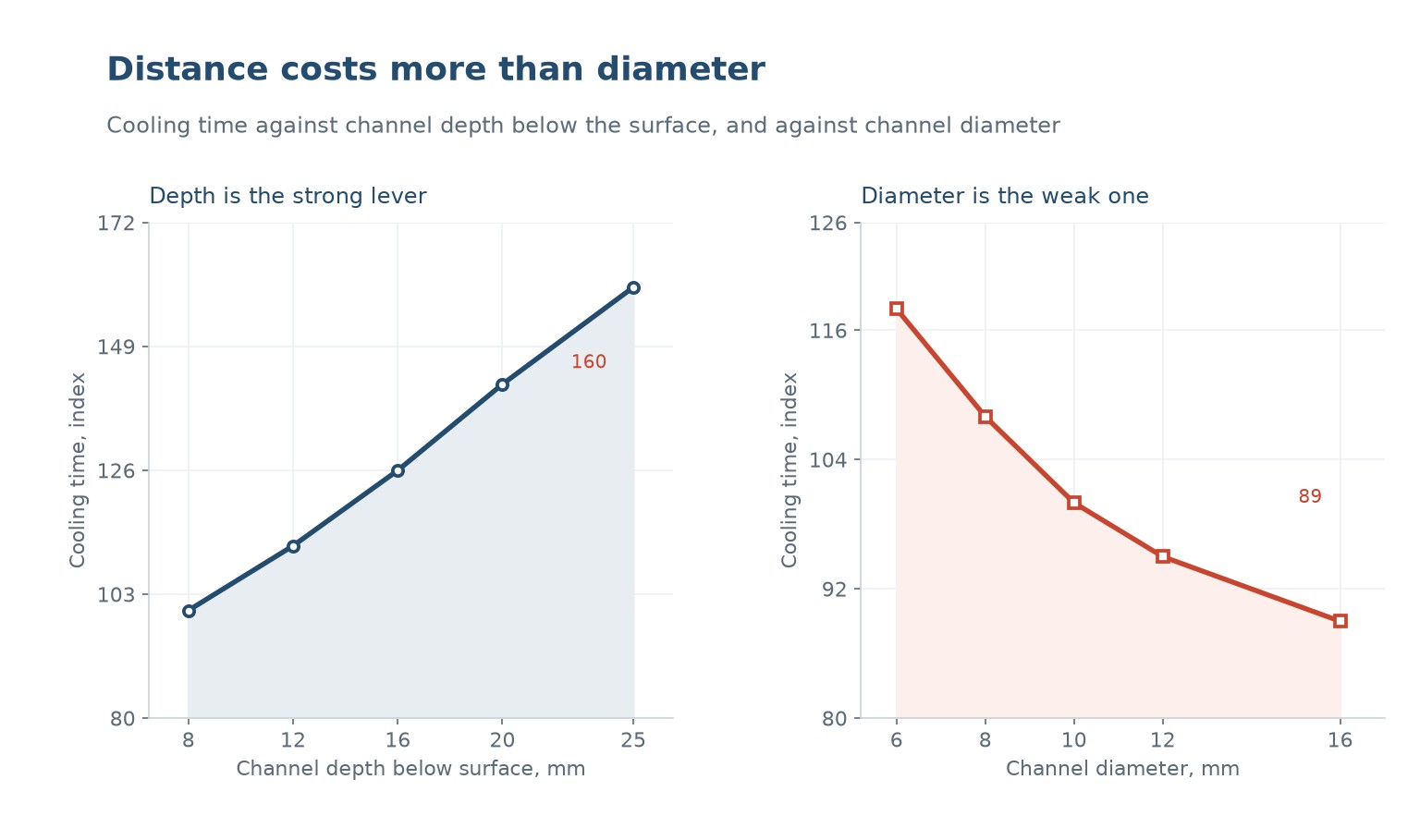
Diameter is the weak lever
A larger channel carries more water and has a larger surface area, so it removes more heat. But the gain is much smaller than the gain from moving the channel closer, because the limiting resistance is the steel between the channel and the plastic, not the water side.
Going from a 6 mm to a 16 mm channel takes the cooling time index from 118 to 89, which is 25 percent. That is worth having, and it costs a larger drill, a larger pump and more water, and it is a smaller gain than the 60 percent available from channel depth.
There is a practical floor on diameter. Below about 8 mm the flow may not be turbulent at the available pressure, and a laminar flow has a much lower heat transfer coefficient. The Reynolds number, not the diameter, is what decides whether the channel is working.
What a baffle does, and what it does not
A baffle is a divider pushed into a drilled channel to force the water to the bottom and back. It is used where a channel cannot be drilled straight through, such as under a tall core, and it works by turning a single pass into a two-pass flow along the same hole.
What it does not do is increase the heat transfer much. The baffle splits the flow into two halves, each with a smaller cross-section, and the effective area is the same. The real gain is that it gets water to the bottom of the hole instead of letting it short-circuit across the top.
A baffle installed in a channel that is already drilled through, and already has water flowing along it, does very little. It adds pressure drop and it can create a dead zone behind it. This is why a baffle that was added to fix a hot spot often does not, and the hot spot turns out to be a channel that is too far from the surface.
Series, parallel and the flow that goes the wrong way
A series circuit sends all the water through every channel in turn. It is simple and it guarantees flow through every channel, and it means the water gets progressively warmer as it goes, so the last channel cools less than the first. On a long circuit the difference is enough to warp a part.
A parallel circuit splits the flow, which equalises the temperature but relies on every branch having the same resistance. If one branch is shorter or larger, it takes most of the flow and the others stagnate. A parallel circuit that is not balanced is worse than a series one.
The way to check is to measure the temperature of each outlet. A circuit where one outlet is much cooler than the others is a circuit where that branch is taking most of the flow and the rest are not working.
| Layout | Advantage | Risiko |
|---|---|---|
| Series | Guaranteed flow everywhere | Water warms along the path |
| Parallel, balanced | Even temperature | Needs equal resistance |
| Parallel, unbalanced | Cheap to drill | Stagnant branches |
| Baffled | Reaches the bottom of a hole | Pressure drop, dead zones |
| Conformal | Follows the cavity | Cost, and hard to clean |
Table 1 — Cooling circuit layouts and their failure modes
The water side still matters
Turbulent flow is what makes a channel work. A laminar flow has a much lower heat transfer coefficient, and it happens when the velocity is low or the channel is large. The usual target is a Reynolds number above 4,000, and the flow rate needed to reach it depends on the diameter.
Temperature control matters too. A chiller running at 15 C and a tower running at 30 C give very different cooling times, and the difference is often larger than the difference between two channel designs. The mould temperature is a process variable, and the circuit is only the delivery system.
Scale and fouling are the slow failure. A channel that has been running for years has a layer of scale on the wall, which is an insulator. The symptom is a cooling time that has crept up with no change in the tool, and the fix is a descale rather than a redesign.
Designing it in the right order
Place the channels first, at one to two diameters below the surface, following the cavity. Then size the diameter from the flow available. Then decide the circuit layout from the temperature uniformity requirement. Doing it in the other order produces a circuit that is hydraulically neat and thermally wrong.
Then check the hot spots. The corners, the deep ribs and the thick sections are where the heat is, and they need a channel closer or a separate circuit. A uniform circuit over a non-uniform part gives a non-uniform part.
| Decision | Order | Reason |
|---|---|---|
| Channel placement | First | Dominates cooling time |
| Diameter | Second | Weak lever, flow limited |
| Layout | Third | Uniformity |
| Hot spot circuits | Fourth | Local heat |
| Water temperature | Last | Process setting |
Table 2 — The order that gives a working circuit
How far below the cavity should a cooling channel be?
One to two channel diameters from the surface to the channel centre. Closer risks distortion under injection pressure; further adds cooling time roughly in proportion to the distance.
Does a bigger cooling channel shorten the cycle?
Yes, but much less than moving it closer. Going from 6 to 16 mm takes about 25 percent off the cooling time, where moving from 25 to 8 mm depth takes about 38 percent.
What does a baffle actually do?
It forces water to the bottom of a blind hole instead of letting it short-circuit across the top. It does not increase the heat transfer area, so it does not help in a channel that already has full flow.
Why is one part of my mould hotter than another?
Usually a channel that is further from the surface, or a parallel branch that is taking most of the flow. Measure the outlet temperatures; a much cooler outlet is a branch that is doing all the work.
How do I know if my flow is turbulent?
Calculate the Reynolds number from the flow rate and the channel diameter. Above about 4,000 the flow is turbulent and the channel is working; below that the heat transfer coefficient falls sharply.
Can cooling time creep up without a tool change?
Yes, through scale in the channels. A descale restores it, and the symptom is a gradual loss of cooling performance across all cavities at once.
A cycle that is limited by cooling?
Send the part section and the current circuit. We will tell you where the channels should be, whether the flow is turbulent, and what the cycle could be.




 ID
 EN
 ES
 FR
 DE
 PT
 AR
 RU
 JA
 KO
 IT
 NL
 TR
 PL
