
The line in one paragraph
HDPE pipe extrusion is a single-screw process feeding a spider or basket die, followed immediately by vacuum sizing, spray or immersion cooling, haul-off and cut-off. The melt leaves the die at 190 to 220 °C as a tube that is still soft enough to deform under its own weight, and the rest of the line exists to stop it from doing so.
What makes HDPE different from PVC pipe is that there is no calibration sleeve holding the shape by contact. PVC pipe is sized against a water-cooled sleeve that sets the surface within a few centimetres. HDPE is sized by vacuum against a perforated sleeve while the wall is still molten through most of its thickness, which means the roundness you get depends on how evenly the vacuum pulls and how fast the wall stiffens.
Sag: a race between gravity and crystallisation
Sag is the downward movement of the tube between the die and the first cooling point. It is not a surface defect; it is a change in wall thickness, thick at the bottom and thin at the top. A pipe with 5 percent sag has a bottom wall 10 percent thicker than the top and an ovality that no sizing sleeve will correct, because the asymmetry is already frozen in.
Three variables drive it. Melt temperature sets how soft the tube is. Line speed sets how long it hangs. Wall thickness sets how much mass is hanging. The relationship is not linear in any of them: doubling the wall roughly quadruples the sag, because mass and thermal resistance both increase.
The practical rule used on most lines is to keep the unsupported distance between die and first cooling under 150 mm for pipes below 160 mm, and under 80 mm above 315 mm. Beyond that, the tube is hanging long enough to move regardless of what the vacuum does.
| Pipe OD | Typical wall (SDR 17) | Max unsupported length | Sizing method |
|---|---|---|---|
| 32 mm | 2.0 mm | 150 mm | Vacuum sleeve |
| 110 mm | 6.6 mm | 130 mm | Vacuum sleeve |
| 250 mm | 14.6 mm | 100 mm | Vacuum tank |
| 400 mm | 23.7 mm | 85 mm | Vacuum tank + internal air |
| 630 mm | 37.4 mm | 70 mm | Vacuum tank + internal air + water cooling inside |
Table 1 — Unsupported length between die and first cooling, by diameter. Above 400 mm the internal air pressure becomes a shaping tool, not just a support.
Cooling is the only lever that actually works
You cannot raise the melt temperature to improve flow and then complain about sag; the two are the same decision. What you can do is remove heat faster, and that means more tank, colder water, or both.
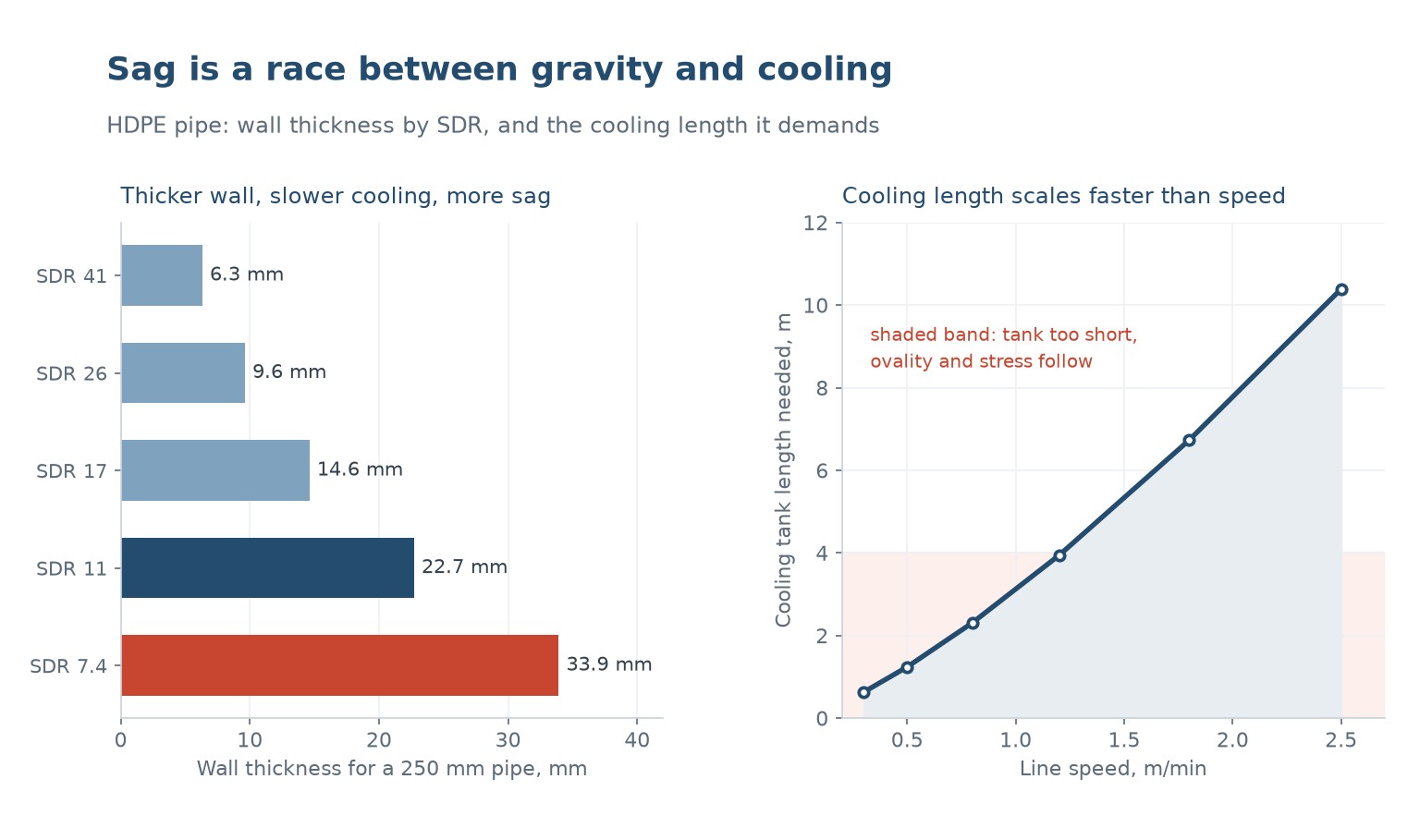
The cooling length required grows faster than line speed. In practice, going from 0.5 to 1.0 m/min on a 250 mm pipe needs roughly 2.5 times the tank length, not twice, because the wall has to shed heat through an increasingly thick frozen layer. A line that was commissioned with an 8 m tank and then pushed to double speed will produce oval pipe and the operator will blame the vacuum.
Water temperature matters more than most operators expect. HDPE gives up heat slowly, and a 25 °C tank against a 15 °C tank changes the achievable line speed by 15 to 20 percent on thick walls. Chillers pay for themselves on anything above 315 mm.
Spray cooling is more effective than immersion for large diameters, because the water that has already absorbed heat runs off instead of insulating the pipe. The best lines use a short immersion section to set the surface and then spray for the rest of the length.
Sizing: holding a round that wants to be oval
Vacuum sizing works by pulling the still-soft tube against a perforated sleeve or into a ring of water. The vacuum level is not the interesting number; the distribution is. A sleeve with blocked holes on one side pulls unevenly and produces an oval that follows the blockage pattern.
For pipes above 250 mm, internal air pressure is used together with external vacuum. A slight positive pressure inside the tube pushes the wall out against the sleeve, which improves roundness and reduces the vacuum needed. The pressure is small — 0.02 to 0.05 bar — and it is regulated, not guessed.
The sizing sleeve diameter must allow for shrinkage after the pipe leaves the line. HDPE pipe shrinks about 1.5 to 2.5 percent in diameter over the first 24 hours, depending on wall and cooling. A sleeve cut to the nominal diameter will produce pipe that measures under nominal the next day, which is why sizing sleeves are cut oversize by a factor that is specific to the line.
SDR, wall and the pressure rating nobody reads
SDR is the ratio of outside diameter to wall thickness. It is the only number that matters for pressure rating, because the hoop stress in a pressurised pipe depends on that ratio and not on the absolute size. A 32 mm SDR 11 pipe and a 630 mm SDR 11 pipe have the same pressure rating.
The rating itself comes from a long-term hydrostatic test at 20 °C, extrapolated over 50 years. For PE100 that gives a design stress of 8 MPa, and the rating follows as 2 × 8 / (SDR − 1). SDR 11 gives 16 bar, SDR 17 gives 10 bar, SDR 26 gives 6 bar.
| SDR | Wall for 250 mm OD | Pressure rating (PE100, water, 20 °C) | Typical use |
|---|---|---|---|
| SDR 41 | 6.3 mm | 4 bar | Gravity sewer, drainage |
| SDR 26 | 9.6 mm | 6 bar | Low-pressure drainage |
| SDR 17 | 14.6 mm | 10 bar | Water distribution |
| SDR 11 | 22.7 mm | 16 bar | Mains pressure water, gas |
| SDR 7.4 | 33.9 mm | 20 bar | High-pressure industrial |
Table 2 — SDR against wall and rating for a 250 mm PE100 pipe. The rating assumes water at 20 °C; derate for temperature and for aggressive media.
The number that gets missed is the temperature derating. PE100 at 40 °C is rated at about 0.74 of its 20 °C value, and at 60 °C about 0.52. A line specified for 16 bar cold service and then used for 60 °C process water is running at roughly 8 bar of actual capacity, and it will fail at a joint long before the pipe bursts.
What goes wrong above 250 mm
Small pipe is forgiving. Large pipe is not, because every problem has more time and more mass to express itself.
| Symptom | Most likely cause | First thing to check |
|---|---|---|
| Ovality above specification | Uneven vacuum or blocked sizing holes | Vacuum distribution around the sleeve |
| Wall thick at bottom, thin at top | Sag — melt too hot or line too fast | Melt temperature, then line speed |
| Longitudinal line on the surface | Die lip damage or a drag mark in the sleeve | Die lip with a straight edge |
| Internal surface roughness | Moisture in the resin or a cold die | Resin moisture, then die temperature profile |
| Diameter drift over hours | Sizing sleeve wear or vacuum leak | Sleeve bore, then vacuum level trend |
| Brittle pipe that cracks on impact | Over-cooled surface, high residual stress | Cooling water temperature and tank length |
Table 3 — The six defects that account for most large-diameter HDPE scrap.
The one that hides until installation
Residual stress does not show on the line. It shows when the pipe is cut — the end opens or closes — or when it is jointed and the fusion face does not line up. A pipe that passes every dimensional check and then curls when cut was cooled too fast on the outside and too slowly on the inside. The fix is a longer tank or warmer water, not a straighter rack.
What line speed can I run on a 250 mm SDR 17 HDPE pipe?
Between 0.6 and 1.0 m/min on a line with 8 to 10 m of cooling. The limit is usually ovality, not the extruder. If you need more speed, add tank length before you add screw speed.
How much does HDPE pipe shrink after extrusion?
About 1.5 to 2.5 percent in diameter and 1 to 2 percent in length over 24 hours. Thick walls shrink more. Sizing sleeves are cut oversize to compensate, and the factor is specific to each line and must be measured, not assumed.
Why does my pipe have a thick bottom wall?
Sag. The tube hangs between the die and the first cooling point and the wall flows downward. Reduce melt temperature by 10 °C, shorten the die-to-tank distance, or slow the line. All three work; the first is cheapest.
Is spray cooling better than a water bath?
For pipe above 315 mm, usually yes. Immersion water heats up around the pipe and insulates it; spray removes the heated water continuously. Many large lines use a short bath to set the surface and spray for the remainder.
What vacuum level should the sizing tank run at?
0.2 to 0.4 bar below atmospheric is typical. More vacuum does not fix ovality caused by sag; it only pulls a distorted tube harder against the sleeve. Fix the sag first.
Can I run PE100 on a line set up for PE80?
Yes, with a temperature adjustment. PE100 runs about 5 to 10 °C cooler and needs slightly more energy in the screw because of its higher molecular weight. The pressure rating of the pipe changes, so the marking must change with it.
Extruding HDPE pipe and fighting ovality?
Tell us the diameter, the SDR and the line speed you want. We will tell you what the cooling length has to be and where the sag will show up first.




 ID
 EN
 ES
 FR
 DE
 PT
 AR
 RU
 JA
 KO
 IT
 NL
 TR
 PL
