
A PVC fence has to survive two things that have nothing to do with each other. It has to stay standing in wind, which is a structural question about stiffness, spans and fixings. And it has to look acceptable after ten years in the sun, which is a chemistry question about stabilisers, pigments and ultraviolet exposure.
The two are usually specified separately and they fail separately. A fence that is structurally sound but goes chalky and pink after four summers is a warranty claim. A fence that holds its colour perfectly but leans in the first gale is a different warranty claim. Both are decided at the design stage, and neither can be fixed on the extrusion line.
The reason they are worth separating is that the fixes pull in different directions. More stiffness means more wall, more mass and more cost. Better colour retention means more TiO2 and a better stabiliser package, which also costs. A specification that treats them as one item will over-spend on one and under-spend on the other.
Wind load and post spacing
A fence panel is a plate on two posts, and it takes wind pressure over its whole area. The posts are the structure; the infill just transfers the load to them. So the design variables are the post section, the post spacing and the fixing, and the infill profile matters much less than people assume.
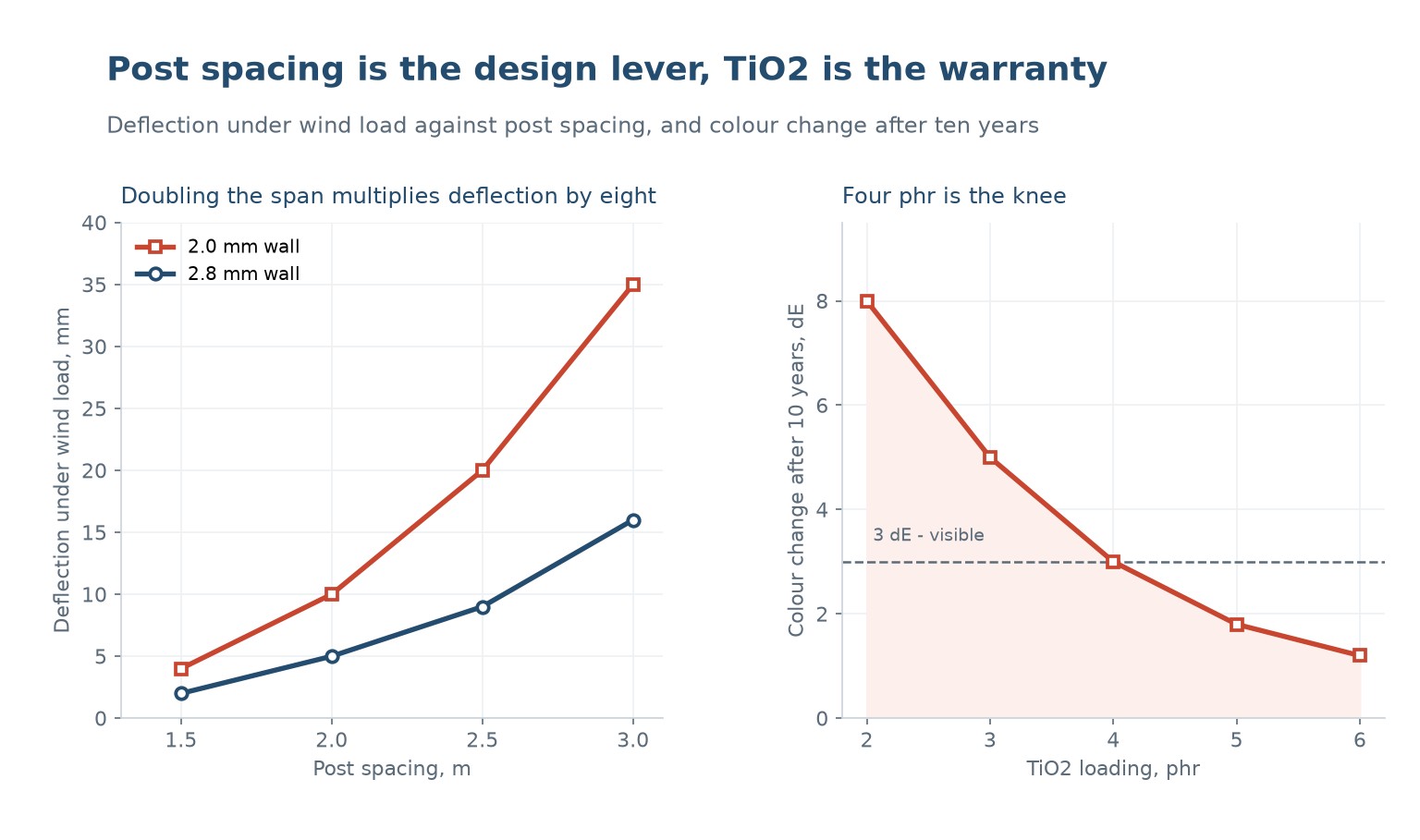
Post spacing dominates. For a 2.0 mm wall post under a design wind load, deflection runs 4 mm at 1.5 metre spacing, 10 mm at 2.0, 20 mm at 2.5 and 35 mm at 3.0. Doubling the spacing from 1.5 to 3.0 multiplies the deflection by nearly nine, which is consistent with a beam deflection that goes with the fourth power of the span for a uniformly loaded member.
A 2.8 mm wall post does much better: 2, 5, 9 and 16 mm at the same spacings. So there are two levers, and they trade against each other. Halving the spacing costs twice as many posts; thickening the wall costs more material per post. Which is cheaper depends on the post design and the local material prices, and it is worth doing the sum rather than defaulting to one.
| Post spacing, m | Deflection, 2.0 mm wall, mm | Deflection, 2.8 mm wall, mm | Verdict at a 20 mm limit |
|---|---|---|---|
| 1.5 | 4 | 2 | Comfortable at either wall |
| 2.0 | 10 | 5 | Comfortable at either wall |
| 2.5 | 20 | 9 | At the limit for 2.0 mm; comfortable for 2.8 |
| 3.0 | 35 | 16 | Too much for 2.0 mm; 2.8 mm still passes |
Table 1 — Post spacing and wall thickness against deflection under a design wind load.
The fixing is the third variable and the one that fails in service. A post that is bolted to a bracket with two screws into a hollow section will rotate before it bends, and the panel will lean. Posts are usually set in concrete or driven into a socket, and the embedment depth matters more than the post section for a fence of any height.
Colour retention is a TiO2 question
Unpigmented PVC degrades in ultraviolet light. The mechanism is a photochemical reaction that produces hydrochloric acid and conjugated double bonds, which show as a yellow-brown discolouration and then as chalking, where the surface breaks down into a powdery layer. Titanium dioxide blocks ultraviolet and stops the reaction, and it is the single most important additive in an outdoor PVC profile.
The relationship between loading and colour change is steep at low loadings and flattens at high ones. After ten years of exposure, 2 phr of TiO2 gives a colour change of 8 dE, 3 phr gives 5, 4 phr gives 3, 5 phr gives 1.8 and 6 phr gives 1.2. The visible threshold is around 3 dE, so 4 phr is the practical minimum and 5 phr is where the curve has flattened enough that more does not buy much.
Two qualifications matter. The first is that TiO2 grade matters as much as loading: a rutile grade with the right surface treatment disperses better and blocks more effectively than an untreated anatase at the same loading. The second is that the thermal stabiliser has to be matched to the TiO2, because a profile that blocks UV but degrades thermally during processing will still discolour.
Impact, and why winter is the test
PVC is glassy at ambient temperature, so it is notch-sensitive and its impact strength falls as the temperature drops. A fence panel that survives a knock at 25 °C can shatter at 0 °C, and the failure is brittle: a clean break with no deformation, usually starting at a sharp corner or a screw hole.
The formulation answer is an impact modifier, typically an acrylic or a chlorinated polyethylene at 5 to 10 phr. That improves low-temperature impact substantially and costs a little stiffness, a little colour retention and some money. It is the standard compromise in any outdoor PVC profile.
The design answer is more effective and cheaper. Radii at every internal corner, no sharp notches, screw holes that are drilled rather than punched, and a wall that is thick enough that the section is not operating near its limit. A profile with generous radii and a 2.8 mm wall will out-perform a 2.0 mm profile with a heavy impact modifier package, at similar cost.
Coextruded caps and the two-layer fence
A coextruded cap is a thin outer layer of a formulation that is optimised for weathering over a core that is optimised for cost and stiffness. The cap is typically 0.3 to 0.5 mm and carries most of the TiO2 and the stabiliser, while the core carries the impact modifier and the filler.
The economics are compelling: the expensive weathering package is used only where it is needed, which is the surface. A capped profile can use 6 phr of TiO2 in a 0.4 mm layer for less cost than 4 phr through a 2.8 mm wall, and it will weather better.
The risk is delamination. A cap that is too thin, or a core and cap with incompatible formulations, will separate at the interface after thermal cycling, and the failure looks like peeling paint. The bond is melt fusion, so the two formulations need compatible viscosities and a shared base resin, and the interface needs to be formed inside the die rather than in the calibrator.
| Pendekatan | Weathering package | Biaya | Risiko |
|---|---|---|---|
| Monolayer, 4 phr TiO2 | Through the whole wall | Sedang | None; simple and reliable |
| Monolayer, 6 phr TiO2 | Through the whole wall | Tinggi | None, but the extra TiO2 is mostly buried |
| Coextruded cap, 0.4 mm | Concentrated at the surface | Lower for the same surface performance | Delamination if the formulations are incompatible |
Table 2 — Monolayer against coextruded cap, on cost and risk.
Writing a fence specification
A fence specification that survives ten years has five items, and most purchase orders have two.
- Design wind load and the post spacing it is calculated for, with a deflection limit stated in millimetres.
- Post wall thickness and section, and the embedment depth and fixing detail.
- TiO2 loading and grade, stated separately, because the grade matters as much as the number.
- Impact requirement at the lowest installation temperature, not at 23 °C.
- Colour and gloss retention after a stated exposure, quoted as a dE and a gloss figure, with the test method.
The colour item is the one that gets negotiated away because it is hard to test and easy to promise. A supplier who is asked for a dE figure after a stated exposure will either have the data or will not, and the answer tells you a great deal about the rest of the specification.
How far apart should fence posts be?
1.5 to 2.0 metres for a typical PVC panel, depending on the post wall thickness and the design wind load. At 3.0 metres a 2.0 mm wall post deflects 35 mm, which is too much for most specifications.
How much TiO2 does an outdoor PVC profile need?
About 4 phr of a rutile grade as a minimum, and 5 phr is where the colour-retention curve flattens. The grade matters as much as the loading.
Why does my fence crack in winter?
PVC is glassy and notch-sensitive at ambient temperature, so impact strength falls as it gets colder. It needs an impact modifier and generous radii, and screws should be drilled rather than punched.
What is a coextruded cap?
A thin outer layer with the weathering package concentrated in it, over a cheaper core. It gives better weathering for less cost, but it can delaminate if the two formulations are incompatible.
What colour change is acceptable after ten years?
Around 3 dE is the visible threshold, so a specification should target 3 or below. At 2 phr TiO2 the change is about 8, which is clearly visible.
Does wall thickness affect weathering?
Not directly, but it affects stiffness and impact. A thicker wall lets you use a simpler formulation and still pass the mechanical requirements.
Developing a fence or railing profile?
Send the panel size, the post spacing and the wind load. We will check the deflection, size the wall and the TiO2 package, and tell you whether a coextruded cap is worth it.




 ID
 EN
 ES
 FR
 DE
 PT
 AR
 RU
 JA
 KO
 IT
 NL
 TR
 PL
