The problem
Symptom. A moulded silicone bellows on a dosing pump develops a fine crack at the root of every convolution after a few months of stroking, and the assembly fails its leak test.
What it costs. The bellows passes a visual check at goods-in, but a fold-root crack breaches the barrier, so a whole batch is scrapped and the tool is blamed for what is really a stroke and radius fault.
This guide links the crack to fold-root bending strain and over-stroke, gives a sectioned-radius and one-million-cycle fatigue test, and sets a geometry and compound clause on the drawing.
Why fatigue cracks start at the fold root
A moulded silicone bellows flexes at each convolution, so bending strain peaks at the inner fold root. A 1.5 mm root on a 2 mm wall concentrates it, and at a +/- 15 mm over-stroke strain reaches about 60 % before a fatigue crack opens.
| Teardown finding | Most likely cause | Confirming check |
|---|---|---|
| Crack at the inner root of every convolution | Fold-root radius too sharp | Measure radius on a section under 10x |
| Crack starts at one angular position | Parting-line witness or mould nick | Mark the angle on fifty failed bellows |
| Crack only at the most compressed fold | Stroke beyond design travel | Log installed stroke and stop height |
| Whole fold creased and split | Compression set plus low tear strength | Check set and tear strength on the certificate |
Table 1 - Reading a bellows fold-root fatigue crack
Need a fixed price for this seal?
Send the gland drawing, temperature range, media and annual volume. We will recommend a compound with test data and return samples with a written production quotation.
Get a silicone seal quotationEmail [email protected]WhatsApp
Reproduce the stroke test before re-tooling
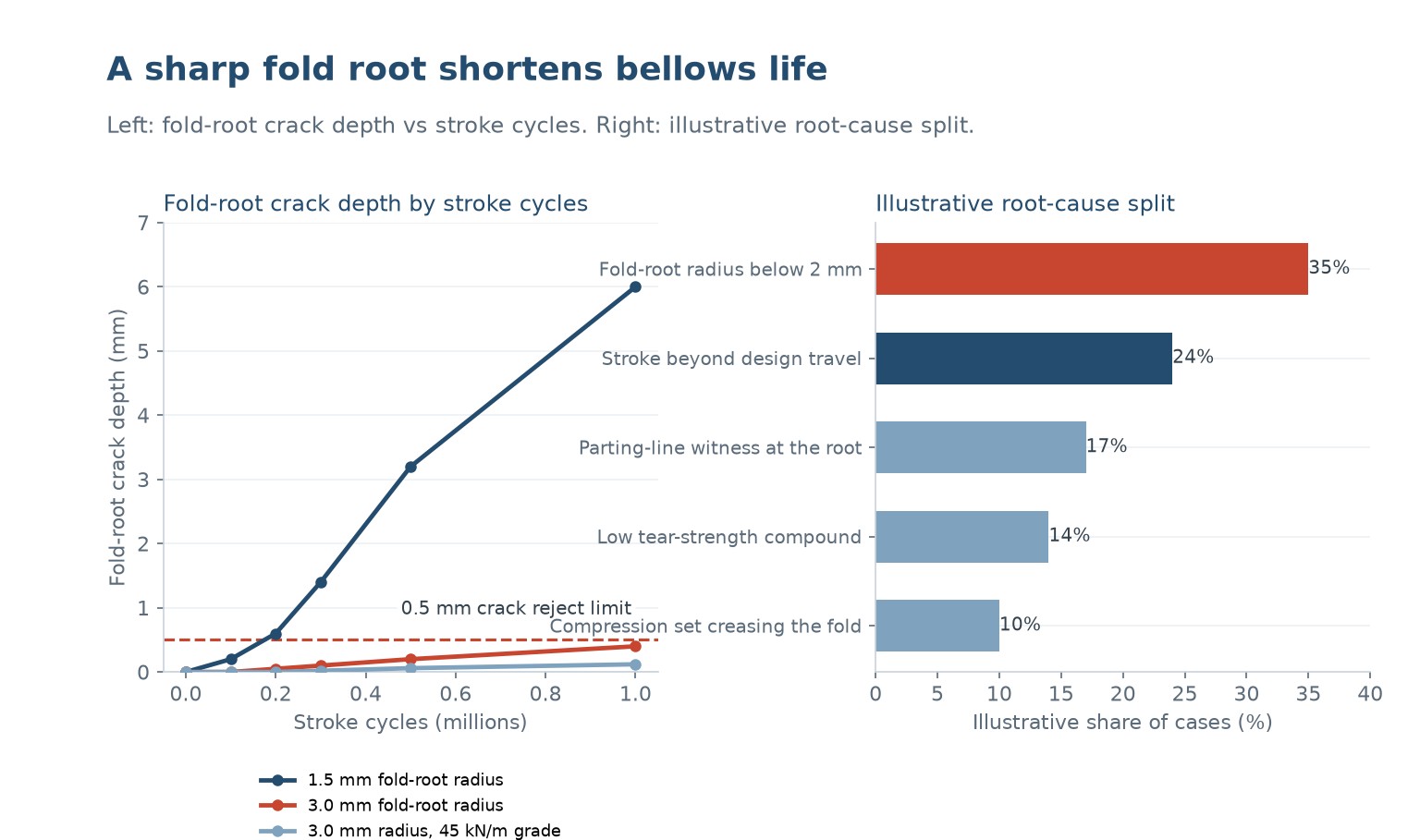
Cycle at 1 Hz, +/- 10 mm and 23 C, inspecting fold roots under 10x every 100,000 cycles. The chart shows a 1.5 mm root crossing the 0.5 mm limit near 200,000 cycles and reaching 6 mm; a 3.0 mm root stays at 0.4 mm.
A five-step diagnostic sequence
- Recover the drawing and a failed bellows.
Note the convolution count, fold-root radius, wall thickness and installed stroke before sectioning anything. - Section one fold and measure the root radius.
Polish a cross-section and read the radius under 10x; a 1.5 mm root concentrates bending strain. - Mark where each crack starts.
Log the angular position on fifty failed bellows; one fixed angle points to a parting-line witness. - Run a one-million-cycle stroke test.
Cycle at 1 Hz, +/- 10 mm and 23 C, inspecting fold roots under 10x every 100,000 cycles. - Re-test with the agreed radius and grade.
Open the root to 3.0 mm, use a 45 kN/m compound and confirm crack depth below 0.5 mm.
The chart below is a typical result from that measurement step. Use it to separate a design limit from a setting that can still be recovered.
Set a root radius, stroke and tear-strength clause on the drawing
Put the geometry on the drawing: a 3.0 mm fold-root radius, a +/- 10 mm stroke with a hard stop and tear strength above 35 kN/m. Require a one-million-cycle test with a 0.5 mm crack limit at 500,000 cycles.
| Paramètres | Typical target | What goes wrong outside it |
|---|---|---|
| Fold-root radius | Above 3.0 mm | A 1.5 mm radius cracks by about 200,000 cycles |
| Design stroke | +/- 10 mm at 1 Hz | A +/- 15 mm stroke raises root strain to 60 % |
| Tear strength of compound | Above 35 kN/m | Below 20 kN/m a nick propagates quickly |
| Fold-root crack at 500,000 cycles | Below 0.5 mm | A deeper crack opens a leak path at 0.5 bar |
Table 2 - Geometry and fatigue parameters to specify
Choose geometry and grade for the duty
Judge the fix by measured crack depth, not compound hardness alone. Opening the root from 1.5 to 3.0 mm cuts one-million-cycle depth from 6 mm to 0.4 mm; a 45 kN/m high-tear grade brings it to 0.12 mm.
| Option | When it fits | Trade-off |
|---|---|---|
| Open the fold-root radius to 3.0 mm | Sharp radius confirmed | New tool and a longer free length |
| Cap the installed stroke at +/- 10 mm | Over-stroke on the assembly | Reduced travel for the mechanism |
| Move to a high-tear 45 kN/m grade | Radius and stroke are fixed | Higher compound price per part |
| Relocate the parting line off the root | A witness mark starts the crack | Tool rework and a new first article |
Table 3 - Options for a bellows that cracks at the fold root
Separate a sharp root from a low-tear compound
A sharp radius and a low-tear compound differ: sectioning one fold settles the geometry, a tear test settles the grade. Send the drawing, installed stroke and a cracked part; we will review the root radius and quote a tool with a written fatigue test.
Want a compound check before you re-order?
Send us the gland drawing and the service conditions. We will compare the compound data against your temperature range and return a recommendation with sample parts.
What to send us
- Gland dimensions and cross-section
- Temperature range and media
- A failed seal if available
- Annual volume
Recovery actions ranked by tooling effort
Rank recovery by tooling effort: cap the stroke at +/- 10 mm, re-test fifty parts at one million cycles, then open the root if cracks persist. Typically, a radius below 2 mm led at 35 % and over-stroke at 24 %.
Before you release this silicone seal
- A minimum 3.0 mm fold-root radius is dimensioned on the bellows drawing
- The maximum installed stroke of +/- 10 mm and its stop height are on the assembly drawing
- A tear strength above 35 kN/m is written into the compound specification
- A one-million-cycle test with a 0.5 mm crack limit at 500,000 cycles is in the purchase order
- The mould parting line is kept off the fold root and first-article sections are retained
Most cold or heat failures are specification gaps, not bad batches. Fix the specification before changing suppliers.
Why does the crack always start at the fold root?
Bending strain peaks at the inner root of each convolution. A sharp radius concentrates it, and repeated stroking opens a fatigue crack there before the bulk rubber shows any wear.
Is silicone not fatigue-resistant?
The polymer is, but geometry dominates. A 1.5 mm root plus a +/- 15 mm over-stroke raises local strain to about 60 %, so the notch fails long before the material does.
How much stroke is too much?
The drawing allows +/- 10 mm. At +/- 15 mm fold-root strain rises from about 25 % to 60 %, and a sharp root fails well before 200,000 cycles; fit a hard stop.
Will a harder compound stop the crack?
Hardness alone does not. Opening the root from 1.5 to 3.0 mm cuts one-million-cycle crack depth from 6 mm to 0.4 mm; a high-tear grade then brings it to 0.12 mm.
What crack size actually leaks?
A fold-root crack deeper than 0.5 mm opens a leak path at 0.5 bar. Inspect every 100,000 cycles under 10x and reject any part that reaches the limit.
Should we just thicken the wall instead?
A thicker wall lowers strain slightly but cannot fix a sharp root or an over-stroke. Correct the radius and the stroke first, then raise tear strength if cracks persist.
Get a seal specified for the real service conditions
Send us the gland drawing and the service conditions. We will recommend a compound with documented test data, review the squeeze, and supply samples with a production quotation.
To get an accurate quote, send:
- Gland drawing or seal cross-section
- Temperature range and media
- Pressure and movement
- Annual volume and target unit price
Request samples and a quotation
Why buyers work with Uplastech
ISO 9001, ISO 14001 and ISO 45001 certified. Founded in 2016, with injection moulding lines in Shanghai and an extrusion plant in Jiangsu. Moulding machines from 90T to 1100T and a maximum shot weight of 5100 g. Samples and a written quotation are available on request.
Continue reading
- Silicone compression set
- Silicone gasket and seal design
- Silicone hardness: Shore A
- Silicone industrial seals
- Silicone o-ring manufacturing
Ready to specify? See our silicone rubber moulding services ou request a written quotation.





 FR
 EN
 ES
 DE
 PT
 AR
 RU
 JA
 KO
 IT
 NL
 TR
 PL
 ID