
What inhibition looks like
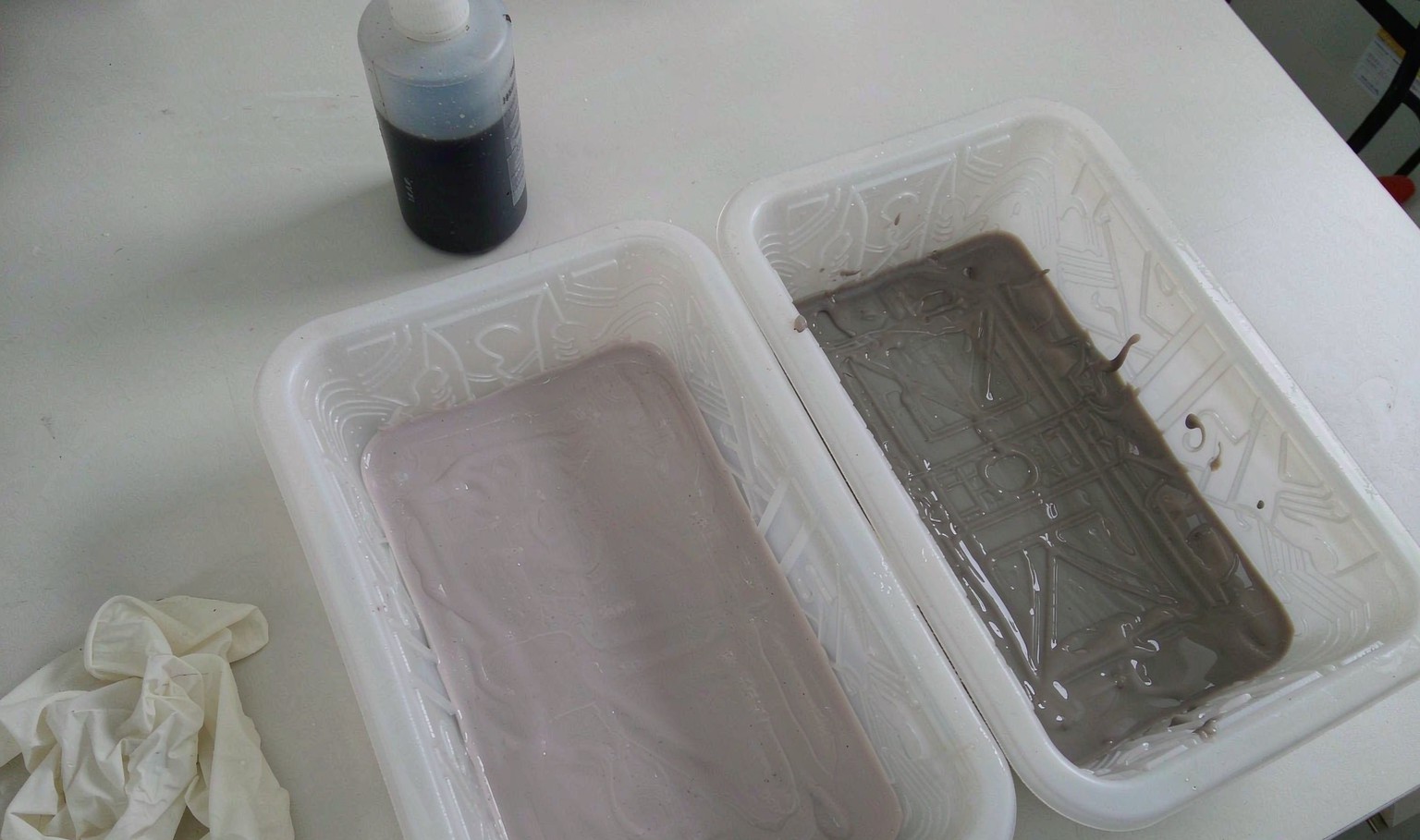
A platinum-cured silicone that has been inhibited does not cure, or cures only partly. The surface stays tacky, or it skins over and stays soft underneath, or it cures everywhere except in a thin layer against the mould face. In the worst case it never sets at all and the part has to be scraped out.
The signature is that it is always at an interface. The silicone in the middle of a thick section cures normally, and the layer touching the contaminated surface does not. That is the diagnostic: if the failure follows a surface rather than a volume, it is inhibition, not a bad mix ratio.
A bad mix ratio gives a uniformly soft or uniformly hard part. Moisture gives bubbles. Old compound gives a shorter working time but it still cures. Inhibition is the only common failure that is surface-specific, and that is what makes it findable.
It also appears suddenly. A mould that has run for a year starts producing sticky parts after a new release agent, a new batch of gloves, or a new cleaning solvent. The compound has not changed; something it touches has.
Platinum cure is a catalyst, and catalysts are poisoned
Addition-cure silicone works through a platinum catalyst that adds silicon hydride across a vinyl group. The platinum is not consumed in the ideal reaction, which is why a tiny amount catalyses a large batch. It is also why a tiny amount of the wrong chemical can stop the whole batch: a poison that binds the platinum takes it out of circulation permanently.
Sulphur, tin, arsenic, lead and a long list of amines and phosphorus compounds all bind platinum strongly. So do some phthalate plasticisers and some sulphur-containing rubbers. The binding is not reversible, so adding more catalyst does not recover the batch; it only wastes catalyst.
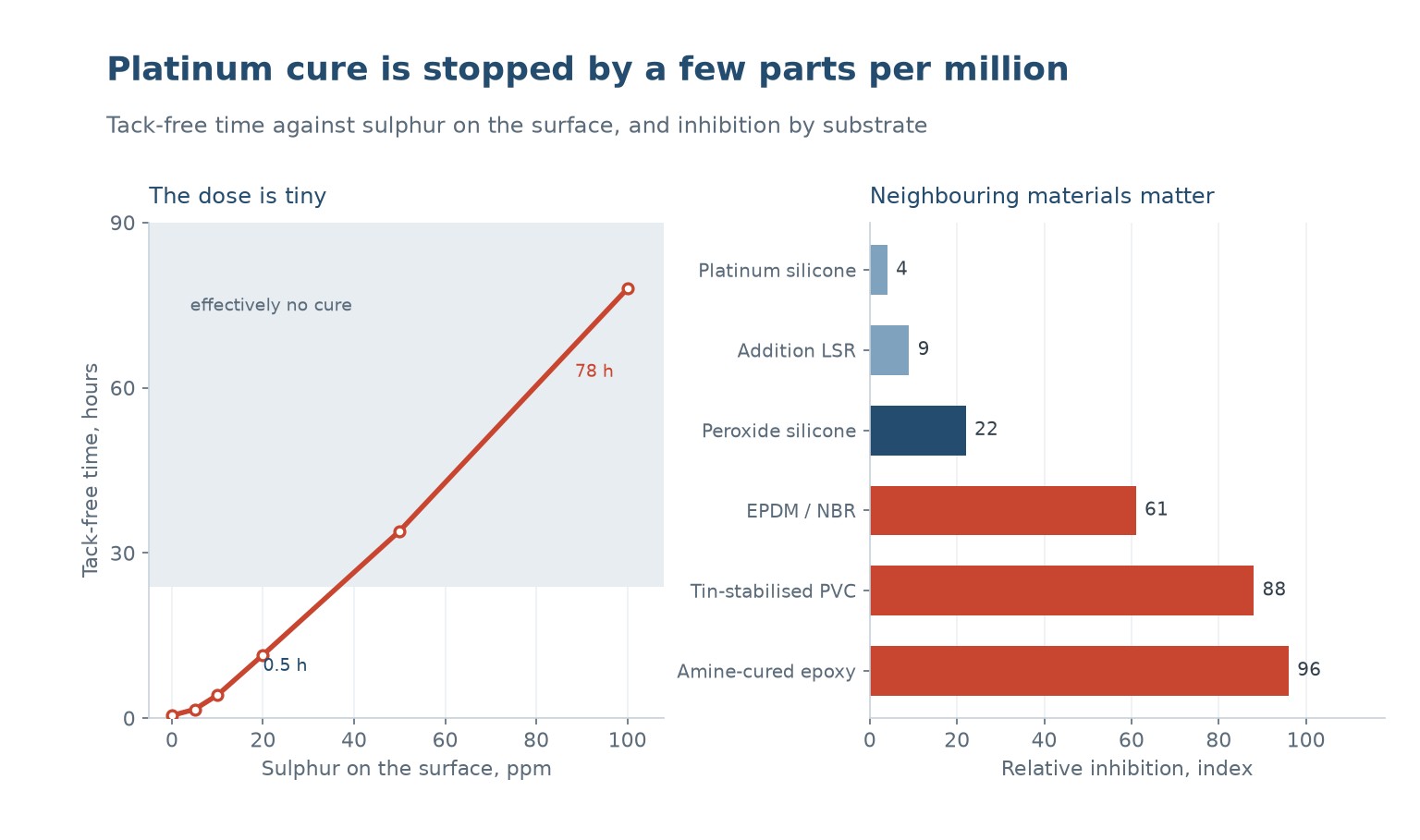
The dose needed is very small. Measured on a 50 Shore A addition-cure compound against sulphur on the mould surface, tack-free time went from 0.5 hours with no contamination to 1.6 hours at 5 ppm, 4.2 at 10, 11.5 at 20, 34 at 50 and 78 at 100. Above about 20 ppm the part is effectively unusable.
That is why a mould that has been used for a peroxide-cure compound can poison a platinum compound for weeks. Peroxide cure leaves acidic and sulphur-bearing residues in the steel, and no amount of wiping removes them from the surface porosity.
The usual suspects
Sulphur is the most common. It comes from vulcanised rubber moulds, from latex gloves, from sulphur-cured clay, and from some machining coolants. A latex glove touched to a mould face is enough to poison it for a run.
Tin is second. Organotin stabilisers are used in flexible PVC, and a PVC mould box or a PVC glove can transfer enough tin to stop a platinum cure. Tin-cured silicone (condensation cure) also leaves tin residues that poison a platinum mould.
Amines come from epoxy, from some polyurethane catalysts and from amine-based release agents. An amine-cured epoxy pattern that has not been fully post-cured will inhibit silicone poured against it, and the inhibition continues for weeks.
The fourth group is less obvious: some phthalate plasticisers, some sulphur-containing antioxidants in other rubbers, and some brands of modelling clay. The clay problem is common in prototype shops, where a sulphur-based clay is used to build up a shape and the silicone poured over it never cures.
| Contaminant | Quelle | Threshold that matters |
|---|---|---|
| Sulphur | Vulcanised rubber, latex gloves, clay | 5 ppm already doubles cure time |
| Organotin | Flexible PVC, tin-cure silicone | Trace amounts, often invisible |
| Amines | Epoxy, PU catalyst, release agent | Uncured epoxy is the worst case |
| Phosphorus | Some flame retardants, some oils | Rare but severe |
| Phthalates | Plasticised PVC, some gloves | Batch dependent |
Table 1 — The contaminants that stop a platinum cure
Which materials are safe to touch
The safe list is short and well known: stainless steel, aluminium, glass, PTFE, polyethylene, polypropylene, and fully cured platinum silicone. Anything on that list can be used for a mould, a container or a tool without a barrier.
The unsafe list is longer: natural rubber, EPDM, NBR, flexible PVC, epoxy that has not been fully cured, polyurethane, some polyesters, and most sulphur-containing clays. Each of these needs a barrier coat or a different material.
The barrier is usually a thin coat of cured platinum silicone itself, or a PTFE liner, or a lacquer that is known to be compatible. A common practice in prototyping is to seal a suspect pattern with two coats of the same silicone, let them cure hard, and then pour the mould against the sealed surface.
Peroxide-cure silicone is a special case. It cures in the presence of the poisons that stop platinum, which is why it is used for moulds and for parts that must be demoulded from difficult substrates. The cost is a longer cure, a smell, and post-cure to remove the by-products.
| Material | Platinum cure | Note |
|---|---|---|
| Stainless steel, aluminium | Safe | Standard mould materials |
| Glass, PTFE, PE, PP | Safe | Use for mixing and storage |
| Cured platinum silicone | Safe | The usual barrier coat |
| Peroxide-cure silicone | Inhibits | Residues stay in the surface |
| Flexible PVC | Inhibits | Tin stabiliser |
| Epoxy, polyurethane | Inhibits | Amine, unless fully post-cured |
| Natural rubber, EPDM, NBR | Inhibits | Sulphur |
Table 2 — Substrate compatibility with addition-cure silicone
Hands, air and the invisible transfer
A mould can be poisoned without anything touching it. Sulphur dioxide in the air from a nearby rubber process, or from a gas-fired heater with a sulphur-bearing fuel, will settle on a surface over a shift. Factories that run rubber and silicone in the same building have this problem and usually blame the compound for months.
Hands are the other route. A latex glove, a barrier cream, a hand wash with a sulphur-containing soap, or a cigarette break all transfer enough to matter. Nitrile gloves are the standard answer, and vinyl gloves are not, because some vinyl gloves carry tin or phthalate plasticisers.
The cleaning routine matters too. Solvent wiping spreads contamination as often as it removes it, because the solvent dissolves the poison and carries it across the surface. A two-stage clean, first with a solvent and then with a fresh lint-free cloth and a compatible release agent, works better than repeated wiping with the same rag.
The practical test is a patch. Pour a small amount of the compound onto the suspect surface, cure it at the normal temperature, and see whether it sets tack-free. It takes an hour and it saves a day of production.
Recovery, and when there is none
An inhibited part cannot be recovered by heating it longer. The platinum is bound, and no amount of temperature will free it. Heating a sticky part usually just oxidises the surface and makes it worse.
The surface can sometimes be salvaged mechanically: abrading the tacky layer and recoating with fresh compound. That works on a mould or a pattern, not on a finished part.
For a mould, the recovery is a full strip and recoat. Sand or bead blast the surface, clean with a solvent that leaves no residue, and apply two fresh coats of a compatible release or a barrier silicone. If the mould is porous and has absorbed the contaminant, the only reliable fix is to remake it.
For a batch of compound that has been contaminated in the pot, there is no recovery. Mixing in more catalyst does not help, because the poison binds the fresh catalyst as well. The batch has to be scrapped, and the cause found before the next one is mixed.
Preventing it, in order of effect
The first control is segregation. Keep platinum-cure silicone away from rubber processing, from flexible PVC, and from epoxy that is still curing. A separate room with its own air is the only reliable version of this, and it is cheaper than the scrap it prevents.
The second is consumables discipline. Nitrile gloves, dedicated mixing tools, dedicated containers, and a release agent that is known to be platinum-safe. A factory that uses whatever glove is in the box will have inhibition problems and will not be able to explain them.
The third is a patch test on any new material that will touch the silicone: a new mould, a new release agent, a new glove, a new cleaning solvent. One hour of testing per new item removes almost all of the surprise.
The fourth is a log. When a batch fails, the log of what changed that week is what finds the cause. Without it, the same failure recurs every few months and gets attributed to the compound.
Why is my platinum silicone still sticky after 24 hours?
Almost always cure inhibition from a contaminated surface. If the stickiness is only at the mould face, it is inhibition; if the whole part is soft, check the mix ratio.
What materials inhibit platinum-cure silicone?
Sulphur-cured rubber, flexible PVC with tin stabiliser, epoxy and polyurethane with amine catalysts, some clays, and some phthalate plasticisers.
How much sulphur stops a platinum cure?
About 5 ppm on the surface already doubles the tack-free time, and 20 ppm makes the part unusable. The dose is very small.
Can I add more catalyst to fix an inhibited batch?
No. The poison binds the platinum permanently, so fresh catalyst is bound as well. The batch has to be scrapped.
Why does a mould that worked for a year suddenly stop curing?
Something changed that touches it: a new release agent, a new glove, a new cleaning solvent, or a change in the air from a nearby process.
What gloves should I use with platinum silicone?
Nitrile. Latex carries sulphur and vinyl can carry tin or phthalate plasticisers.
Silicone that will not cure against a mould?
Send us the mould material, the release agent and a photo of the failure. We will tell you whether it is inhibition, mix ratio or the compound.




 DE
 EN
 ES
 FR
 PT
 AR
 RU
 JA
 KO
 IT
 NL
 TR
 PL
 ID
