
Release and adhesion are the same variable
Mould release works by lowering the surface energy of the elastomer so that it cannot wet the steel. Adhesive bonding works by wetting. There is one variable, surface energy, and the two applications want it at opposite ends. Every phr of release agent you add makes demoulding easier and bonding harder, and no formulation escapes that trade.
This is worth stating plainly because it is usually presented as two separate topics with two separate solutions. It is one topic. The question is not how much release to add, it is what happens to the part after it leaves the mould, and that question has to be answered before the compound is mixed.
A part that is demoulded and shipped is a release problem. A part that is demoulded, bonded to a metal insert, printed or painted is a release problem followed by an adhesion problem, and the second one is decided by the first.
Where the demoulding force actually goes
A demoulding force of 180 N on a simple silicone part is not one thing. It is four contributions, and only one of them is adhesion in the sense most people mean.
| Contribution | Share of force | What removes it |
|---|---|---|
| Chemical adhesion to the tool | 40 percent | Release agent, tool coating |
| Mechanical keying into surface roughness | 30 percent | Tool polish, and it cannot be released away |
| Undercuts and positive draft | 20 percent | Geometry change, not chemistry |
| Thermal contraction gripping the core | 10 percent | Core temperature, ejection timing |
Table 1 — The four contributions to demoulding force, and the lever for each
The mechanical share is the one that surprises people. A tool finished to Ra 1.6 micrometres gives the elastomer somewhere to key into, and no amount of release agent removes that: the agent sits on the peaks and the polymer still fills the valleys. Polishing to Ra 0.4 or below removes more demoulding force than doubling the release dose, and it costs nothing per part.
The thermal share is small but it is the one that changes without warning. A core that runs 10 C cooler than usual grips harder, and the operator responds by adding release, which fixes the symptom and starts the bond problem.
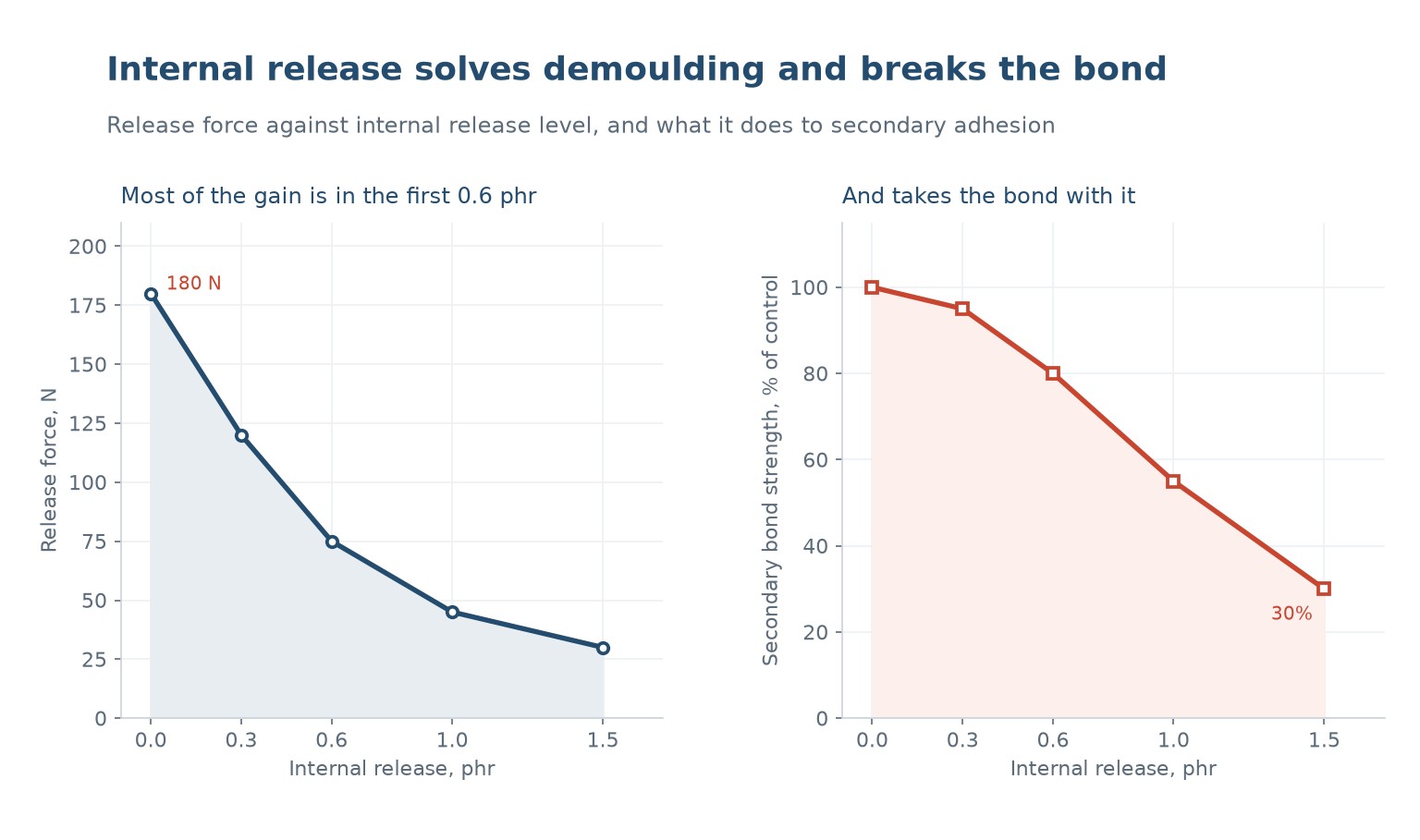
The first 0.6 phr does 58 percent of the work
Internal release is typically a fatty acid ester or a low-molecular siloxane that is incompatible enough to migrate to the surface but compatible enough to mix during compounding. Once at the surface it forms a monolayer that lowers surface energy and prevents wetting.
The migration saturates. At zero phr the release force is 180 N. At 0.3 phr it is 120, at 0.6 phr it is 75, at 1.0 phr it is 45 and at 1.5 phr it is 30. The first 0.6 phr removes 58 percent of the force. The next 0.9 phr removes another 25 percentage points of what was left, which is a quarter of the benefit for two and a half times the dose.
The mechanism behind the saturation is a surface that can only hold so much. Once the monolayer is complete, additional release agent has nowhere to go: it stays in the bulk, and it migrates to the surface slowly over the following weeks. That is why an over-dosed compound demoulds beautifully on day one and produces parts that cannot be bonded on day thirty.
The practical reading of the curve is that the useful range is 0.3 to 0.6 phr, and anything above 0.8 phr should be justified by a demoulding problem that geometry and polish could not solve.
What internal release does to the next process
Secondary bond strength tracks the release dose almost inversely. Against a control with no release, 0.3 phr gives 95 percent, 0.6 phr gives 80, 1.0 phr gives 55 and 1.5 phr gives 30. A part at 1.5 phr is not a part that bonds badly. It is a part that does not bond.
The failure mode is characteristic. The adhesive does not peel from the silicone, it never wets it. The bond line shows a clean separation with no residue on either side, which is the signature of a low-energy surface rather than a weak adhesive. Operators see this and change the adhesive, which never works.
There are two real fixes. The first is to post-cure hot enough and long enough to drive the release out, which works but also ages the rubber and costs a cycle. The second is a surface activation step, flame or plasma, which oxidises the surface and raises its energy regardless of what has bloomed onto it. Plasma is the more controllable of the two and the more expensive to install.
Internal against external, and when each wins
External release sits on the tool, not in the compound, so it does not migrate into the part. That is its whole advantage, and it is decisive for any part that will be bonded, printed or assembled with an adhesive.
Its costs are different. It has to be reapplied, it builds up on the tool, and the build-up transfers to the part as a surface defect after a few hundred shots. A semi-permanent external release, which cures onto the tool as a thin film, reduces the reapplication frequency and is the usual answer for a high-volume tool.
| Criterion | Internal release | External release |
|---|---|---|
| Effect on bonding | Proportional to dose, severe above 1 phr | Minimal if the tool film is cured |
| Reapplication | Never | Every shot to every few hundred shots |
| Tool build-up | None | Real, causes surface defects |
| Effect on cure | Slight retardation at high dose | None |
| Cost per part | Low, in the compound | Labour plus consumable |
| Am besten für | Parts demoulded and shipped | Parts that are bonded or printed |
Table 2 — Internal against external release, on the criteria that decide it
The combination that usually wins is a low internal dose, 0.2 to 0.3 phr, plus a semi-permanent external film on the tool. The internal dose covers the tool's rough spots and the deep cores; the external film carries the bulk of the release without entering the part. Bond strength stays above 90 percent and demoulding force stays low.
What to specify
A release specification has to name the downstream process, because that is what sets the ceiling.
- The internal release type and level, in phr, with a tolerance.
- The tool finish, because it removes more force than the release does.
- Whether the part is bonded, printed or coated, and the minimum bond strength required.
- The external release type and reapplication interval, if one is used.
- The post-cure schedule, if the part must bond and internal release is present.
Then test the bond on a production part, not on a plaque. A plaque has no mould release history, no bloom time and no core-side surface, and it will pass a test the real part fails.
How much internal release should a silicone compound contain?
0.3 to 0.6 phr for a part that is demoulded and shipped. Above 0.8 phr the bond strength falls fast and the demoulding gain is small.
Can I wash release agent off before bonding?
No. Internal release blooms from the bulk, so washing removes the surface layer and the reservoir replenishes it. Use plasma or flame treatment, or reduce the dose.
Why does a polished tool demould more easily?
Mechanical keying into surface roughness is about 30 percent of demoulding force. Polishing to Ra 0.4 or below removes more force than doubling the release dose.
Does release agent affect cure?
Slightly, at high dose. Fatty acid release agents can retard platinum cure, which shows up as a tacky surface on the tool side.
What is the difference between internal and external release?
Internal is mixed into the compound and migrates to the surface. External sits on the tool. External does not enter the part, so it is the right choice for parts that must bond.
Why does my bond fail after a month but pass at the bench?
Bloom. The release reservoir keeps feeding the surface, so a marginal bond degrades over weeks. Test on aged production parts, not fresh plaques.
A silicone part that has to demould and then bond?
Tell us the tool finish, the demoulding problem and what the part is bonded to. We will set the internal dose and the surface treatment so both steps work.




 DE
 EN
 ES
 FR
 PT
 AR
 RU
 JA
 KO
 IT
 NL
 TR
 PL
 ID
