

What heat reversion measures
Heat reversion is the change in length of a profile sample after it is reheated in an oven or oil bath, expressed as a percentage of the original length. It is measured to EN 479 in Europe and to the equivalent standard elsewhere.
The number is small, typically under two percent, and that is the point. The test is not measuring how much the profile moves in service; it is measuring how much stress was frozen into the material when it was made.
Every extruded profile carries that stress. The polymer is stretched by the haul-off, then cooled fast enough that the molecules cannot relax back before the material sets. Reheating lets them try again, and the profile shortens or bows.
So the test is a window into the process, not a property of the compound. Two profiles of the same formulation can pass and fail depending only on how they were pulled and cooled.
Where the stress comes from
Haul-off is the biggest single source. The pull that keeps the line running also stretches the profile while it is still soft, and the faster the line the more stretch is locked in.
Fast cooling locks it in harder. Quenching the surface in cold water sets the skin before the core has relaxed, so the skin and core end up wanting to move differently and the profile bows when it is warmed.
Die design contributes too. A short land or an unbalanced flow path makes the polymer arrive at the calibrator already oriented, and the calibrator can only hold the shape, not undo the orientation.
Formulation is the fourth lever. A lubricant package that lets the melt slip rather than shear reduces the orientation built at the die, which is why compounders can help a marginal profile.
What passes and what does not
For window profiles the usual limit is two percent, and many customers now ask for one and a half. Above that the profile is likely to bow, shorten or open at a welded corner in service.
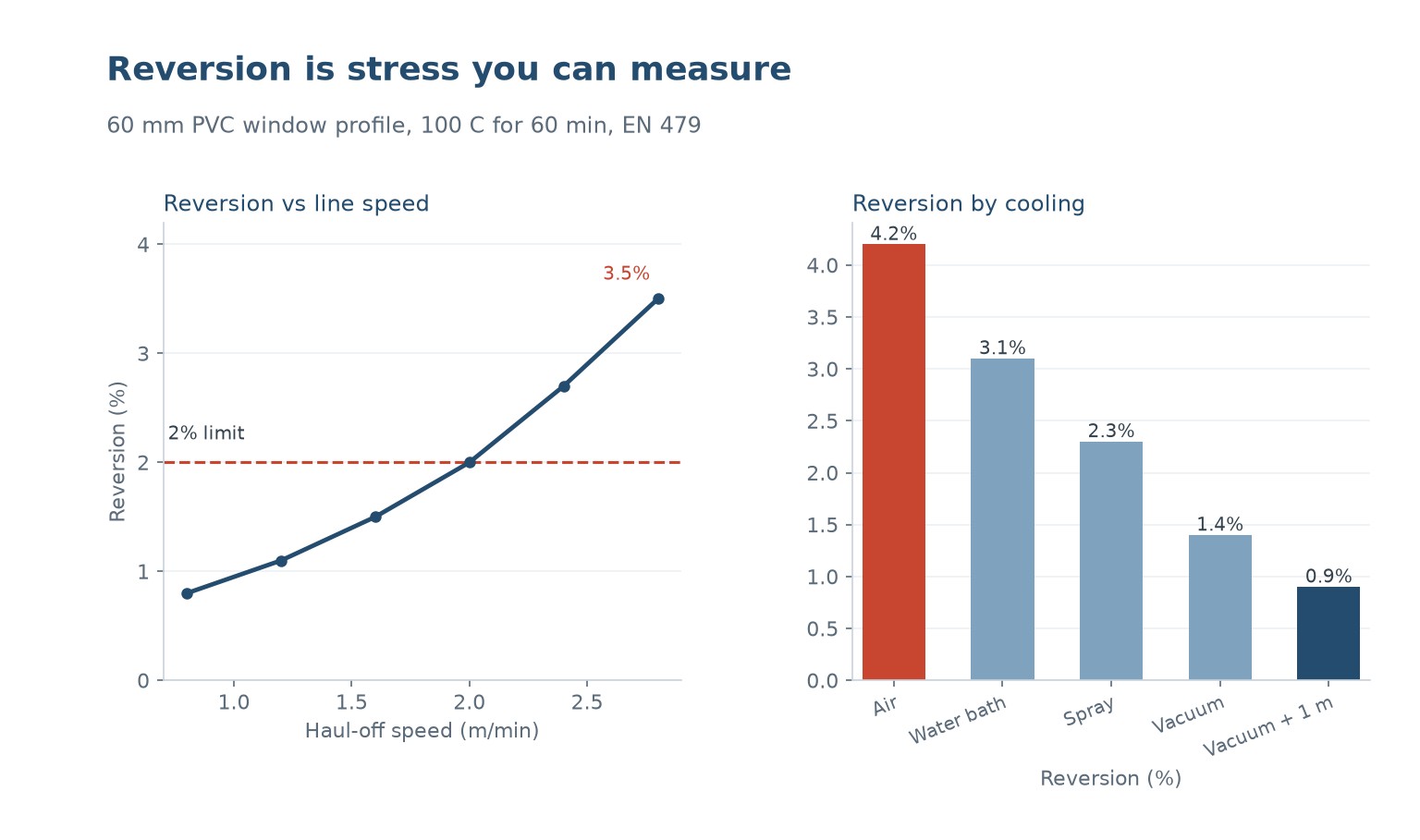
The left chart is reversion against haul-off speed on a 60 millimetre PVC window profile. At 0.8 metres per minute it sits at 0.8 percent; by 2.8 it is 3.5 percent and out of specification.
The curve is not linear. There is a gentle region where extra speed costs little, and then a knee where the profile starts carrying real orientation and reversion climbs fast. Most lines are run just past that knee.
That is why slowing down by ten percent often fixes a failing profile: the knee is close, and the line was only slightly over it.
Cooling method changes the number
The right hand panel compares cooling setups on the same profile and compound. Air cooling is the worst at 4.2 percent because the profile stays soft for so long that the haul-off keeps stretching it.
A water bath improves it to 3.1 percent, spray cooling to 2.3, and vacuum calibration to 1.4 because the profile is held against a cooled form while it sets.
Lengthening the calibrator by a metre drops it further to 0.9 percent, which is usually the cheapest fix available. Extra cooling length costs a sleeve, not a new line.
Notice that the best result comes from holding the shape while cooling, not from cooling harder. Cold water on a short sleeve shocks the skin and leaves the core free to shrink later.
Bringing a failing profile back
Start with line speed, because it is free. Reduce it in five percent steps and re-test; a profile at 2.4 percent often comes back under two with a ten percent reduction.
Then check cooling. If the calibrator is shorter than the cooling table, the profile is leaving soft, and adding sleeve length usually beats adding water flow.
Then look at the haul-off itself. Worn belts and uneven caterpillar pressure produce a pulsing pull that shows up as varying reversion along the length, which the test average hides.
Only then touch the die or the compound. Both are expensive changes, and both are usually unnecessary if the profile was only marginally out.
| Change | Typical reversion | Kosten |
|---|---|---|
| Air cooled, fast line | 4.2% | None, but slow |
| Wasserbad | 3.1% | Niedrig |
| Spray cooling | 2.3% | Niedrig |
| Vacuum calibration | 1.4% | Mittel |
| Calibrator + 1 m | 0.9% | Mittel |
Table 1 — Reversion from different cooling setups on the same profile.
Testing routinely, not reactively
Heat reversion is cheap enough to run every shift: cut three 200 millimetre samples, measure, hold them at 100 degrees for an hour, cool, measure again. The whole test fits in a lunch break.
Sample from the same place each time. Reversion varies along a coil, and a sample taken during start-up will not represent the run, so the routine needs a defined point.
Keep the results against line speed. After a few weeks the relationship is obvious, and the operator can see the safe speed rather than guessing at it.
And test after any change, including a compound change that looks unrelated. A new lubricant package or a different PVC supplier can move the number by half a percent without any process change at all.
| Standard | Methode | Limit |
|---|---|---|
| EN 479 | 100 C, 60 min, oil or air | 2.0% |
| GB/T 8814 | Reheat, measure length change | 2.0% |
| Customer spec | Same, tighter | 1.5% |
| Internal target | Safety margin | 1.2% |
Table 2 — Reversion standards and typical limits.
What is heat reversion in a PVC profile?
The length change of a sample after reheating to about 100 degrees, as a percentage. It shows how much orientation and stress were frozen into the profile during extrusion.
What is an acceptable heat reversion?
Two percent for most window profiles under EN 479, with many customers asking for 1.5. Above that the profile risks bowing or shortening in service.
What causes high heat reversion?
High haul-off speed stretching the soft profile, fast cooling that locks the orientation in, and a die that delivers an already oriented melt.
Does slowing the line reduce reversion?
Yes, and it is the first thing to try because it costs nothing. A ten percent speed reduction often brings a marginal profile back into specification.
Which cooling method gives the lowest reversion?
Vacuum calibration on a long sleeve. Holding the shape while it cools beats cooling harder on a short sleeve, which shocks the skin and leaves the core stressed.
How often should heat reversion be tested?
Every shift on a running profile line, always at the same point in the run, and after any change to compound, die or line speed.
Profiles bowing or growing in service?
Send the section, the line speed and your reversion results. We will tell you whether it is haul-off, cooling or the die.






 DE
 EN
 ES
 FR
 PT
 AR
 RU
 JA
 KO
 IT
 NL
 TR
 PL
 ID
