

- 1. Where the dividing line actually sits
- 2. Two processes that share a name
- 3. Machines: roll-fed versus sheet-fed
- 4. Tooling: aluminium pressure versus epoxy patience
- 5. Cycle time and what drives it
- 6. The cost structure, side by side
- 7. Tolerance and repeatability
- 8. Part size, thickness and the physics limit
- 9. When each is the right answer
- 10. The hybrid cases: medium gauge and cut-sheet thin
- 11. Secondary operations: where the labour actually goes
- 12. Material efficiency and the waste question
- 13. A decision table
- 14. Frequently asked questions
Where the dividing line actually sits
There is no official boundary between thin-gauge and heavy-gauge thermoforming. Different shops draw it in different places, and the trade literature is inconsistent. The most useful convention, and the one used here, is:
| Category | Sheet thickness | Feed | Typical cycle | Typical part |
|---|---|---|---|---|
| Thin gauge (packaging) | 0.15 – 1.5 mm | Roll | 2 – 10 s | Food trays, blister packs, cups, clamshells |
| Medium gauge | 1.5 – 3.0 mm | Roll or cut sheet | 10 – 60 s | Thin enclosures, trays, inserts, dunnage |
| Heavy gauge (thick gauge) | 2.5 – 12 mm+ | Cut sheet | 1 – 20 min | Machine covers, bathtubs, pallets, automotive panels, tool boxes |
The overlap between 2.5 and 3.0 mm is real — a 3 mm ABS sheet can run on either a roll-fed machine or a cut-sheet machine, and which one is cheaper depends on volume, not on the material.
The boundary matters because it changes almost everything else: the machine, the mold, the heating system, the cycle, the labour content, the tolerance and the cost structure. Choosing the wrong side of it is one of the more expensive mistakes a buyer can make, and it is not obvious from a drawing.
Both processes heat a thermoplastic sheet and pull it onto a mold with vacuum. Beyond that they diverge.
| أسبكت | Thin gauge | Heavy gauge |
|---|---|---|
| Sheet feed | Continuous roll, indexed | Individual cut blanks, hand or robot loaded |
| التدفئة | In-line oven, sheet moves through | Stationary oven, sheet clamped and held |
| Clamping | Chain rails with pins or grippers | Full-perimeter clamp frame, often hydraulic |
| التشكيل | Vacuum, pressure, or plug assist | Vacuum, pressure, plug assist, often all three |
| Mold material | Aluminium, always | Aluminium, epoxy, wood, plaster, printed |
| درجة حرارة العفن | 20 – 40 °C, actively cooled | 60 – 90 °C, often actively heated |
| التشذيب | In-line punch or steel rule die | Separate 5-axis CNC or robot trim |
| Cycle | Seconds | Minutes |
| Labour per part | Very low | High — loading, unloading, trimming, finishing |
| Tooling cost | Low per mold, but many molds | High per mold, few molds |
| Tolerance | ±0.2 – 0.5 mm typical | ±0.5 – 2.0 mm typical |
| Changeover | 1 – 4 hours | 20 minutes – 2 hours |
The labour difference is the one that surprises buyers most. A thin-gauge line produces thousands of parts an hour with two operators; a heavy-gauge cell produces tens of parts an hour with the same two operators, plus trimming.
Machines: roll-fed versus sheet-fed
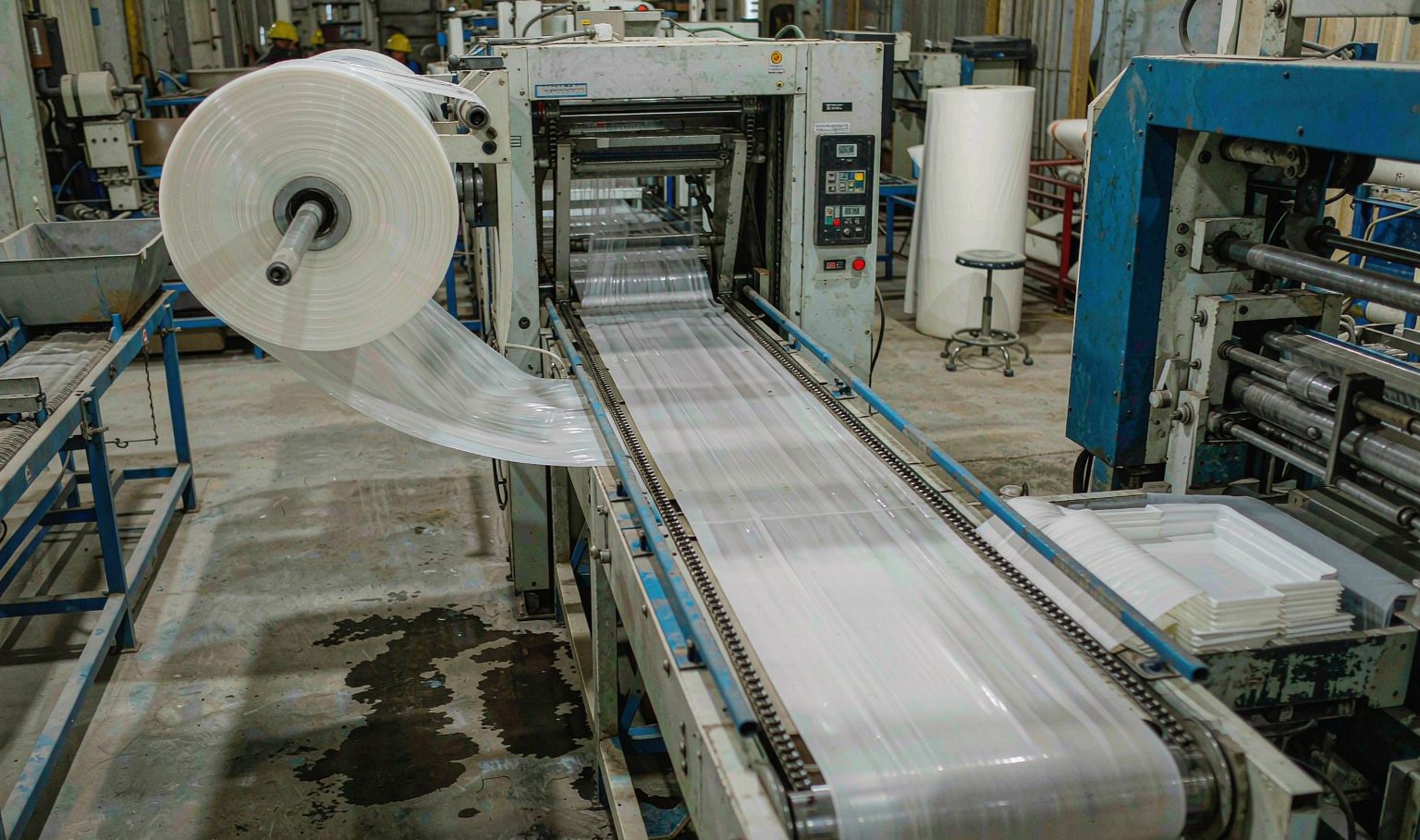
Roll-fed (in-line) machines
A roll of sheet is fed through an oven, formed, trimmed and stacked in one continuous line. These machines are built for one thing: high volume of a small part. A typical packaging line runs 20 – 60 cycles a minute, with multi-cavity molds of 4 to 40 cavities.
The economics depend entirely on volume. A line has a high capital cost and a long setup, so it only makes sense when a single product runs for weeks at a time. Changeover involves changing the mold, the trim tool, the stacker and the oven profile — a few hours at best.
Cut-sheet (sheet-fed) machines
A single blank is clamped, heated in a stationary oven, formed, cooled and removed. The machine may be a simple single-station press or a rotary multi-station machine where heating, forming and cooling happen at separate stations simultaneously.
Rotary machines are the productivity answer for heavy gauge: three or four stations mean the oven is heating one sheet while another is being formed and a third is cooling, which cuts the effective cycle substantially. They are also much more expensive and much less flexible about part size.
| Machine type | Capital cost | Output | المرونة | الأفضل لـ |
|---|---|---|---|---|
| In-line roll-fed | عالية | Very high | منخفضة | Packaging, 100k+ parts/year |
| Single-station cut sheet | Low – medium | منخفضة | عالية | Prototypes, short runs, large parts |
| Rotary multi-station | عالية | Medium – high | متوسط | Heavy gauge production, 5k – 100k/year |
| Vacuum-assist press (double-ended) | Medium – high | متوسط | متوسط | Deep draws, pressure forming, tight detail |
The single-station cut-sheet machine is the most flexible and the least productive. It is also the only practical option for parts over about 1.5 m, and for runs under a few hundred where the setup time dominates.
Tooling: aluminium pressure versus epoxy patience
Thin-gauge tooling is aluminium, water-cooled, multi-cavity and expensive per mold but cheap per part because of the cavitation. Heavy-gauge tooling is often a single cavity, frequently not aluminium, and the mold cost is a significant fraction of the project.
| Tooling aspect | Thin gauge | Heavy gauge |
|---|---|---|
| Cavities | 4 – 40+ | 1 – 4 |
| Mold material | Aluminium, cast or machined | Aluminium, epoxy, wood, plaster, printed |
| التبريد | Essential, designed in | Often heating rather than cooling |
| Typical mold cost | $2,000 – 15,000 per cavity set | $800 – 40,000 depending on size and material |
| Mold life | 500,000 – 5,000,000 cycles | 50 – 100,000 cycles (aluminium) |
| Trim tool | Steel rule or machined punch, in line | 5-axis CNC fixture or robot path |
| Lead time | 3 – 8 weeks | 1 – 6 weeks |
A thin-gauge packaging tool with 24 cavities can cost $60,000 – 150,000 — far more than a heavy-gauge mold — but it produces millions of parts. The mold cost per part is where the comparison has to be made.
Where heavy gauge wins on tooling: below about 2,000 parts, a heavy-gauge part can be tooled in epoxy or even wood for a few hundred dollars, and be in production in a week. The same part in thin gauge would need a fully machined, cooled, multi-cavity aluminium tool and a trim tool — and would never pay back.
Cycle time and what drives it
The cycle structure is completely different, and understanding it explains why the cost curves cross where they do.
| Cycle element | Thin gauge (1 mm) | Heavy gauge (6 mm) |
|---|---|---|
| Load / index | 0.5 s | 15 – 30 s |
| Heat | 3 – 6 s | 150 – 300 s |
| Transfer to mold | 0.3 s | 3 – 8 s |
| Form | 0.5 – 1.5 s | 5 – 20 s |
| Cool | 2 – 4 s | 30 – 120 s |
| Eject / unload | 0.3 s | 10 – 30 s |
| Total | 5 – 10 s | 4 – 8 min |
Heavy-gauge figures are for a single-station machine. A rotary machine overlaps heat, form and cool across stations and can reduce the effective cycle by 40 – 60 %.
Two observations that matter commercially:
- In thin gauge, cooling dominates. Heat is seconds, cooling is seconds, and the mold is the bottleneck. Improving cooling by 20 % improves the cycle by 10 – 15 %.
- In heavy gauge, heating dominates. On a 6 mm sheet, heating may be 60 – 70 % of the total cycle. Improving the oven — more power, closer heaters, short-wave emitters, two-sided — is where the cycle time is won. This is why heavy-gauge machines are specified with very high installed heater power.
The cost structure, side by side
A worked comparison. Same nominal part — a rectangular cover, 400 × 300 × 100 mm — in two versions: 1.2 mm HIPS on a thin-gauge line, and 3 mm HIPS on a heavy-gauge machine. Annual volume 20,000.
| Cost element | Thin gauge (1.2 mm) | Heavy gauge (3 mm) |
|---|---|---|
| Sheet consumed per part (incl. trim) | 0.19 kg | 0.44 kg |
| Material cost per part | $0.34 | $0.79 |
| Machine rate | $45 / h | $38 / h |
| زمن الدورة | 7 s (4 cavities) | 5.5 min (1 cavity) |
| Machine cost per part | $0.02 | $3.48 |
| Labour per part | $0.01 | $0.62 |
| Trimming per part | $0.01 (in line) | $0.85 (CNC) |
| Tooling amortised over 20,000 | $2.40 | $0.55 |
| Total per part | $2.78 | $6.29 |
Illustrative numbers, not a quote. The thin-gauge tooling is a 4-cavity aluminium tool at $48,000; the heavy-gauge tool is an epoxy mold at $6,000 plus a $5,000 trim fixture.
The important thing in that table is not the totals — it is where the money goes. In thin gauge, tooling amortisation dominates at low volume and machine time becomes irrelevant at high volume. In heavy gauge, machine time and labour dominate at any volume, and tooling is almost irrelevant.
Which means:
- At 20,000 parts a year, thin gauge is roughly half the price — but only if the part can be made at 1.2 mm, which for a 400 × 300 × 100 mm cover means a wall of about 0.75 mm at the corner. That may be structurally unacceptable, and then the comparison is meaningless.
- At 500 parts a year, heavy gauge wins easily, because the thin-gauge tooling amortisation becomes $96 per part.
- The crossover is around 5,000 – 15,000 parts a year for a part of this size, and it moves with part size, wall thickness requirement and trim complexity.
Tolerance and repeatability
Thin gauge is more repeatable than heavy gauge, for reasons that have nothing to do with skill.
| الميزة | Thin gauge | Heavy gauge |
|---|---|---|
| Overall length / width | ±0.3 mm | ±1.0 – 2.0 mm |
| Depth | ±0.3 mm | ±0.8 – 1.5 mm |
| Wall thickness | ±10 % | ±15 – 25 % |
| Flatness (on a 300 mm face) | 0.5 mm | 1.5 – 3.0 mm |
| Trim position | ±0.2 mm (hard tooling) | ±0.5 mm (CNC), ±1.5 mm (hand) |
| Part-to-part variation | Very low — process is closed | Higher — sheet gauge, mold temp and operator all vary |
Heavy-gauge tolerance is dominated by three things: sheet gauge variation, thermal expansion of a large mold, and trim positioning. None of them are fixable by trying harder.
The practical consequence: if a drawing calls for ±0.3 mm on a 600 mm heavy-gauge part, the drawing is asking for a process that does not exist. Either the tolerance moves, or the part moves to a different process, or the critical features are machined after forming.
Part size, thickness and the physics limit
Thin gauge is limited by sheet width, not by length. Packaging lines run sheet up to about 1,200 – 1,600 mm wide; wider material exists but the machinery becomes unusual. Length is unlimited because the sheet is continuous.
Heavy gauge is limited by the machine's platen and by sag. A sheet 3 m × 2 m at 8 mm weighs about 45 kg, and holding that flat in an oven at 180 °C without sagging into the mold is a real engineering problem. Machines exist up to about 3 m × 2 m; beyond that, sag control and oven uniformity become the constraints rather than the press.
The sag limit is a square law. Doubling the span quadruples the sag for the same thickness and temperature. This is why large heavy-gauge parts are often formed from thicker sheet than the wall thickness requires — the extra thickness is there to keep the sheet stiff in the oven, not to make the part stronger.
When each is the right answer
Choose thin gauge when
- Volume is high — typically above 10,000 parts a year, and clearly above 50,000.
- The part is small enough to fit several cavities in the sheet width.
- Wall thickness of 0.3 – 1.2 mm is acceptable structurally.
- The part is a packaging item, a tray, a liner, a blister or a disposable.
- Tight dimensional tolerance matters.
- Labour content has to be near zero.
Choose heavy gauge when
- Volume is low to medium — hundreds to tens of thousands.
- The part is large — over about 600 mm in any direction.
- The wall needs to be 2 mm or more for stiffness, insulation, or abuse resistance.
- The part is a machine cover, an enclosure, a housing, a tub, a pallet, a panel.
- Tooling cost has to be low, or the design is still moving.
- The part needs secondary operations anyway — inserts, bonding, assembly — so the labour is there regardless.
When neither is right
There is a class of part that neither serves well: a large part with a thin wall and high volume. A 900 mm panel at 1.5 mm, 200,000 a year. Thin gauge cannot make it because the sheet is too wide for standard lines and the draw is too deep; heavy gauge cannot make it economically because the cycle and labour are too high. The usual answers are:
- Reaction injection moulding (RIM) أو structural foam — different tooling, different economics.
- Twin-sheet thermoforming — two thin skins formed and fused, giving a stiff hollow part at low weight.
- Thermoformed shell plus a frame — split the part into a formed skin and an extruded or moulded frame.
- Compression moulded SMC for very large, stiff panels.
The hybrid cases: medium gauge and cut-sheet thin
Two cases that do not fit the clean division, and are worth knowing about because they are often the cheapest answer.
Medium gauge on a roll-fed machine
Sheet from 1.5 to 2.5 mm can run on some roll-fed lines, particularly for trays and inserts. The cycle is slower (15 – 40 s) and the tooling is heavier, but the labour content stays low and the trim is still in-line. This is often the right answer for a part that is slightly too thick for packaging and slightly too small for a cut-sheet machine.
Cut-sheet thin gauge
For a large part at low volume — 500 pieces of a 1,200 mm panel at 1.5 mm — a cut-sheet machine is often the only practical route, because no packaging line is wide enough and no heavy-gauge mold is justified. The cycle will be slow and the labour high, but the tooling is a few thousand dollars and the part exists in two weeks.
Secondary operations: where the labour actually goes
On a thin-gauge part there are almost no secondary operations. The part comes off the line trimmed, counted and stacked. On a heavy-gauge part, forming is often less than half the total labour content, and the rest is a sequence of manual or CNC steps that each have to be planned and costed.
| Operation | Thin gauge | Heavy gauge |
|---|---|---|
| التشذيب | In-line steel rule or punch | 5-axis CNC, robot, or hand routing |
| Hole drilling / punching | In the trim tool | Separate fixture or CNC operation |
| Edge finishing | None | Deburr, radius, sometimes polish |
| Insert fitting | Rare | Common — bonded, riveted or press-fit |
| Assembly / bonding | Rare | Common — solvent, adhesive, ultrasonic, mechanical |
| Painting / printing | In-line for packaging | Separate, often after assembly |
| التلدين | Never | Sometimes, for stress-critical parts |
| الفحص | Automated camera, in line | Manual or CMM, per batch |
The number of secondary operations on a heavy-gauge part is the main reason its price per part is dominated by labour rather than by material or machine time.
Two implications worth carrying into a cost discussion:
- Designing out one secondary operation is worth more than a 10 % material saving. A formed feature that replaces a drilled hole, or a moulded-in recess that replaces a bonded insert, removes a fixture, an operator step and an inspection point.
- Trim strategy should be decided at design stage. A part whose trim line runs across a curved surface needs a 5-axis path or a complex fixture; a part whose trim line follows a flat flange can be trimmed on a simple router table at a fraction of the cost. That is a drawing decision, not a production decision.
Material efficiency and the waste question
Both processes start from sheet and both produce trim scrap, but the scrap fractions are very different and they are frequently misjudged.
| Waste source | Thin gauge | Heavy gauge |
|---|---|---|
| Trim scrap (skeleton) | 15 – 35 % of sheet | 10 – 25 % of sheet |
| Start-up / setup scrap | Low — a few metres | Higher — several sheets per setup |
| Reject rate | 1 – 3 % | 3 – 10 % on a difficult part |
| Scrap recyclability | High — single material, clean | High if untrimmed and unassembled |
Thin-gauge trim skeleton is a higher percentage but is generated in one place, in one material, and is easy to bale and sell. Heavy-gauge scrap is a lower percentage but is generated across several operations, often after inserts or adhesive have been added, which makes it unrecyclable.
The practical point: a heavy-gauge part with a bonded insert and a painted finish has a much worse end-of-life profile than its 15 % trim scrap suggests, because the assembled part cannot be separated economically. If recycled content or end-of-life matters to the buyer, that is a design conversation — mono-material, mechanical fastening rather than adhesive, and a trim line that keeps the scrap clean.
A decision table
| If your part is… | Thin gauge | Heavy gauge |
|---|---|---|
| Under 300 mm, 0.5 – 1.2 mm wall, 50k+/year | Yes — clearly | لا يوجد |
| Under 300 mm, 2 – 3 mm wall, 5k/year | Marginal | نعم |
| 400 – 800 mm, 1.5 mm wall, 20k/year | Marginal — check sheet width | Yes, if the wall can be 2 mm |
| 400 – 800 mm, 3 mm wall, 2k/year | لا يوجد | نعم |
| Over 1,000 mm, any wall, any volume | لا يوجد | نعم |
| Over 1,000 mm, 1.5 mm wall, 100k/year | لا يوجد | No — twin-sheet or RIM |
| Prototype, 5 pieces | لا يوجد | Yes — wood or printed mold |
| Food tray, 2M/year | نعم | لا يوجد |
| Machine cover, 300/year | لا يوجد | Yes — epoxy mold |
| Automotive interior panel, 30k/year | لا يوجد | Yes — aluminium mold, CNC trim |
The two rows that catch people out are the large thin high-volume part (where neither process fits) and the small thick low-volume part (where heavy gauge is cheaper despite the slower cycle).
Frequently asked questions
What is the difference between thin gauge and thick gauge thermoforming?
Thin gauge uses roll-fed sheet of 0.15 – 1.5 mm with cycles of a few seconds and in-line trimming, typically for packaging. Heavy gauge uses cut sheet of 2.5 – 12 mm with cycles of minutes, separate CNC trimming and much more labour, typically for large durable parts.
Which is cheaper?
Per part, thin gauge is usually much cheaper above about 10,000 parts a year, because the cycle is seconds rather than minutes. Below a few thousand parts a year, heavy gauge is cheaper because the tooling is a fraction of the cost and the thin-gauge tooling cannot be amortised.
Can thick gauge parts be made on a thin gauge machine?
Only up to about 2.5 – 3 mm, and only on machines rated for it. Beyond that the roll cannot be fed, the oven cannot deliver enough energy in the available time, and the trim station cannot handle the thickness.
Why is heavy gauge tolerance worse?
Three reasons: sheet gauge varies more in thick material, a large mold expands measurably with temperature, and trimming is done on a separate CNC machine or by hand rather than with a fixed steel tool. Typical achievable tolerance is ±0.5 – 2.0 mm against ±0.2 – 0.5 mm for thin gauge.
How long does a heavy gauge cycle take?
Typically 2 – 8 minutes on a single-station machine, dominated by heating (60 – 70 % of the cycle for a 6 mm sheet) and cooling. A rotary multi-station machine overlaps the stages and can cut the effective cycle by 40 – 60 %.
What is medium gauge?
Roughly 1.5 – 3.0 mm. It can run on either a roll-fed line (slowly) or a cut-sheet machine (quickly). It is the zone where the choice depends on volume, part size and whether in-line trimming is worth the tooling.
Is pressure forming available in both?
Yes. In thin gauge it is standard for packaging that needs sharp detail. In heavy gauge it is used for deep draws, tight radii and texture reproduction, often combined with plug assist. Pressure forming adds tooling cost and machine complexity in both cases.
Why do heavy gauge parts need a heated mold?
A cold mold chills the sheet surface on contact, producing chill marks, high residual stress and warpage. Running the mold at 60 – 90 °C keeps the sheet surface soft long enough to conform and lets the part cool more evenly. The penalty is a 30 – 90 minute warm-up before the first good part.
Can thin gauge parts be made from recycled sheet?
Yes, widely — many packaging items are made from rPET and rPP. The constraints are food-contact approval and colour consistency rather than the process. Heavy gauge also uses regrind, usually as a coextruded core layer rather than in the whole thickness.
Which process should I choose for 500 large covers a year?
Heavy gauge, without question. An epoxy or aluminium mold and a cut-sheet machine will produce 500 parts in a few weeks at a tooling cost of a few thousand dollars. A thin-gauge line would need full aluminium tooling and in-line trim, and the tooling alone would cost more than the whole project.
Not sure which side of the line your part falls on? Send the drawing
We will tell you which process fits, what the tooling costs, and what the part price is at your volume — including the case where the answer is a process we do not run.




 AR
 EN
 ES
 FR
 DE
 PT
 RU
 JA
 KO
 IT
 NL
 TR
 PL
 ID
