
Two different things happen after demould
A thermoformed part leaves the tool at the wrong size. Not because the tool is wrong, but because two independent effects act on the part between the forming station and the trimming fixture.
الانكماش is thermal contraction as the part cools from forming temperature to room temperature. It is uniform in direction, proportional to the temperature drop, and predictable from the material's coefficient of thermal expansion.
Spring-back is elastic recovery. While the part is on the tool it is held against the surface by vacuum. When the vacuum is released, the material — which was stretched during forming — relaxes towards its unstretched shape. The result is that radii open up, walls straighten slightly, and the part moves away from the tool surface.
The practical consequence: you cannot compensate for both with one number. Shrinkage is a scale factor; spring-back is a shape change. A tool scaled up by 1.5% to compensate for shrinkage will still produce parts whose radii are wrong.
Shrinkage: the predictable part
| المواد | Typical shrinkage | Direction | الملاحظات |
|---|---|---|---|
| ملاحظة | 0.4 – 0.6% | Fairly uniform | Low and predictable |
| HIPS | 0.4 – 0.7% | Fairly uniform | Similar to PS |
| ABS | 0.4 – 0.7% | Fairly uniform | Good dimensional stability |
| PVC (rigid) | 0.3 – 0.6% | Fairly uniform | Low shrinkage; good for large parts |
| PETG | 0.2 – 0.5% | Fairly uniform | Low; good dimensional control |
| ب م أ م أ | 0.3 – 0.6% | Fairly uniform | منخفضة |
| كمبيوتر شخصي | 0.5 – 0.7% | Fairly uniform | Needs hot mould to minimise stress |
| ص | 1.2 – 2.0% | Higher in flow direction | Crystalline; significant and directional |
| البولي إيثيلين عالي الكثافة | 1.5 – 2.5% | Higher in flow direction | Crystalline; the hardest to control |
Table 1 — Thermal shrinkage by material. The amorphous resins are half the value of the crystalline ones, which is why PS and ABS dominate dimensionally critical parts.
Crystalline materials shrink more and shrink directionally, because the crystals form in the direction of stretch. A PP part will be smaller in the machine direction than across it, and the difference can be 0.5% or more. That is why PP is rarely used for parts where two dimensions have to be equally accurate.
The compensation is straightforward: scale the tool by the shrinkage factor. A 1.5% shrinkage means the tool is made 1.5% larger than the nominal part. The complication is that shrinkage depends on the actual cooling history, so the number from a data sheet is a starting point, not a specification.
Spring-back: the shape change
Spring-back happens because the sheet is stretched during forming and the stretch is elastic to some degree. When the vacuum releases, the elastic component recovers.
| الميزة | Spring-back effect | Magnitude |
|---|---|---|
| Inside radius | Opens up (radius increases) | 0.5 – 3 mm on a 5 mm radius |
| Wall angle | Opens away from the tool | 0.5 – 2° |
| Flat bottom | Bowes towards the tool side | 0.5 – 2 mm over 300 mm |
| Deep draw walls | Straighten slightly | Visible on long walls |
| Ribs and details | Shallower than the tool | Proportional to depth |
| Overall height | Slightly taller or shorter | Depends on geometry |
Table 2 — What spring-back does to features. Radii and wall angles are the most affected and the most visible on an assembled part.
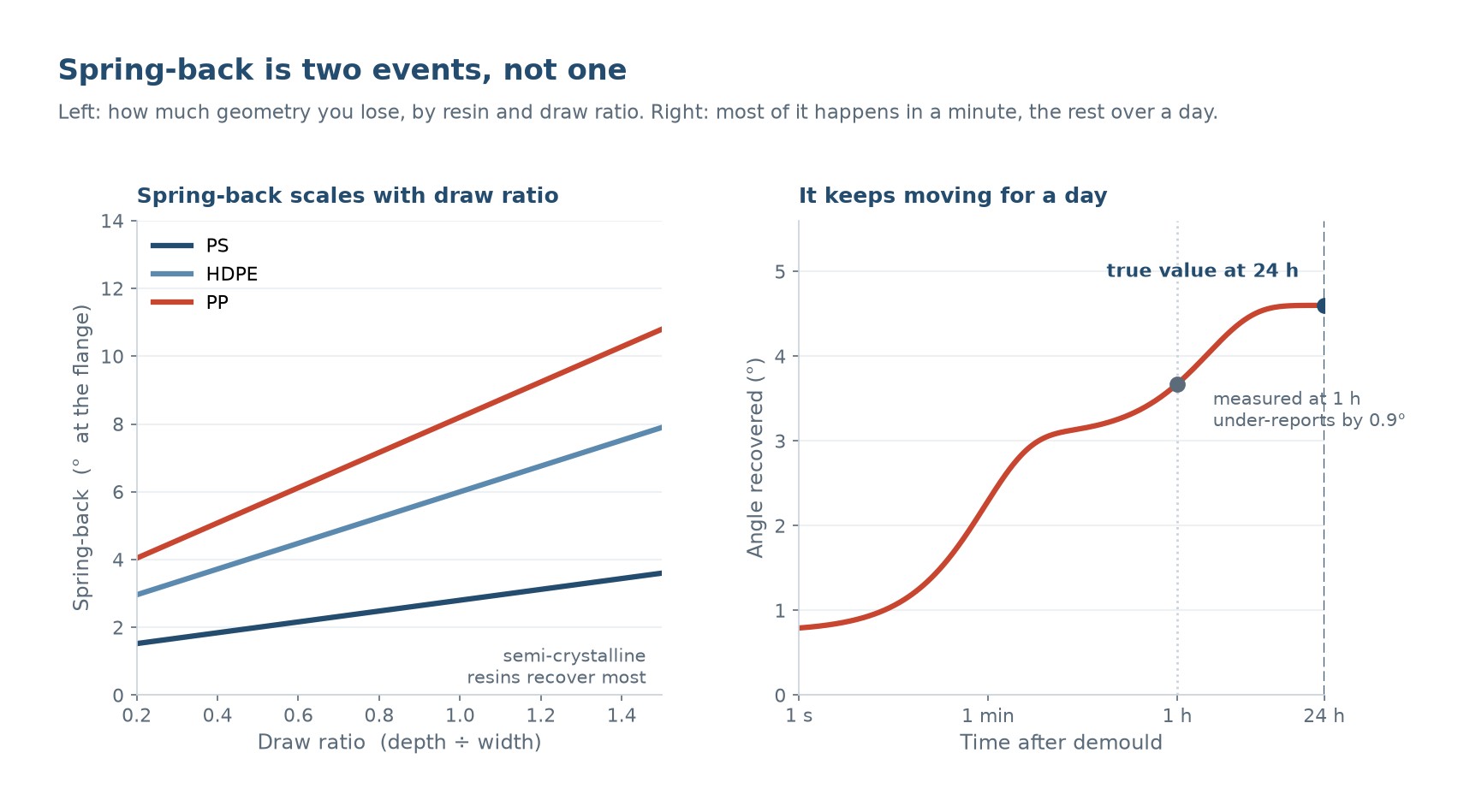
The magnitude depends on how much the material was stretched. A shallow part formed with little stretch springs back very little; a deep draw with high stretch springs back significantly. That is why the same material and the same thickness can produce parts with different spring-back on different tools.
There is also a time element. Some spring-back is immediate (elastic recovery on vacuum release), and some develops over hours as residual stress relaxes. A part measured five minutes after demould and the same part measured a day later will not be identical.
Compensating in the tool
| النهج | What you change | Works for | Limitation |
|---|---|---|---|
| Scale the tool | Multiply all dimensions by (1 + shrinkage) | الانكماش | Does nothing for spring-back |
| Adjust radii | Make the tool radius smaller than nominal | Radius opening | Needs trial data |
| Add draft | Increase wall angle on the tool | Wall opening | Changes the part design |
| Crown the base | Make the tool base convex | Base bowing | Only for flat-bottomed parts |
| Over-form | Form deeper, then trim to length | Height changes | Adds material and trim cost |
| Trial and correct | Measure the first parts, adjust the tool | Everything | Costs a tool revision |
Table 3 — Tool compensation methods. In practice every tool needs a trial-and-correct cycle; the question is how well you can predict the first attempt.
The economics of tool correction are worth understanding. A first tool that is 95% right needs a small revision, which costs a fraction of the tool. A first tool that ignores spring-back entirely can need a re-make. Spending an extra day on the design to predict spring-back is usually cheaper than the revision.
Process levers that change spring-back
| Lever | Effect on spring-back | Effect on other things |
|---|---|---|
| Higher sheet temperature | Less spring-back (more relaxation) | Faster cycle needed; risk of sag |
| Higher mould temperature | Less spring-back | Longer cooling |
| Slower forming | Less spring-back | Longer cycle |
| Plug assist | More uniform stretch, less variation | Extra tooling |
| Higher vacuum / pressure | Better contact, slightly less spring-back | Marks, more vent wear |
| Longer hold on vacuum | Part sets closer to tool shape | زمن الدورة |
Table 4 — Process levers. Temperature is the strongest: a hotter sheet and a hotter tool both reduce spring-back, at the cost of cycle time.
Hotter is not always better. A sheet that is too hot sags before forming and thins excessively at the bottom of the draw, which creates its own dimensional problems. The window is the same one that governs forming quality generally, and spring-back is a secondary consideration within it.
Measuring and predicting
| Measurement | When | What it tells you |
|---|---|---|
| Part dimensions at demould | Immediately | Forming accuracy, before relaxation |
| Part dimensions at 1 h | 1 hour after | Most of the immediate relaxation |
| Part dimensions at 24 h | Next day | The settled dimension — this is what the customer measures |
| Part dimensions at 72 h | Three days | Confirms the part has stopped moving |
| Comparison to tool CAD | At 24 h | The correction factor for the next tool |
Table 5 — Measurement schedule. The 24-hour dimension is the one that matters; anything measured sooner is optimistic.
Building a correction record is the most valuable thing a thermoformer can do. For each material, thickness and draw depth, record the measured dimension at 24 hours against the tool dimension. After a dozen parts you have a correction table that lets the next tool be right first time.
Design rules that reduce the problem
| Rule | لماذا |
|---|---|
| Generous radii (1× thickness minimum) | Tight radii spring back proportionally more |
| Draft of 3–5° minimum | Compensates for wall opening and aids release |
| Avoid long flat bottoms | They bow; add ribs or crown the tool |
| Keep draw ratio under 1:1 depth to width | Deeper draws stretch more and spring back more |
| Put critical dimensions on formed features, not trimmed edges | Trimmed edges add their own variation |
| Specify tolerance by feature, not by part | Some features hold much better than others |
Table 6 — Design rules. The tolerance allocation rule is the most commercially useful: putting a tight tolerance on a feature that cannot hold it causes most of the arguments.
The draw ratio rule is worth stating as a number. Above about 1:1 (depth equal to width), wall thinning and spring-back both increase sharply, and the part becomes hard to control. If a design needs a deeper draw, pressure forming or a different process is worth considering.
Why is my thermoformed part the wrong size?
Two reasons: shrinkage and spring-back. Shrinkage makes the whole part smaller and is compensated by scaling the tool. Spring-back changes the shape — radii open, walls straighten — and is not fixed by scaling. Measure at 24 hours and correct the tool for both.
How much does thermoformed plastic shrink?
0.3–0.7% for amorphous resins (PS, ABS, PVC, PC, PETG) and 1.2–2.5% for crystalline ones (PP, HDPE). Crystalline materials also shrink directionally, which makes them harder to hold on two dimensions at once.
What is a typical spring-back?
Radii open by 0.5–3 mm on a 5 mm radius, wall angles open by 0.5–2°, and flat bottoms bow by 0.5–2 mm over 300 mm. The amount depends on how much the material was stretched, so deeper draws spring back more.
Can I eliminate spring-back?
No, but you can reduce it and compensate for it. Hotter sheet, hotter mould and slower forming all reduce it. The rest is tool compensation: make the radii smaller than nominal and add draft so that the opened-up part lands on the drawing.
Why do dimensions change over the first day?
Residual stress relaxation. The part leaves the tool with stress locked in, and over hours it creeps towards a lower-energy shape. Measuring at 24 hours captures the settled dimension; measuring at five minutes gives a number the customer will never see.
Should I measure the part on the tool or off it?
Off the tool, at 24 hours, at room temperature. Measuring on the tool tells you about the tool, not the part. Any dimension that only works while the part is clamped is not a dimension.
Does trimming change the dimensions?
Yes — trimming releases the constraint of the flange, and the part can move. That is why trimming should happen before final measurement, and why the trim fixture should be designed around the settled shape, not the CAD shape.
Can I use the same tool correction for a different material?
No. Shrinkage differs by a factor of three between amorphous and crystalline resins, and spring-back differs with stiffness. Each material and thickness combination needs its own correction, which is why the correction record is per combination.
Parts not matching the drawing after forming?
Send us the part drawing, material, gauge and the dimensions you are actually getting at 24 hours. We will separate shrinkage from spring-back and tell you what to change on the tool.




 AR
 EN
 ES
 FR
 DE
 PT
 RU
 JA
 KO
 IT
 NL
 TR
 PL
 ID
