
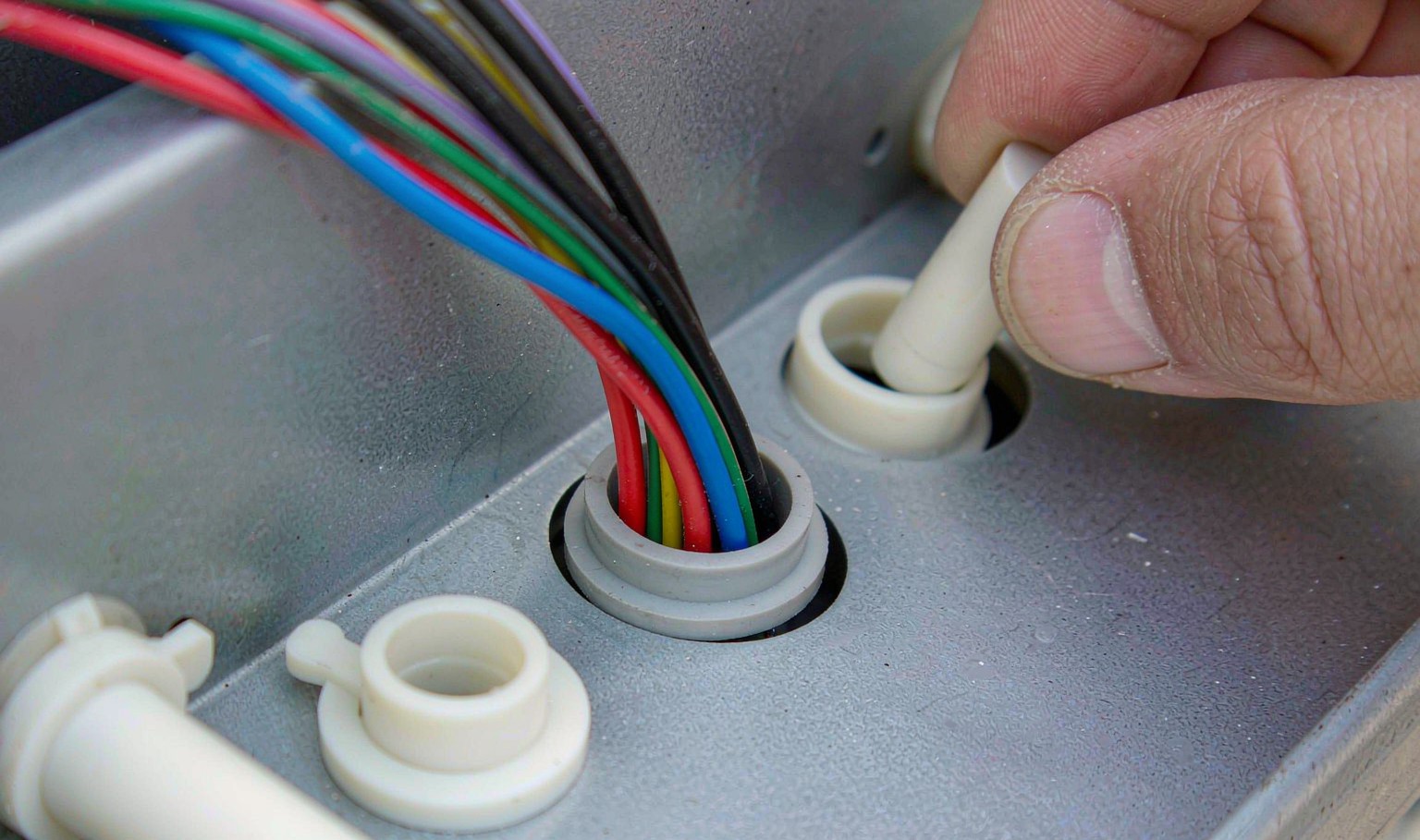
A grommet is a squeeze fit, not a plug
A silicone grommet seals by being compressed between the wire and the hole. The compression is what generates the contact pressure, and the contact pressure is what keeps water out. Everything else — the material, the hardness, the geometry — exists to keep that compression in the right range.
The ratio that matters is the bore diameter to the cord diameter. A ratio of 1.05 means the bore is five percent larger than the wire, so the wire slides in easily and the seal relies almost entirely on the grommet's own compression against the hole. A ratio of 1.30 means the bore is thirty percent larger, and the wire rattles.
Pull-out force shows the effect clearly. At a ratio of 1.05 the force is 42 N, at 1.10 it is 31, at 1.15 it is 22, at 1.20 it is 15 and at 1.30 it is 8. The working band for most harness applications is between 1.08 and 1.18, where the force is high enough to hold the wire and low enough not to cut the insulation.

Too tight is as bad as too loose
A grommet that is too tight grips the wire well and damages it. The insulation is compressed permanently, and in a vibrating harness the wire fatigues at the point where the insulation was crushed. The failure appears months later as an intermittent, and it is traced to the grommet with difficulty.
A grommet that is too loose does not seal, and it does not hold the wire either, so the harness moves in the hole and wears the seal. Both failures are the same distance from correct, in opposite directions, which is why the window is narrow and why the bore is specified with a tolerance.
The wire itself has a tolerance, and it is not small. A nominal 4 mm cable can be 3.8 to 4.2 mm depending on the insulation and the manufacturer. A grommet designed for exactly 4.0 mm will be too loose on a 3.8 and too tight on a 4.2, and the design has to be centred on the range rather than on the nominal.
Sealing force saturates, permanent set does not
Squeeze generates sealing force, and the force rises steeply and then flattens. At 10 percent squeeze the sealing force index is 55, at 15 percent 78, at 20 percent 92, at 25 percent 100 and at 30 percent 102. Past about 20 percent there is almost nothing to gain in sealing.
Permanent set rises the other way. At 10 percent squeeze the set is 6 percent, at 15 it is 9, at 20 it is 14, at 25 it is 22 and at 30 it is 34. Past 20 percent squeeze the grommet starts to take a set, and a grommet that has taken a set has lost the compression that was producing the seal.
So the two curves cross in usefulness around 15 to 20 percent squeeze. That is where the sealing force is close to maximum and the set is still low. Designing at 30 percent squeeze to be safe is designing for a grommet that will seal well on day one and leak after a year.
| Squeeze | Sealing force | Permanent set | Verdict |
|---|---|---|---|
| 10% | 55 | 6% | Marginal seal |
| 15% | 78 | 9% | Good compromise |
| 20% | 92 | 14% | Best sealing |
| 25% | 100 | 22% | Set is building |
| 30% | 102 | 34% | Will leak with age |
Table 1 — Squeeze against sealing force and permanent set
What an IP rating actually requires
IP67 means dust-tight and protected against immersion for 30 minutes at 1 m. IP68 is immersion at a greater depth or for a longer time, agreed between the customer and the supplier. IP69K is high-pressure, high-temperature spray, which is a different test and a much harder one for a grommet.
The rating is on the assembly, not on the grommet. A grommet that passes IP67 in a flat plate at room temperature can fail in a real enclosure with a rough hole, a weld seam or a cable that pulls sideways. The test has to be on the assembly in its mounting condition.
IP69K is the one that catches people out. A high-pressure jet at 80 C and 100 bar will find any gap, and a grommet that relies on a light squeeze will be lifted off the wire. For washdown applications the squeeze has to be higher and the grommet often needs a retaining feature.
| Rating | Test | Grommet implication |
|---|---|---|
| IP54 | Splash | Light squeeze is enough |
| IP67 | 1 m, 30 min | 15-20% squeeze, clean hole |
| IP68 | Deeper or longer | Higher squeeze, tested as agreed |
| IP69K | 80 C, 100 bar jet | Retention feature, high squeeze |
Table 2 — IP ratings and what they ask of the grommet
Why silicone, and what hardness
Silicone is used for harness seals because it stays flexible from minus 50 to 200 C, it does not harden with age the way nitrile does, and it resists ozone and UV. A harness in an engine bay or an outdoor enclosure sees all three.
Hardness matters more than people expect. A 40 Shore A grommet at 15 percent squeeze gives a lower sealing force than a 60 Shore A grommet at the same squeeze, but it conforms better to a rough hole. For a machined hole, 50 to 60 Shore A is usual; for a punched or cast hole, 40 to 50 conforms better.
The compound also decides the compression set. A well post-cured platinum silicone will hold its set better than a cheap peroxide one, and in a seal that is the property that matters most. A grommet that takes a set has stopped sealing, whatever its hardness.
What to put on the drawing
The drawing needs the wire range, not a nominal wire size, because the tolerance is what the design has to survive. It needs the hole diameter and its tolerance and finish, because a rough hole gives a leak path under the grommet. It needs the squeeze at the nominal wire and the allowable range.
It needs the IP rating and the test condition, and it needs the operating temperature range including any peaks. And it needs the retention requirement: whether the grommet has to hold the wire against a pull, or only seal.
What is the right bore-to-cord ratio?
Between 1.08 and 1.18 for most harness work, which gives a pull-out force between about 22 and 38 N without crushing the insulation. Below 1.05 the wire is difficult to insert; above 1.25 it does not seal.
Can a grommet be reused after the wire is pulled out?
Not reliably. Pulling the wire out leaves the bore stretched and the grommet set, and re-inserting a wire gives a lower contact pressure. A grommet is a single-assembly part.
Does silicone grommet hardness matter for IP67?
It affects conformability more than sealing force. A softer grommet conforms to a rough hole better; a harder one holds a higher force at the same squeeze. The hole finish decides which matters more.
What temperature can a silicone grommet take?
Continuous from about minus 50 to 200 C, with peaks higher. That range is why silicone is used in engine bays and outdoor enclosures where nitrile would harden.
Why does my IP67 assembly leak after a year?
Usually permanent set. A grommet designed at 30 percent squeeze loses a third of its compression to set and stops sealing. The design should sit at 15 to 20 percent.
Can one grommet cover a range of wire sizes?
Yes, within a limited range, and the range should be tested at both ends. A grommet that seals a 4 mm wire may not seal a 3.8 mm one, and the drawing should give the range rather than a nominal.
A harness seal that has to pass IP67 or IP69K?
Send the wire range, the hole and the test condition. We will tell you the squeeze, the hardness and the geometry that will pass, and where the assembly is likely to leak.




 AR
 EN
 ES
 FR
 DE
 PT
 RU
 JA
 KO
 IT
 NL
 TR
 PL
 ID
